The power of partnerships: European climate leadership with less America


Summary
- Global governance arrangements are under pressure from the climate action withdrawal of the Trump administration and, in many countries, from leaders’ fears of a growing domestic “greenlash”.
- The EU has adjusted its topline messaging in response, but most governments remain committed to driving the global green transition.
- Many countries around the world share the same goals as the EU and want to decarbonise their economies while creating jobs and moving up the value chain. However, in an interconnected world, like the EU, they all need partnerships to underpin their own decarbonisation.
- The EU and member states should heed partner countries’ requests for: greater trade openness to generate demand for low-carbon products made in the global south; share technology more generously; and establish stronger access to finance in pursuit of equitably shared green growth.
- These partnerships can contribute to alliances for global governance reform in order to futureproof the multilateral framework for climate action in an increasingly transactional world.
No single story
The author Chimamanda Ngozi Adichie gave a powerful TED talk in 2009 entitled “The danger of a single story”. She argued that the limited representation of a person, place or issue obscures its true and full meaning.
This danger of a single story is playing out at the European level, where national leaders are lowering their ambitions on the green transition. A recent push by French president Emmanuel Macron and Polish prime minister Donald Tusk—to delay the agreeing of climate targets for the EU—suggests they have bought into the single story that international climate cooperation has become too toxic.
Yet, it is not a lowering of ambition that is required. Instead, European policymakers need to understand the complexities of international climate politics and build their bilateral and multilateral strategies accordingly.
It is true that circumstances have changed. President Donald Trump has decided—again—to pull the United States out of the Paris agreement as part of a broader rollback of climate action. America’s path is now clear, with oil and gas production to be ramped up, the green elements of the Inflation Reduction Act dismantled and climate-focused parts of the US administration drastically cut or closed. Funding is curtailed. This means there is now virtually no space for climate cooperation between the EU and the US. Nevertheless, Europeans have alternatives to working with America.
In an overlooked story, global players within the BRICS group and beyond are pressing ahead with decarbonising their economies—in the interests of their own growth and competitiveness. Countries keen to partner with the EU on this may share with Trump a proclivity towards transactionalism, but they are more than willing to demand what they want in pursuit of their green transition. They acknowledge the threat of climate change and the need for the multilateral system to help states combine climate action with domestic economic progress.
This policy brief draws on a series of online roundtables organised by ECFR in December 2024, and February and May 2025, attended by stakeholders from EU member states, EU institutions and partner countries in Africa, Asia and Latin America. The roundtables focused on how to manage different aspects of climate interdependence and improve global governance. Speakers shared their perspectives on these questions and suggested ways the EU could sharpen its interaction with their countries or institutions. (The full set of speakers is listed in the acknowledgments.)
The paper uses findings from these conversations, along with broader research, to argue the EU is in a strong position to forge international partnerships that drive stronger climate action. Such partnerships can operate within, and in turn strengthen, the global governance framework that seeks to manage the catastrophic risks of a world warming beyond the aim of “well below” 2°C above pre-industrial levels as settled on by the Paris agreement. The EU remains an enormous draw as a potential partner for many countries, businesses and populations around the world. Europeans should therefore redouble their focus on building partnerships that power the green transition in Europe and elsewhere. They must grasp the dynamics driving international relations around decarbonisation, understand where the EU is failing to harness them, and adapt their policies and financing accordingly. Even while international institutions and structures come under pressure, the EU can keep up the global momentum for climate action.
Success on this front matters most of all for averting climate disaster. But it also matters because achieving visible results in a transactional world will help EU leaders challenge the “greenlash” from newly emboldened domestic forces. European decision-makers can demonstrate that the choice between greening and competing is a false one in a world that, despite the frictions, is moving inexorably towards building a new, low-carbon economy.
The US goes one way—we go another
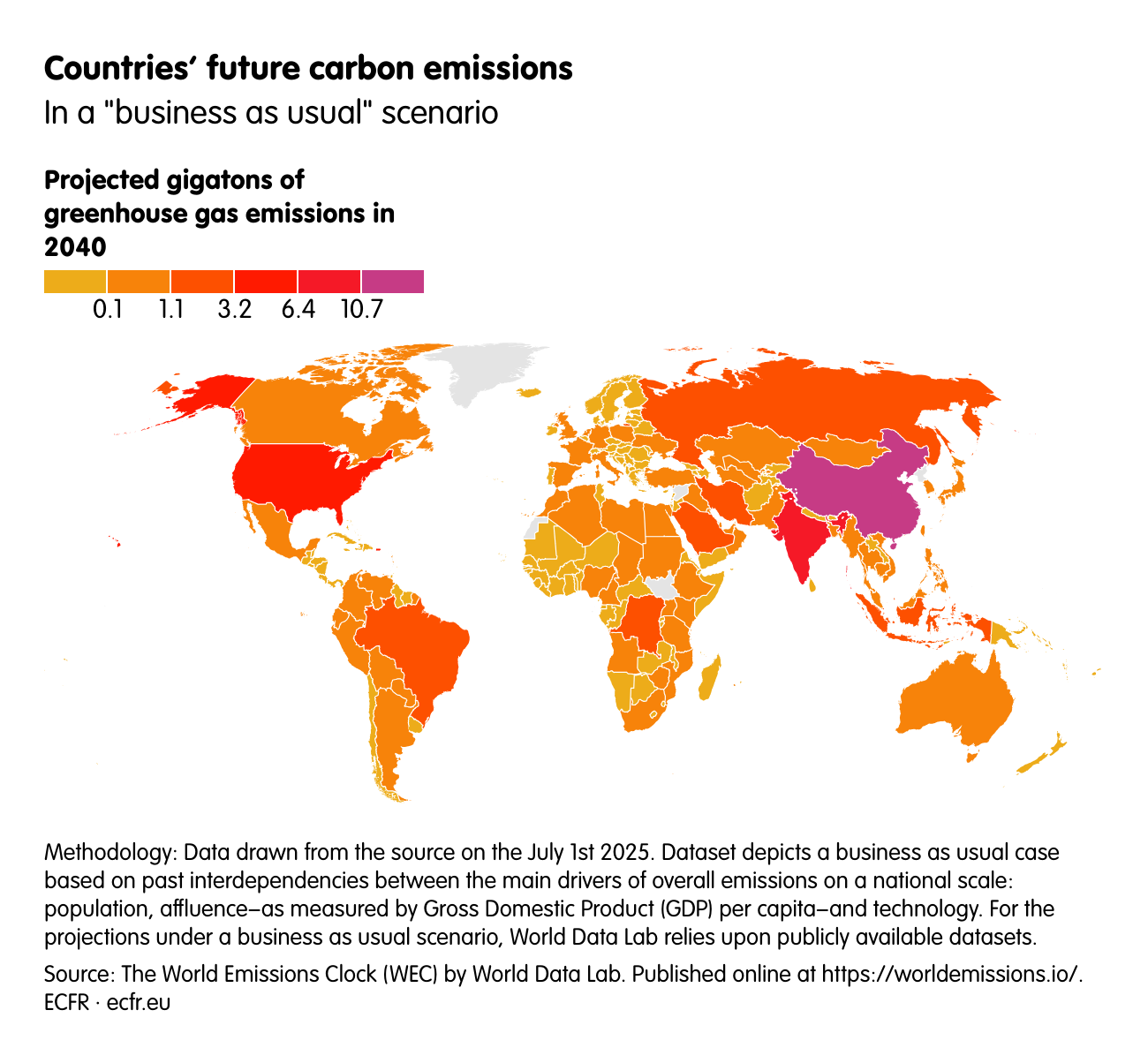
EU leaders intending to stay the course on decarbonisation need to adapt their climate foreign policy to the hyper-connected, global moment of today. Every country’s contribution to global carbon emissions is defined not only by the domestic energy and production choices it makes, but also by the international partners it chooses to help implement its national approach. As the map below shows, the US is on the wrong track; but many other partners are available to develop the technology and resources supply chains the EU needs for its own transition. Moreover, given that by 2040 the bloc will be responsible for a relatively small proportion of global emissions compared to other middle-sized powers, it should make sure it gears its investment offers towards supporting their sustainable transitions and economies.
China is the most well-known competitor in this field. And its success is sustained by the way in which it has assembled a range of partnerships to support its own green industrial revolution, including through the BRICS+ group. Through long-term investment—from skills to infrastructure—in broader relationships in Latin America, Africa and South-East Asia, China has concluded agreements with governments and businesses in these regions to obtain the resources it needs for its green technology while, at least ostensibly, also assisting those countries. This investment in external relationships to reinforce green development is increasingly pursued by other countries, including Australia, India, Japan and South Korea.
The EU needs to learn from this and develop a comparably powerful strategic long-term network with partner countries. To do this, it must be willing to invest in relationships with these partners, and it will need many of them. The EU’s goal should remain to drive decarbonisation forward in an environment where the US has stepped back from this aim. Success will hinge upon gaining the trust and buy-in of countries in other parts of the world, many of which feel bruised by OECD states’ failure to deliver on climate finance promises and by the negative impact of the EU’s carbon border adjustment mechanism (CBAM) and other trade-related EU regulation. This will require the EU to make a convincing offer to these countries. In the highly transactional global environment, the value of partnership with the EU will have to be made explicit. It must help partner countries mitigate the impact of its own policy choices and support countries’ decarbonisation in a manner compatible with their economic development.
Multilateralism under pressure
In the decade of relatively intense international climate cooperation since the signing of the Paris agreement in 2015, international institutions have driven global climate action forward. But the US has left the agreement, and its withdrawal of financing for the multilateral system, and anti-climate action in general, have created major challenges. These range from drastically reduced resources available in the UN system—with the secretary-general launching in March 2025 a UN80 reform process for operating on a tighter budget—to the task of how to manage COP30 in Brazil without significant US climate finance contributions.
However, the multilateral framework remains indispensable. Indeed, other key players, including many “middle powers” as well as China, are still willing to make the multilateral system work to govern global emissions reduction efforts. For example, at the recent meeting of climate ministers from around the world in Copenhagen, in discussing the road map to COP30 in Brazil there was strong support for multilateralism on climate issues. Ambitious coalitions of the willing are growing, such as the Climate Club, an intergovernmental coalition of governments. Authors’ conversations with national policymakers suggest many governments remain keen to support international institutions and harness them to galvanise action by individual states or by working collaboratively. And as global polling work conducted by ECFR has found, the prospect of a world dominated by competition between the US and China is most unappealing. People want options and the freedom to choose their partners.
Domestic action under pressure
Since the 1990s, the EU has significantly reduced its carbon emissions, drawing on a broad permissive consensus among the European public to act on this. The latest Eurobarometer data, from June 2025, show that 85% of EU citizens see climate change as a major challenge and 81% back the EU-wide goal of achieving climate neutrality by 2050. A growing proportion—now 38%—feel personally exposed to climate and environmental risks. The EU is broadly on course to deliver on these ambitions, including meeting its target of a 55% reduction in greenhouse gas emissions by 2030.
However, the climate action consensus is facing a greenlash, as the policy decisions necessary to deliver the next phase of targets become more divisive within and between EU member states. The cost of living remains top of citizens’ concerns, and is also one of the policy areas where voters’ approval of their governments is weakest. EU governments are strongly focused on creating jobs and keeping inflation as low as possible. Some European politicians—particularly from the right—have seized on (and led) this shifting sentiment to pit spending on the green transition against other policy areas. A clear example of this type of narrative was the claim made by the president of the European People’s Party, Manfred Weber, to have successfully “defeated” the ideological agenda of the European Green Deal.
This pressure has filtered up to EU institutions: the European Commission has modified its approach by placing competitiveness on a level with decarbonisation. Still, much of the EU’s substantive policy remains intact. One of the most high-profile expressions of this is the bloc’s recent decision to make the Clean Industrial Deal one of the three pillars of the European Competitiveness Compass, along with innovation and economic security. Successfully meeting these ambitions ought also to help to bolster domestic support where the green agenda is under attack in member states. Such policy changes can help strengthen the narrative that the EU thrives in a global environment where green competition is increasingly the norm—rather than regarding the choice to decarbonise as an economic sacrifice (which political “challenger” forces are suggesting).
There is no “either, or” about these questions. European decision-makers who recognise the continued imperative of climate action must find ways to deliver tangible results. As no single country can achieve this alone, international cooperation is an important part of defeating the greenlash.
Boosting partnership working
The solution in this new landscape is for the EU to build a stronger network of partnerships geared around decarbonising economies internationally.
All countries rely on trade and cooperation with others to develop their niche with new green economies in the current global market. The economic benefits this generates can create a virtuous circle in terms of the public acceptance of investment in the green transition. The EU should look at what others are doing in this regard and emulate them.
First, it must explicitly name decarbonisation as the way to secure economic resilience: many countries have explicitly made decarbonisation a goal of their industrial policy. These range from Beijing’s “Made in China 2025” policy, to South Korea’s “Korean New Deal”, to the approaches of India, Brazil, Japan and Gulf Arab states.
Second, the EU must invest in a network of relationships with partner countries around this strategy. The European Commission’s president, Ursula von der Leyen, has remarked that other countries are more willing to cooperate with the EU since Trump returned to the White House. They are already carving out a role for themselves in a growing international network around green industrialisation.
Yet so far, European and multilateral financial assistance for developing countries to reduce their emissions in these areas has been limited. This was a point participants from Latin America and Africa were keen to make in all of our workshops. There has been some progress: at COP29, Germany, Britain, Canada and the Climate Investment Fund pledged $1.3bn for this purpose. Moreover, partnerships to accelerate industrial decarbonisation can take various forms. Significant initiatives already exist at global level, such as the Industrial Deep Decarbonisation Initiative and the launch of the Global Matchmaking Platform. Some are included in the EU’s Global Gateway initiative. Individual member states are also active in this field.
But this is not enough. A fresh look at greater coordination is required.
New climate partnerships
Why
From the point of view of the EU, partnerships can reinforce wider multilateral cooperation to decarbonise; and they are vital for the delivery of national energy and climate plans, which set out how states plan to meet their Paris agreement commitments. From the point of view of partners, in our roundtables, representatives from countries around the world made clear that they wish to move up value chains linked to green transitions. For them, simply exporting raw materials such as green hydrogen or critical minerals will not suffice. They want investment in their own countries and the infrastructure, jobs and skills this brings. They also emphasised that partnerships with the EU around clean tech, and the resources and energy critical to it, should not be built into dialogues that are separate from the broader relationship. They should be embedded within it.
What
In terms of specific sectors for the bloc to target, steel, cement and chemicals are the key industrial contributors to carbon emissions globally. Alongside this, access to low-carbon electricity is necessary for industries to adopt less carbon-intensive production processes. Support for industrial decarbonisation must therefore go hand in hand with continued support for renewable energy and grids that have greater coverage and connectivity. Other promising areas of cooperation include the manufacturing of low-carbon products such as batteries and electric vehicles and the production of sustainable biofuels.
How
The EU already has the policy in place to act on this. The political guidelines of the European Commission highlight the need to further develop international partnerships for green transitions both in climate policy and in efforts to increase economic security. Other relevant policy developments include proposals for the Clean Industrial Deal and for new Clean Trade and Investment Partnerships.
To embark on this, the European Commission should lead a more strategic mapping of how it will meet the resources and technology needs of its green transition; it can use this to inform the build-up of a network of partnerships that underpin the transition. This will not be a one-size-fits-all approach—far from it. In each case, the partnerships will need to clearly provide benefits to both sides in terms of decarbonisation and economic development. But the overall network of different types of partnerships should support the EU’s ability to meet ambitious emissions targets over the coming decades as well as partner countries’ ability to meet their own.
Not all European policymakers are yet convinced by the idea of full-fledged partnership working. Feedback within our workshops and interviews indicate that ministries of industry in EU member states are sometimes reluctant to support non-EU countries in building stronger green industries that, as a result, will be able to compete with domestic companies. However, making European industry competitive and supporting partners’ development are not mutually exclusive. Often the opposite is true. Many European companies already depend on supply chains that extend into partner countries, so strengthened partnership and collaboration would also bring them significant benefits. Where there are true conflicts of interests, heads of government must consider the geostrategic perspective. But protectionism instead of partnerships—as advocated by some nationalist parties in the EU—would be a weak strategy for a resource-poor continent such as Europe.
In the highly volatile transactionalism of the second Trumpian age, the EU should lean into forming and celebrating partnership working with countries around the world to deliver decarbonisation. Writ large, partnership working can power both climate action and future growth.
For an expanded partnership strategy to be efficient, the EU needs to identify the most promising countries for future cooperation. ECFR’s Multilateral Matchmaker outlines the wide range of partners that wish to work with the EU to tackle climate change, especially when the partnerships are embedded in a broader set of interests including technology and security. These countries include Chile, Colombia, Ghana, Indonesia, Kazakhstan, Kenya, Malaysia, Mexico, Morocco, Nigeria, the Philippines and the United Arab Emirates. Looking specifically at the critical raw materials and resources that are central to the EU’s own green transition, ECFR’s Power Atlas also identifies the potential of working with Argentina, Australia and Bolivia—for example for lithium cooperation; Algeria, Botswana, Mongolia and Namibia for solar energy; and Britain and Iceland for wind power.
How the EU can build stronger climate partnerships
So what is the right way to build these climate partnerships? The message from partner countries is that Europeans can do more to:
- help generate demand;
- cooperate on technology;
- give a real boost to the amount and form of financing available.
In addition, the EU, together with partners, should strengthen global governance on all three of these areas.
The provisions contained within the Paris agreement will remain vital to monitoring countries’ progress towards their targets. But, looking ahead, the main driver of the green transition will to a large extent be self-interest—for countries and companies to compete internationally in a decarbonising world, they will need to decarbonise their industrial processes and electricity generation.
In addition to UN institutions, coalitions of the willing have emerged in recent years and also have important roles to play, including to speed up industrial decarbonisation. At COP26 in Glasgow, many countries signed the Breakthrough Agenda to facilitate decarbonisation in several sectors. Another such initiative is the Climate Club, which is co-chaired by Germany and Chile; and the LeadIt initiative is co-chaired by Sweden and India. These groupings advance the global agenda through knowledge sharing, cooperation on technical standards, and commitments to green public procurement. The Climate Club secretariat is hosted by the International Energy Agency and OECD, and there is also close cooperation with the United Nations Industrial Development Organisation (UNIDO).
The EU should continue to support such coalitions. However, European policymakers need to be aware of the growing cooperation within the BRICS+ group on similar topics. For example, the Green Manufacturing Partnership aims to “build green supply chains, enhance green development capacities, and open international markets for sustainable products”. If the EU is too slow to act, potential partners might look more to cooperation in BRICS and bilateral action between emerging and developing countries, narrowing Europeans’ ability to influence the future landscape of green industries. As noted, some political leaders are now more reluctant to move forward on climate action. But as the new climate geopolitics take shape, the European Commission, along with member states still positive about ambitious climate action, must develop offers that address the triad of areas—trade, technology and finance—that require work. This will help shape the incentives for states and companies in both the EU and partner countries to act.
Creating markets
Generating demand
The first of these areas is about how to generate demand for low-carbon products made in emerging and developing countries. Several of these countries have nascent low-carbon industries that European demand can help to grow. With the US now backing down from earlier domestic and international commitments to decarbonise, action by other OECD countries has become even more important to create demand. This should include stronger commitments from the EU. Several participants in our workshops (as well as studies) emphasised the need to create market demand for such products. There is frustration that EU declarations about cooperation on green hydrogen, for example in Africa, have not yet resulted in enough large-scale customer contracts from Europe.
Generating stronger demand is stated as a priority in global initiatives such as the Breakthrough Agenda, which has the support of 61 countries. Commitments to procuring low-carbon products are also a priority for the Climate Club. Meanwhile, “buyers clubs” have been established by companies and public authorities to create demand. Example sectors include low-carbon iron and steel, green ammonia, low-carbon fertiliser and alternatives to traditional cement.
However, progress has been limited. In this context it is first of all important that the European Commission’s ongoing review of EU procurement directives does not promote only domestic companies, as the French president and others are advocating. While securing domestic resilience by creating stronger European production capacity in critical sectors is important (as the commission has argued), Europe will never be secure on its own. The EU should take this opportunity to ensure its procurement rules allow imports on terms that benefit developing countries.
The EU can also promote coordinated private offtake agreements with developing countries. Under such agreements, buyers guarantee to purchase a certain quantity of low-carbon products from new facilities. Some are already in place. In Europe, Germany and the Netherlands have coordinated the purchase of green hydrogen through the H2GlobalPlatform. In another development, a Namibian company has secured an offtake agreement with a German company for green iron produced in a EU-supported facility. Japan has concluded noteworthy agreements with India on low-carbon ammonia.
The EU could play a larger role in supporting such endeavours. EU agreements with countries on critical raw materials are now being followed by an EU initiative for the joint procurement of such materials, a similar approach to that adopted by the bloc for liquefied natural gas. The EU could extend this approach on joint procurement to other products related to the green transition, such as low-carbon iron and ammonia.
Alongside these trade and procurement measures, updated regulation is required. This is despite the current push for “simplification” in the EU. For instance, setting a mandatory quota for a certain amount of low-carbon steel in new cars would help create markets for both domestic industries and companies in partner countries. If such regulations are well designed and implemented, they can inspire other countries and generate demand in their domestic settings. In addition, a price on carbon emissions would make investment in low-carbon alternatives profitable. In this regard, CBAM and international outreach on carbon pricing are important to create price incentives for investments in low-carbon production.
New trade frameworks
Demand will not be enough, however. To galvanise shared green industrialisation, trade frameworks also have to allow developing countries to export their products without facing prohibitive barriers. In the present environment, the trade policy of the Trump administration is detrimental to many developing countries. At the same time, China’s “dumping of overcapacity” is problematic for both Europe and many of its partners.
There are many relevant free trade agreements and other cooperation deals between the EU and partner countries that remove tariffs and other trade barriers to low-carbon products, among other items. However, this is not true for all potential partners. Interest in concluding new deals with the EU has increased due to the policies of the Trump administration. Additionally, Clean Trade and Investment Partnerships—announced this year by the European Commission—are a new toolkit for the EU. The EU should use these as flexible mini-trade deals that focus on critical raw materials, renewable energy, green hydrogen and related supply chains. The first agreement, with South Africa, is in train. India is next in line. Such partnerships can improve access to the EU market for partner countries by establishing more favourable trading conditions. However, the EU needs to develop its offers in these negotiations, by including, for example, more technology cooperation (as discussed in the next section).
At the same time some trade protection measures are required to safeguard European industry from Chinese dumping of overcapacity and to establish alternative supply chains (relating, again, to China). Such measures must be developed in collaboration with partner countries, not merely as Europe’s de-risking strategies. Otherwise new obstacles to developing countries’ access to European markets might emerge as a result of pressure from vested industrial interests. It is important that policymakers limit trade protection to areas where it is truly necessary.
Several partner countries are critical of CBAM. Since the measure was first proposed, the present authors (along with many others) have argued for complementary policies to support partner countries, financed partly by a share of the income generated by CBAM. However, EU institutions have not yet taken up such ideas. In the current geopolitical landscape this is worth reconsidering, with Trump strongly opposed to CBAM and an increasing number of global trade conflicts taking place. Providing support to partner countries to deal with CBAM would be a good incentive to help them reduce their carbon emissions—which is, after all, the stated purpose of the measure.
Cooperating on technology
The second area where European policymakers have an opening to facilitate investment in decarbonisation is in technology cooperation.
Technology development can significantly reduce the costs entailed by low-carbon transitions, as described by the Intergovernmental Panel on Climate Change. However, so far developing countries have not benefited enough from such processes. Speakers at our roundtables emphasised that the uptake of new green technology, such as hydrogen-based steel making, is lower in those countries, their institutions are weaker and financing costs are higher. Studies, for example by the OECD, confirm this. But stronger international partnerships to build green innovation ecosystems can help developing countries benefit while also increasing the mutual trust Europe needs for resilient supply chains.
Joint efforts to strengthen global governance are important in this regard. Together with partners, the EU could more strongly support technology cooperation under the UNFCCC and the Paris agreement. For example, the Climate Technology Centre and Network (CTCN) is doing important work to accelerate the development and transfer of environmentally sound technologies for low-carbon and climate-resilient development. However, the network is currently significantly underfunded. Providing more funding for the CTCN could enable it to move beyond project-based interventions to transformative programmes. The EU could also support the establishment of a green technology licensing mechanism within the UNFCCC Green Climate Fund, as well as a donor conference to help close the green technology gap.
UNIDO is undertaking important work, for example through the Global Clean Technology Innovation Programme. As part of the UN system, it has legitimacy across the world. However, UNIDO is already underfunded, and the policies of the Trump administration pose it an existential threat. The EU and its member states should increase their support for UNIDO and other relevant UN institutions, such as the United Nations Environment Programme (UNEP). This would make it possible to support new low-carbon production facilities in partner countries, contributing both to their economic development and to resilient supply chains for Europe.
Against this backdrop, promoting the co-development of green technologies by companies and research institutes should be a key part of European external action. This could help drive decarbonisation while also fostering interdependence and increasing competitiveness.
Participants in our roundtables related that partner countries are sometimes disappointed that China does not do enough to help them move up the value chain, for example through knowledge sharing and support for technology development. This is illustrated by a study from the ECDPM think-tank regarding the ambitions of the Democratic Republic of the Congo (DRC) to scale up local cobalt processing and develop battery value chains. According to the study, high social and environmental standards are considered a real added value offered by the EU to partner countries such as the DRC and Morocco. The EU could still make offers that are perceived as more beneficial than those put forward by China.
As discussed in our roundtables, these could include moving from project-based cooperation, as in the current Horizon Europe programme, to providing broader support for research and innovation ecosystems. For example, the EU could support industrial research institutes in partner countries by providing subsidies to European institutes to establish joint ventures. Other candidates for stronger cooperation include institutional capacity, research infrastructure and test beds for new products. The next EU framework programme for research should include such elements with specific budget lines for international cooperation. This could be linked to a co-innovation and technology transfer financial instrument, as previously proposed by the present authors.
Finally, building institutional capacity in partner government ministries and agencies for technological development should also be a priority in climate partnerships. “Twinning” institutions in EU member states with candidate accession countries through exchange opportunities for staff, joint seminars and so on has been a successful method within Europe. But current programmes for such cooperation with countries in other parts of the world remain too small.
Getting the financing right
There is an urgent need for Europeans to play their part in scaling up finance for the low-carbon transition of carbon-intensive industries in developing countries. The Trump administration’s withdrawal from the Paris agreement and drastic reduction of international development support make this task challenging. The EU and its member states hold the advantage of already being the world’s largest providers of development assistance. At a minimum, European governments need to safeguard direct climate financing and broader development aid as much as possible in a turbulent geopolitical landscape. This includes both bilateral aid and support for international financial institutions.
However, to build stronger partnerships and more resilient supply chains, the EU should step up its efforts both in global institutions and in its own actions. It must increase its contributions to climate finance. The positive byproduct of this will be to reinforce the bloc’s leverage in its network of climate partnerships.
In this context, it is important to understand what others are doing. As of October 2024, China claimed it had invested nearly $20bn through its Global Development Initiative, with over 1,100 projects carried out under its aegis. In addition to national banks, China plays a key role in the New Development Bank, which was founded by the BRICS group. Other initiatives include a new Special Fund for the China-Africa Green Industrial Chain, which supports green industrialisation with a focus on renewable energy, critical minerals and the manufacture of environmental goods. However, it was clear in our roundtable discussions that many existing and potential partner countries want to avoid becoming overly dependent on China, including for finance.
Many of them share a wish that Europe can help fulfil. As well as the need to invest in its own green industrial policy, the EU’s next long-term budget, the multiannual financial framework (MFF), must promote investments in low-carbon industrial transformations in partner countries and have a significant external dimension. It is also important that the competitiveness fund foreseen in the next MFF be based on partnerships rather than solely on promoting domestic industries. A technology transfer and co-innovation financial instrument could be one such element, as the present authors have previously proposed. In addition to the regular budget, this could be financed by some of the income from CBAM and the emission trading system.
The European Investment Bank (EIB) also has an important role to play in supporting partnerships for low-carbon transitions in developing countries. It has increased its lending capacity following a decision to raise the gearing ratio. However, more is needed, and its member states should agree to increase the bank’s capital.
Multilateral development banks and derisking investments
One specific challenge is how to de-risk investment. This is a highly relevant question for industrial decarbonisation because initial capital requirements are normally very high. The EU has taken some steps. It provides direct support infrastructure such as grids and railways through the NDICI-Global Gateway, which is part of the current budget, and guarantees through the EFSD+ programme. Individual member states, such as France and Germany, also play an important role through their development banks, Agence Française de Développement and KfW respectively.
However, further action is needed. Green guarantees are a promising method of de-risking investment in perceived high-risk markets. Donors and multilateral development banks (MDBs) can provide guarantees against currency risks, as well as “first-loss guarantees” when companies introduce new technologies such as hydrogen-based steel making. Together with Nigeria, Germany has taken an important initiative in this regard through the Green Guarantee Group. Now, the EU should expand the EFSD+ programme in the next long-term budget and improve coordination with EU-based export credit agencies that also strengthen de-risking investments.
More generally, emerging and developing countries are often deeply critical of the current global financial architecture. This complicates partnerships. Several participants in our roundtables emphasised that reforms to MDBs and the IMF are needed to increase climate finance in emerging and developing countries. While the G20 has agreed a roadmap, sufficient concrete action is still needed. Several proposals have been made, for example through the Bridgetown Initiative, but progress has been slow. This is an area where the EU and its member states need to engage more strongly.
EU member states must coordinate more effectively within the MDBs and the IMF to implement reforms such as increasing MDB financing capacity and cooperating more efficiently with governments, national development banks and the private sector. One example is the use of special drawing rights at the IMF, through which significant resources could be channelled to developing countries for climate action. As industrial decarbonisation is essential for the transition to low-carbon value chains, MDBs must increase their knowledge of such transitions, as they previously did about renewable energy. In addition to these multilateral processes, the EU and its member states need to intensify their own efforts.
Partner countries
Finally, closing the climate finance gap also requires action from partner countries. All countries must ensure they have an attractive investment climate, for example by tackling corruption and upholding the rule of law in business disputes. They must also combat vested interests, such as coal lobbies. The EU can increase its support for well-functioning institutions that are important to investors, such as commercial courts and frameworks for stronger capital markets.
Recommendations
Drawing on insights explored in this paper, we propose a six-point plan for Europeans.
- Build understanding within the EU of what interests they share with key partner countries when it comes to delivering green industrial transitions.
- The European Commission should lead a mapping: of the strategic needs required for the EU to reach the 2040 climate targets and improve global climate governance; and of the partner countries with which the EU will have to work to achieve different elements of this.
- This should be coupled with a study carried out by the European External Action Service into what partner countries’ specific wants and needs are in this area.
- The EU should then use these two inputs to help it decide how best to invest its diplomatic and financial resources to firm up the relationships necessary for the global transition.
- Gear climate partnerships towards interests broader than pure decarbonisation.
- Green industrial partnerships are not about decarbonising in isolation. To succeed, they must also be about securing economic development and poverty reduction; and about the technology and critical raw materials needed for wider economic security, preparedness and resilience in Europe.
- Ensure the right incentives are in place on both sides of climate partnerships.
- The EU should de-risk investments in green industrial transitions through the next MFF, the EIB and multilateral institutions such as the World Bank, for example by expanding the EFSD+ programme.
- The EIB must engage more in financing investment in industrial decarbonisation and improving institutional capacity, following the example of the bank’s promotion of renewable energy.
- The EU should establish a co-innovation and green tech diffusion budget line in the next MFF.
- The EU should provide more finance for research institutes and test beds. It should allocate more earmarked financing to joint research and development within the next EU programme. It should give more support that enables participation by global south countries in research consortia and for joint centres of excellence.
- Construct the right policy framework around climate partnerships.
- To create better markets, pooling of procurement can be an important tool, as is already the case with LNG. Trade rules need reform, including rules of origin and openness to others’ local content requirements.
- Provide more visibility to climate partnerships beyond policymakers within the EU, engaging the private sector in particular.
- Projects with EU financing on refining minerals, use of green hydrogen in value chains, electric vehicles and battery cell production, training on green science and skills—all are of great value to European businesses. EU policymakers should raise awareness within the private sector of these efforts to demonstrate that the green transition is about far more than just regulation.
- Build protections against undiluted transactionalism through improved global governance. Bilateral and regional climate partnerships can reinforce alliances for reforms of the multilateral framework.
- On demand and market access, the EU and its member states should work with OECD partners such as Japan, South Korea and Canada to promote public procurement of low-carbon products from emerging and developing countries. Cooperating at the multilateral level to draw up low-carbon standards, for example for green steel, is an important part of this. This includes working with China as well as within global organisations.
- On innovation cooperation and knowledge transfer, these are crucial elements on which global governance needs to improve. The EU should work more closely with partners such as Brazil, India, South Africa and OECD countries to connect coalitions of the willing such as the Climate Club with UN institutions. This should include providing more support to multilateral initiatives such as the Global Cleantech Innovation Programme (UNIDO) and CTCN (UNFCCC) and to important UN programmes such as UNEP.
- On finance, the EU and its member states need to contribute more to multilateral initiatives such as the Industry Decarbonisation programme of the climate investment funds and coordinate in MDBs to generate more climate finance.
A close study of climate geopolitics in 2025 reveals that climate-focused industrial partnerships with a broad range of partners are essential. The policies of the Trump administration, the increasingly transactional nature of international relations and worries over a domestic greenlash are all reasons to act. But this deeper understanding also reveals that a continued path towards decarbonisation, for Europeans and many other committed players, is entirely achievable in this new context. Political leaders must make this a priority, overriding budget constraints and other issues that have proved obstacles in the past. Europe cannot become green and secure on its own; its contribution to improved global governance is urgently needed.
About the authors
Susi Dennison is a senior policy fellow at the European Council on Foreign Relations and director of ECFR’s European Power programme. Her topics of focus include strategy, politics and cohesion in European foreign policy; climate and energy; migration; and the toolkit for Europe as a global actor.
Mats Engström is a senior policy fellow at the European Council on Foreign Relations, based in Stockholm. He has been involved in EU policymaking and analysis since the 1980s, including as deputy state secretary at the Swedish Ministry for the Environment and as a political adviser to the foreign minister.
Acknowledgments
The authors are grateful for the intellectual partnership with the Global Challenges Foundation (GCF) in formulating the project that has fed into this paper. They are also grateful for GCF’s generous support, which enabled ECFR’s work on this.
Myriad conversations with colleagues have informed the thinking that has gone into this paper, but we would like to thank in particular the speakers at the roundtables referred to in the paper for their insights: Jacob Werksman, principal adviser for international aspects of EU climate policy at DG CLIMA, European Commission; Ellen Davies, head of programmes at the African Climate Foundation; Prabhat Upadhyaya, adviser for G20 and multilateral affairs at the African Climate Foundation; Maria Netto, executive director of Instituto Clima e Sociedade; Heleen de Coninck, professor of socio-technical innovation and climate change at Eindhoven University of Technology; Abhishek Jain, director of green economy and impact innovations at the Council on Energy, Environment and Water; Anthony Agotha, special envoy for climate and environmental diplomacy at the European External Action Service; Thomas Östros, vice-president of the European Investment Bank; Isadora Souza, adviser on trade and green industry at Plataforma CIPÓ; and Leanne Govindsamy, head of just transition at Southern Transitions.
Within ECFR, Carla Moll, Marissa Gillwald and Katrine Westgaard have driven the delivery of this project forward through a turbulent and fast-moving environment. Agathe Demarais’ careful read of earlier drafts, and Anthony Dworkin’s reflections on the role of multilateralism within this picture have been invaluable. We are very grateful for Adam Harrison’s brilliant editing—despite ours only being one of a surge in publications coming out of ECFR over the past month—which has greatly sharpened the paper. We would also like to thank Gosia Piaskowska and Chris Eichberger for their help on the graphics.
Despite these many and varied contributions, any mistakes in the final paper remain the authors’ own.
The European Council on Foreign Relations does not take collective positions. ECFR publications only represent the views of their individual authors.