Avoiding gas panic: Why Europe should remain calm about US energy supply
American gas supplies are helping Europe’s move away from Russian energy. Despite trade tensions under Donald Trump, reliance on the US carries fewer risks than reliance on Russia

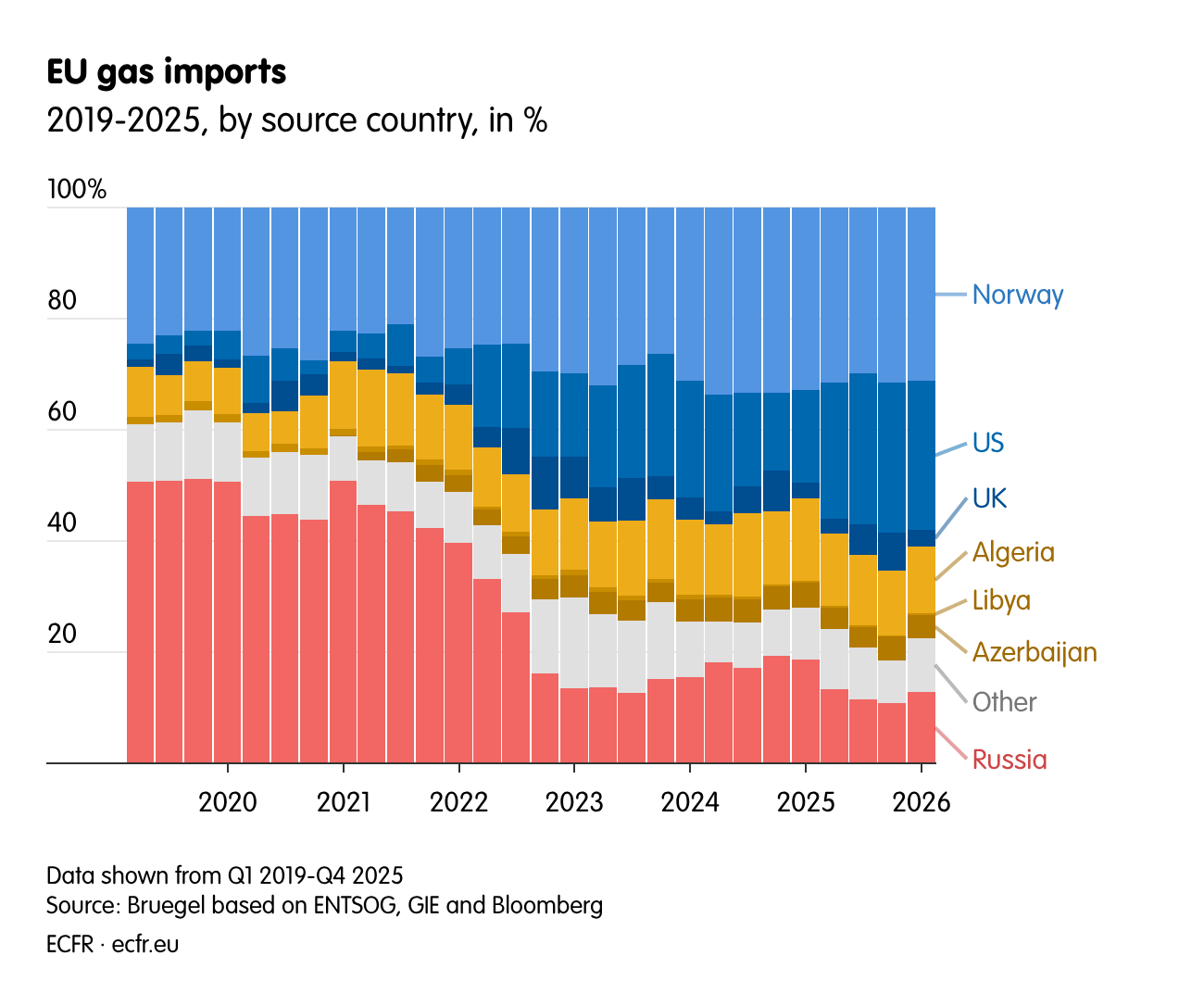
The United States has become one of the European Union’s most important suppliers of fossil fuels. According to statistics published by Bruegel, in 2021 the US share of gas supplies to the EU was less than 6%; by 2025 it had risen to over 26%. The situation is similar for crude oil. In 2025, the US ranked second, after Norway, as the most important supplier to the EU.
Europe seeks new sources
Following Russia’s invasion of Ukraine in 2022, the EU sought alternative sources of liquified natural gas (LNG) and oil. ECFR’s Energy Deals Tracker shows how the increase in US imports was a result of individual decisions by member states and European energy companies to start long-term contracts with American partners. But it was also a consequence of political decisions taken between the EU and the US. For example, in March 2022, European Commission president Ursula von der Leyen and former US president Joe Biden reached a deal to increase US supplies of raw materials to the EU.
The EU’s growing reliance on American fossil fuel imports was publicly highlighted as a problem after the beginning of Donald Trump’s second presidency and his aggressive overtures to Greenland. Where Trump has announced measures to increase the production and export potential of fossil fuels in the US, and strengthen American energy dominance globally, he is also using trade policy instruments aggressively. This is not only against America’s geopolitical rivals (with China in first place), but also against its allies—including the EU.
No time to panic…
Though EU policymakers are presenting the bloc’s growing energy dependence on the US as a growing challenge, there are three reasons why Europeans shouldn’t panic
Though EU policymakers are presenting the bloc’s growing energy dependence on the US as a growing challenge or a threat, in reality there are three reasons why Europeans shouldn’t panic.
1. Europe’s level of dependence on US supplies is much lower than it was on Russia
According to EU statistics, in 2021 Russia’s share of gas imports to the EU was almost 45%, with the supply volume (pipelines plus LNG), totalling around 157 billion cubic metres (bcm). In the same year, America had a supply volume of approximately 21bcm, which rose to almost 83bcm by 2025.
At the beginning of 2026, the EU has a more diversified gas supply portfolio than it did in 2021, with providers including countries such as Algeria, Nigeria, Norway, Qatar, and Trinidad and Tobago. Additionally, the overall volume of gas imports to the EU has decreased from 361bcm in 2021 to 313bcm in 2025.
The US is also a major oil supplier to the EU. However, its share of imports is 15% and Europe’s portfolio of suppliers is even more diverse than for gas. Furthermore, according to forecasts by the International Energy Agency, an oversupply of oil is expected in the global market in the coming decade. The specific nature of the market—it is easily transported, highly competitive and has higher diversification potential—makes it easier to diversify supply sources.
2. There is little risk that politics will impact supply
Until 2021, the EU’s dependence on gas supplies from Russia was based mainly on long-term contracts with Gazprom, a Kremlin-controlled company subject to political directives (as evidenced by Russia and Gazprom actions towards its EU contractors in 2022). However, in the case of the US, supplies are contracted between European and private American companies.
The risk that American companies will suspend or restrict supplies for political reasons is therefore negligible. At most, these supplies may become more expensive if the Trump administration uses trade policy tools to increase the cost of fossil fuel imports, particularly LNG, to the EU.
3. The European market is important for American companies
In 2025, US LNG export reached 153-157bcm, with Europe’s share of this at 60%. In the coming years, the US will launch new export terminals to double its LNG export capacity. American companies—and Trump, despite harsh rhetoric —will likely be more interested in maintaining energy cooperation with Europe than in pursuing action to disrupt it.
…but it’s good to be prepared
However, the EU and its member states should pursue three types of activities aimed at reducing the risks of excessive dependence on fossil fuels from individual suppliers.
First, the EU and its member states should adhere to the principle of diversifying their sources of supply and maintaining the broadest possible portfolio of gas and oil suppliers. At the same time, they need to continue their efforts to become completely independent of fossil-fuel imports from Russia.
The EU’s July 2025 trade deal with the US, which commits to purchasing $750bn of US energy (LNG, oil and nuclear energy products) by 2028, risks tying Europe’s energy supply to a single dominant supplier and weakening the bloc’s energy security. According to the Institute for Energy Economics and Financial Analysis, new long-term LNG contracts could increase EU dependence on US gas from 27% in 2025 to around 40% by 2030. Maintaining diversification course will be particularly important in the context of possible future threats or political pressure from the Trump administration towards European allies.
At the same time, to avoid increasing dependence on individual suppliers (including the US) the EU should create a transparent and comprehensive database to track its long-term dependence on fossil-fuel imports. This would highlight the contracts concluded so far by member states and European companies with third countries and companies from third countries. The EU could establish a separate internal agency, as proposed in a joint report by Bruegel, Forum Energii and ECFR, to enable ongoing monitoring of dependency levels on individual suppliers across the EU. This would help the EU and member states to avoid new contracts that increase dependency on certain suppliers.
Finally, the EU and its member states need to continue reducing their dependence on fossil-fuel imports. This could be via further development of renewable energy sources; improving energy efficiency; and developing nuclear energy, which in the long term could reduce the role of fossil fuels in the European energy mix. At the same time, this would increase EU energy security, making it more resilient to geopolitical turmoil in places that supply fossil fuel imports to the EU.
Ensuring long-term security
Regardless of political tensions with the US, the EU and its member states should not panic or make rash decisions regarding energy cooperation. Oil and gas supplies from the US are important for reducing dependence on Russia, which should remain a key priority for Europe.
At the same time, the EU’s overall energy policy must prioritise diversifying supply sources and continuing the energy—to truly strengthen EU energy security in the long term.
The European Council on Foreign Relations does not take collective positions. ECFR publications only represent the views of their individual authors.