Carbon bargain: How Europe can adapt to Africa’s new energy alliances


Summary
- African countries view the energy transition as a tool for economic transformation, to deliver jobs, industrialisation and development. This stands in contrast to Europeans’ more limited focus on decarbonisation.
- As America, China and Arab Gulf states all seek deeper engagement in Africa’s energy and minerals sectors, African states are actively shaping and arbitraging among competing offers. This structural hedging complicates Europe’s preferred model of stable long-term partnerships.
- Europe’s comparative advantage lies in rules, finance and early-stage support, including regulatory assistance, grants and technical expertise to help establish new sectors such as carbon markets, green hydrogen and biofuels. Its weakness lies in reconciling norms and delivery.
- The EU and European governments should adjust their rules of engagement to allow more gradual transition models, aligning with industrialisation, not just decarbonisation objectives. They should leverage industrial complementarity and use finance more flexibly to bring about strategic projects that serve both African development and European interests.
Talking past each other
“We are not here to negotiate our survival. We are here to design the world’s next climate economy.” Ethiopian president Abiy Ahmed’s opening words at the Second Africa Climate Summit in September 2025 captured a fundamental shift in how African countries approach the global energy transition. It is no longer a conversation about victimhood or passively receiving donor priorities. It is about African countries’ agency, leverage and strategic positioning; making the most of the energy transition to deliver on African interests, just as others around the world are.
As in many other regions of the world, Africa’s energy transition is not following a linear shift from fossil fuels to renewables. It is a broad, contested project through which African states are renegotiating their development models, revenue sources and geopolitical alignments. At COP30 and during South Africa’s G20 presidency, African countries demonstrated their growing centrality to global climate debates, contributing to the new just transition mechanism (the Belém Political Package) and positioning themselves through the Addis Ababa Declaration (issued at the Second Africa Climate Summit) as proactive seekers of new financing instruments, energy solutions and transition pathways that account for development and industrialisation realities.
Yet this assertion of agency is unfolding within enduring structural asymmetries. African countries face some of the world’s highest borrowing costs and receive only a marginal share of global climate finance. They are largely positioned at the low-value end of global energy, mineral and manufacturing value chains. Energy poverty continues to shape domestic political economies and limit policy space. These asymmetries define African engagement with the energy transition not as a moral imperative alone, but as a high-stakes negotiation over growth, sovereignty and economic survival.
From African governments’ vantage point, the decarbonisation challenge looks very different to that conceived in European capitals. Where the EU and European countries have long pursued decarbonisation as the principal goal of their climate and energy policies—through initiatives like the flagship European Green Deal—African countries see an energy transition that can deliver simultaneously on key policy priorities, including industrialisation, job creation and universal energy access. As one person interviewed for this paper put it, from the African perspective, “Decarbonisation is the means; the goal is access to energy.”[1] This fundamental divergence in how to conceptualise the transition shapes every negotiation, partnership design and policy choice and has increasingly generated friction in Africa–Europe engagement.
The EU and member state governments have begun to recalibrate their decarbonisation focus under domestic political pressure and since the last European Parliament election’s shift to the right. Yet this adjustment has not resolved the deeper disconnect. African motivations, constraints and trade-offs remain poorly understood—and are often insufficiently reflected—in European policy instruments. As a result, Europe risks promoting frameworks that appear misaligned with African priorities at a moment when alternative partners offer flexible and politically attuned engagement.
African actors are leveraging the interest of other international players in Africa’s untapped energy domains. China and Gulf states in particular often make offers that resonate more directly with African governments’ dual-track strategies—supporting both hydrocarbons and renewables, moving quickly from commitments to projects, and tolerating greater policy heterodoxy. While African governments vary in how strategically they manage these relationships, many are increasingly confident in setting terms, sequencing engagements and playing partners off against one another.[2]
Drawing on research, interviews and roundtables with policymakers, academics, private sector actors and international organisations—with a focus on Angola, Gabon, Kenya and South Africa—this policy brief examines how African decision-makers are prioritising socio-economic development, jobs, cheap energy to power industry, climate finance innovation and resource sovereignty as they transition their economies away from fossil fuels. It highlights where African and European approaches overlap, and where they do not. It sets out ways in which European policymakers can adjust the language and substance of their policy in supporting African countries in the energy transition as they define it. The paper also demonstrates the potential for Europe to become closer to Africa than competitors in this domain.
The choices African governments make matter for Europe’s strategic future: they influence global supply chains, the geography of clean energy manufacturing, the availability of critical minerals and the political coalitions that will define global climate governance. Europe’s own energy transition, efforts to reduce dependency on China and broader geopolitical influence hinge on its ability to work with this frame—not around it.
African views of the energy transition: A means to an end
African actors and Europe (and other external powers) pursue different logics on energy and climate issues. Understanding these reveals the divergences between how European and African countries perceive the energy transition.
In Africa, policymakers and other actors conceptualise the energy transition—across official AU strategies, national policy documents and as expressed in interviews conducted for this research—not only as an important dimension to address climate change, but mostly as a means to achieve other policy ambitions. These include expanding energy access for their populations and providing new jobs; building up African industry linked to new energy value chains; leveraging climate finance to address adaptation and mitigation challenges; and strengthening their diplomatic influence within a changing global energy order.
Development first, climate second
Improving livelihoods and promoting economic growth are core preoccupations of African governments. Energy is a fundamental prerequisite for socio-economic progress, yet almost half of the continent’s population still lacks access to reliable and affordable electricity. Over 80% of sub-Saharan Africa’s population relies on traditional biomass for cooking. While other parts of the world enjoy near-universal access to electricity, in Africa new connections have struggled to outpace population growth.
But the development imperative extends beyond access alone. For fossil fuel-producing African countries contemplating the energy transition, maintaining revenues, employment and industrial competitiveness while facing pressure to shift to cleaner energy generates profound political tensions. For other countries, population growth and costly import dependencies create pressure to expand economic opportunities. Demonstrating an ability to deliver for citizens—whether through energy provision, job creation or economic growth—underpins political legitimacy and affects ruling parties’ re-election prospects.
In global negotiations, African states have become increasingly explicit in demanding that global energy transition frameworks integrate principles of equity and differentiated responsibilities. Equity refers to the benefits industrialised countries obtained through fossil fuel-driven growth and motivates climate finance justice as compensation for historical emissions (to which Africa contributed only around 4%). Differentiated responsibilities refer to Africa’s negligible historical contribution to global greenhouse gas emissions and its states’ more limited fiscal and technological capacity. These claims in diplomatic relations express historical grievance but also a clear strategic preference: that climate cooperation must support socio-economic transformation, not constrain it. The energy transition cannot happen at the expense of jobs, revenues and livelihoods. As one roundtable participant noted during research for this paper, “The priority is to provide dignified lives for people, not to get to net zero.”[3]
Countries’ specific resource endowments and development trajectory shape what this means in practice. For major fossil fuel-producing countries, the core tension lies between persistent dependence on hydrocarbons and the imperative of transformation towards renewables. In such places, state capacity, elite patronage networks and political legitimacy remain tightly bound to fossil fuel revenues. This can generate resistance to transformation even as economic vulnerabilities mount. Angola exemplifies this as sub-Saharan Africa’s second-largest oil producer. Over 90% of its export revenues come from hydrocarbons. Despite their country’s abundant oil resources, 40% of Angolans lacked electricity access in 2023, and the economy remains vulnerable to commodity price shocks. The Angolan government has a plan to expand renewable energy capacity to 73% of electricity generation by 2027 (up from 66% in 2024), which reflects a recognition that it must diversify. However, execution has faltered because of declining oil revenues, fiscal pressures and entrenched interests resisting reform. This results in a government caught between acknowledging the need for long-term economic transformation and the political impossibility of accelerating it.
Coal producers like South Africa face similar political economy dynamics, but with a crucial difference: coal fuels domestic industry rather than merely generating export revenues. This creates an even more profound challenge as coal underpins lower electricity costs and industrial competitiveness while providing significant employment. Rapid coal decommissioning therefore has serious social, political and economic implications for countries like South Africa.
In some places, resource revenues are on the decline, which produces a different dynamic again. In Gabon, oil production is shrinking, and so the country has attempted to monetise its vast forests, which cover almost 90% of its territory, by generating carbon credits for their protection. Yet these mechanisms have failed to generate sufficient revenue to replace oil rents or meet growing demands for jobs and economic opportunities. Faced with this shortfall, and amid increased pressure from Gabonese who need more land for agriculture and the ability to use forest and marine resources for income generation, biodiversity protection is increasingly being pitted against socio-economic development needs. Consequently, while still committed to biodiversity protection in principle, recovery of the oil and gas sector is taking centre-stage for a government under pressure to deliver tangible economic benefits for its citizens. This is evidenced by its efforts to secure new investment in the country’s oil and gas sector.
For Kenya, which is not dependent on oil revenues, the energy transition offers the possibility of new jobs and green economic growth. Some 90% of its national grid is now powered by renewable energy, much of it from geothermal sources, although solar and wind are also making growing contributions. Greater use of these cheaper renewable energy sources should lower power prices over time, easing affordability constraints for small businesses and households and enabling expanded energy access.[4] Kenya has embraced a low-carbon transition not on ideological grounds, but due to cost-based pragmatism. Although the government still hopes to initiate oil production from the Turkana oil fields, momentum towards renewable energy, e-mobility and other low-carbon technologies is considerable and offers more inclusive benefits for Kenyans than oil production could deliver.
Together, these cases exemplify the powerful “development first” imperative that shapes Africa’s energy transitions: socio-economic growth hinges on increased energy access, while the preservation of industrial competitiveness and (from the point of view of those in power) the maintenance of political legitimacy remains central.
In Europe, the task of decarbonisation has been about transitioning away from established industrial bases in the context of relatively high living standards for citizens. In contrast, African states still need to industrialise while navigating the dual challenge of expanding basic service provision and lowering their dependence on hydrocarbons. The political stakes of failure are comparable; the material starting points are not. Whether they are grappling with their reliance on fossil fuels—as in Angola and Gabon—or pursuing green growth—like in Kenya—or navigating a major industrial transition—like South Africa—the different roads ahead share a common destination: climate action that serves, and does not sacrifice, socio-economic progress.
Industrial growth
The global energy transition has triggered intense industrial competition, with major and emerging economies racing to capture control of value chains in renewables, batteries, critical minerals and green hydrogen. America’s Inflation Reduction Act; the EU’s Green Deal Industrial Plan, Net Zero Industry Act, Critical Raw Materials Act, carbon border adjustment mechanism (CBAM); and China’s mineral processing and manufacturing dominance and export bans—all reflect a shared logic. These powers understand the energy transition as an industrial opportunity, not just an environmental imperative.
It should be no surprise, then, that African states are pursuing the same strategy. They want to leverage their resource endowments and potential comparative advantages to shift from their historical role as raw material exporters towards higher-value processing and manufacturing. For many African countries, their industrial ambitions hinge on access to cheaper, renewable energy. In turn, this green industrialisation would create jobs, ensure economic diversification, introduce greater industrial sophistication, reduce dependency on imported fuels and enhance their sovereignty over natural resources.
African governments see minerals, in particular, as a key strategic asset. To improve their control over their resource wealth, mineral-producing African countries are deploying increasingly assertive policy tools: introducing local content requirements to oblige companies to source goods and services locally; banning the export of unprocessed minerals to enforce more mineral processing in-country; and making regulatory changes that aim to secure greater revenues from extraction. Again, this mirrors policies long employed by industrialised economies to build domestic capacity, from historical American and European trade protections to contemporary Chinese export controls on rare earths and gallium.
The difficulty for African countries lies not in their chosen approach, but in executing it from a position of structural disadvantage. African mineral producers face technological gaps, limited access to patient capital, inadequate infrastructure and fierce competition against more established counterparts, especially in China, that have lower production costs and mature supply chains. While optimism runs high among African politicians about new mineral-based industrialisation opportunities, in part due to growing resource nationalism and interest from external actors, transforming entrenched patterns of extraction within highly competitive global markets requires overcoming significant structural obstacles.[5]
How different countries navigate these constraints reveals both shared aspirations and divergent approaches shaped by specific resource endowments and economic structures. Mandating local mineral processing is one way African governments are trying to push industrialisation. Gabon is a good example of this: it is planning an export ban to require Eramet and other manganese miners to embark on in-country refining.
Developing new industrial sectors is also a priority for many African countries, as seen with Angola and Kenya, for example, which are looking to develop export-orientated green hydrogen and biofuels sectors. Kenya is also seeking to expand its e-mobility sector and export power to the region through the East African Power Pool. As Africa’s most industrialised country, South Africa is focused on retooling existing industry, such as repurposing automotive plants for electric vehicles and developing local battery manufacturing. In so doing, it is attempting to move its industries towards cleaner energies while maintaining international competitiveness.
Although African countries have dramatically different starting points, their varied approaches reflect a shared logic: to capture industrial value from the energy transition. The challenge for most African countries remains how to execute industrial strategies while competing against economies with decades-long headstarts, privileged access to capital and technology and the market power to shape global value chains in their favour.
Financial diversification
Finance remains the central constraint shaping Africa’s energy transition. The continent faces high debt burdens, hesitancy on the part of some external investors and tightened aid budgets that restrict fiscal space and increase the cost of capital. Despite years of diplomatic pressure from African and other low-income countries, global climate finance initiatives have fallen short, mainly due to insufficient funding and a lack of consensus between advanced nations and low-income countries on just transition pathways. Amid declining international cooperation and increasingly polarised domestic politics in the global north, moral appeals for financial accountability fail to gain traction.
The result is a widening gap between African climate needs and the willingness of donors to meet—or increase—financial commitments. Africa’s finance gap for adaptation alone now ranges from $187-359bn annually. There are also considerable disparities across African countries, with 10 countries securing over 50% of Africa’s total climate finance flows and the bottom 30 countries together receiving only 10% of funding. Despite its significant renewable energy resources, Africa also received just 2% of global renewable energy investments over the past two decades. Bilateral funding often comes with conditionalities that reflect donor interests rather than African priorities, which limits its contribution to driving structural transformation.[6]
To remedy this, across the continent, governments are actively trying to leverage the global energy transition to increase financial flows—by diversifying the sources, instruments and the political terms of capital. Their objective is to reduce dependence on a narrow donor base, raise the quantity and flexibility of finance and align it more closely to domestic priorities than donor preferences. Specifically, African governments are deliberately diversifying the external partners they work with in order to minimise dependencies and widen possible areas of cooperation. They are also pursuing new climate finance opportunities, including through green bonds, carbon markets, public-private partnerships and climate-tech venture capital.
Crucially, governments are trying to mobilise domestic capital. While domestic finance contributed only around 10% of Africa’s total climate finance in 2022, this could rise markedly as African pension funds, sovereign wealth funds and commercial and development banks collectively hold substantial assets that could anchor transition-related investments. Deployed alongside external finance, these domestic sources can strengthen local ownership, increase alignment with domestic priorities and improve project credibility. However, weak state governance, capacity gaps and uneven regulatory environments continue to limit their deployment.[7] Furthermore, while the proliferation of external partners interested in investing in African energy and minerals sectors gives governments more bargaining power, it also strains administrative capacity, with fragmented reporting and compliance requirements presenting additional burdens.[8]
How countries navigate constraints and opportunities in mobilising climate finance and funding for the energy transition varies significantly based on debt profiles, resource endowments and existing relationships with international financial institutions. African countries with limited fiscal space often find transition investments squeezed out by their debt service obligations. This puts them in a position of having to secure external finance to fund their energy transition while maintaining hydrocarbon production for some degree of fiscal and regime stability. Angola is a prime example of this. Tight domestic fiscal constraints have led it to seek concessional climate finance through multilateral channels, solicit private investment in critical minerals and scale up renewable energy generation capacity to lower reliance on costly diesel imports.
Gabon and Kenya have tried to establish carbon markets to monetise their biodiversity protection but have made little progress to date. This is partly because African carbon credits have been undervalued, priced at only $7-12/tonne compared to $110/tonne for European carbon credits in 2024. It is also because carbon offset initiatives are poorly designed for high forest, low deforestation countries like Gabon, whose relatively lower deforestation rate means there is limited scope to further avert deforestation.[9] More could be earned through afforestation initiatives, but with almost 90% of the country already forested, any forest expansion would further curb living space and economic opportunities of Gabonese. In Kenya, carbon credits have been a topic of notable public backlash, with carbon credit projects being viewed locally as schemes that benefit foreign project developers and industrialised polluters at the expense of local communities. Whether carbon markets will bring in non-negligible climate funding for African countries remains to be seen.
Climate finance has also been inadequate to compensate more industrialised places like South Africa for shifting away from fossil fuels. Stagnant electricity demand in the country means renewable energy capacity cannot be built out without reducing coal-fired generation, yet early coal retirement incurs financial losses and higher electricity costs that neither industry nor households in South Africa can afford.[10] This has made South Africa a test case for international “just transition” finance, particularly the Just Energy Transition Investment Plan, which aims to mobilise $12.5bn from the US (now withdrawn), the EU, Britain, France and Germany. Less than 10% of this amount is currently in the form of grants, however, raising debt concerns for South Africa. Yet its implementation reveals fundamental tensions, with donors pushing for more rapid decarbonisation than South Africa can endure if it is to protect coal sector employment, preserve industrial competitiveness and maintain energy security. European demands for South Africa to decarbonise—when it accounts for less than 2% of coal-fired electricity globally—is a clear demonstration of the cognitive dissonance Europe’s approach has in African countries.[11]
The different situations of these four countries illustrate real misalignment between the financial architecture of Africa’s energy transition and the continent’s needs and capacities. Without adequate, appropriately structured finance, governments face impossible trade-offs between debt service, social spending, transition investments and biodiversity protection. African states’ strategies of financial diversification—mobilising domestic resources, cultivating alternative partners and innovating with new instruments—are necessary adaptations to this inadequate system. The energy transition’s ultimate shape across Africa will be determined less by technology, resources or political will than by who pays, on what terms and with what conditionalities attached.
Diplomacy and strategy
In support of these ambitions, African countries are attempting to reshape global governance rules and press for new mechanisms that reflect African realities—such as just transition frameworks, adaptation finance and industrialisation. They are thus repositioning themselves strategically, leaving behind their past role as recipients of climate rules and assistance to become active shapers of the energy transition. Their calling card is the world’s urgent need for decarbonisation, which they want to put in service of broader development and sovereignty objectives.
While African countries continue to push for meaningful action in global energy and climate-related forums, they are simultaneously creating Africa-led platforms. This is a deliberate strategy. On the one hand, African states remain deeply invested in existing multilateral forums, including COP negotiations, UNFCCC financial bodies, multilateral banks and UN decision-making structures. Yet at the same time they are seeking to reform these institutions, as well as change financing models that they view as insufficiently representative of African countries or responsive to their development needs, energy access imperatives and differentiated responsibilities. Their engagement in these arenas is less about rejecting the energy transition than reshaping its terms.
African governments are therefore increasingly investing in African-owned forums and initiatives aimed at consolidating positions and setting agendas. The Africa Climate Summits in Nairobi (2023, with its Nairobi Declaration) and Addis Ababa (2025) exemplify this. Initiatives like the Africa Green Industrialisation Initiative further put into practice this approach by framing the transition as a vehicle for structural transformation.
African forums also serve as a foundation for continental coordination, which is key to amplifying bargaining power in global negotiations like COP or the G20. As chief negotiator of the African Group of Negotiators (AGN), Richard Muyungi has noted that a united front reduces the risk of external powers dividing the continent and was instrumental in elevating adaptation globally, leading to the establishment of the Global Goal on Adaptation.[12] The AGN has secured diplomatic achievements, including recognition of adaptation needs, just transition language embedded in global frameworks and the establishment of the loss and damage funding mechanism. These represent meaningful shifts, demonstrating Africa’s growing negotiation capacity and influence. Yet translating these wins into actual resource flows and reformed governance structures has proven far more difficult.
This diplomatic strategy is not uniquely African—it reflects how states everywhere use climate governance to advance national interests. The EU leverages its climate leadership to set global regulatory standards, positioning European companies advantageously. The US uses climate finance and technology partnerships to counter Chinese influence. Gulf states have used their hosting of major climate negotiations—notably the UAE’s presidency of COP28—to shape the global energy transition narrative, securing language that allowed for continued fossil fuel production alongside renewable investment, while positioning themselves as green energy hubs and climate finance providers.
What distinguishes Africa’s approach is the combination of three assets: resources that are critical for the energy transition (gas, critical minerals, renewable energy); moral authority rooted in acute vulnerability and minimal levels of historical emissions; and collective bargaining across 54 states to demand not just financial transfers but structural reforms to global governance. Yet diplomatic influence is uneven in practice: collective continental positions are difficult to maintain across highly diverse national interests. Individual countries leverage different assets and occupy distinct positions in global climate governance, shaping how—and how effectively—they can advance African priorities.
As the continent’s only G20 member, South Africa has used its membership to further embed just transition principles into global frameworks. Its G20 presidency in 2025 advanced African priorities on reforming multilateral development banks and increasing climate finance flows, helping consolidate political momentum and shared language around these issues. At the same time, South Africa’s continued engagement with European models emphasising decarbonisation (such as the Just Energy Transition Partnership and the recent EU-South Africa memorandum of understanding on minerals and metals value chains) is complemented by its access to BRICS+ countries partnerships, which are often agnostic about types of energy source. Maintaining access to both sets of partners allows South Africa to hedge against rigid transition pathways while managing energy security concerns and domestic political constraints linked to coal dependence. Like many African countries, South Africa seeks to diversify partnerships in order to preserve policy space, manage external conditionality and retain control over the pace and sequencing of its transition.
Renewable energy credentials offer a different form of leverage. Countries with strong clean energy profiles and innovative climate ecosystems, like Kenya, have sought to position themselves as climate frontrunners to attract finance, partnerships and political visibility. President William Ruto has spearheaded continental initiatives like the Africa Climate Summit and the Africa Green Industrialisation Initiative, helping shift Africa’s narrative from being a victim of climate change to a solution driver. However, this activism has generated its own domestic tensions. Many Kenyans perceive their government’s climate diplomacy as serving donor priorities rather than addressing pressing local needs like the cost of living crisis.[13] This gap between global leadership and immediate socio-economic relief illustrates a broader challenge facing African climate leaders: diplomatic leverage can strengthen international standing even as domestic legitimacy depends on how quickly and tangibly external commitments translate into everyday economic gains. As one roundtable participant noted, “Kenyans need to see impact on the level of wananchi [citizens], not the political level.”[14]
For African hydrocarbon producers like Angola, Gabon and South Africa, the diplomatic challenge is fundamentally different. Defending the right to exploit hydrocarbon resources while engaging in global transition debates requires them to navigate pressure to phase out fossil fuels, even as revenues from oil and gas remain central to fiscal stability or coal remains critical for energy security. For these countries, engagement in global energy governance is often orientated towards security flexibility, extended transition timelines and recognition of gas as a transition fuel.
International partner views of the energy transition: Mix and match
African governments are engaging a growing and diverse constellation of external partners in pursuit of their energy transition and climate policies. Different partners offer different value. But these partnerships are neither neutral nor symmetrical.[15] Each external actor brings distinct incentives, political logics, financing instruments and delivery patterns that shape what African governments can realistically achieve.
Europe
Europe retains distinct capabilities in Africa’s energy ecosystems that competitors struggle to match. With USAID’s departure, the EU and member states are among the few external partners providing upstream support, such as grant funding for regulatory reform, capacity building, technical assistance and sectoral development in emerging areas like carbon markets and green hydrogen. As such, European players have carved out niches where grant funding and concessional finance are critical, such as climate adaptation, biodiversity protection and sustainable forestry management. They remain partners for traditional aid-style support, such as regulatory reform and cross-border energy infrastructure. This distinguishes Europe from other bilateral external partners but does introduce Euro-centric approaches into African regulatory frameworks which can cause challenges.[16] Europeans’ ability to deploy a mix of grants and equity also distinguishes them from purely commercial actors.[17] Upstream support can help create systems and establish sectors rather than one-off projects, whereas equity investments offer more patient, longer-horizon funding. These contributions can strengthen ties that extend beyond capital flows into governance and institutional architecture.
Europe also remains Africa’s largest cumulative foreign investor. Nevertheless, its share of African trade has been decreasing over the last decade: the European share of investment stock and flows has faced relative erosion as the investment landscape diversifies, with emerging economies—particularly China and Gulf states—accounting for an increasing proportion of new capital. Gabon’s timber sector, where European loggers were once dominant, is a prime example: Chinese loggers have come to hold over 60% of logging concessions in the country after European companies gradually left amid difficulties in competing with Chinese loggers, many of which do not adhere to the same sustainable forestry practices as European loggers.
More significantly, Europe’s investment in political dialogue with African capitals has, concerningly, slumped in recent years—as illustrated by a nearly four-year gap between EU-AU summits (between February 2022 and November 2025) and repeated instances where annual consultative meetings on political and security cooperation failed to produce joint communiqués, reflecting deeper divergences in priorities. This weakens a dimension of Europe’s activity that once amplified its economic and developmental presence, leaving it less able to build coalitions, shape narratives or respond to political shifts.[18]
The decarbonisation disconnect
Europe’s fundamental weakness lies in the mismatch between its climate-first approach and Africa’s development-first approach with priorities around industrialisation, energy access and job creation. EU institutions have focused narrowly on rapid decarbonisation. For example, in South Africa the EU has adopted prescriptive decarbonisation priorities, pushing for accelerated coal decommissioning that directly conflicts with South Africa’s social, political and economic realities; application of CBAM, which will have deep negative impacts on South Africa’s iron and steel industries; and emphasising the building of new renewable energy generation capacity despite stagnant energy demand and slow economic growth in South Africa.[19] Europeans’ reluctance on oil, gas and coal conflicts with the dual-track hydrocarbon and renewables models that many African countries are pursuing. This leaves Europeans unable to shape interventions around the political and economic realities of African countries.
Angola illustrates the pattern: it has simultaneously capitalised on Europe’s continued reliance on Angolan liquefied natural gas while securing European-backed investments in renewables—including energy firm Azule’s solar park construction and biofuels production expansion. This has allowed Angolan authorities to engage European technical and financial expertise, including on energy diversification, without fully aligning with European climate framing. Angola embraces European support on engineering expertise, project finance and regulatory support while selectively rejecting Europe’s climate narrative and pressure to accelerate fossil phase-out on prescriptive transition timelines. Europe’s positioning, caught between business and policy, allows African governments to cherry-pick what serves their interests while dismissing what constrains them.
When Europe treats fossil fuel engagement as reputationally toxic, it cedes influence over how, and how fast, African countries cease to use fossil fuels. Others fill the gap: the UAE sustains fuel supply and China offers scale for African oil and gas exports. When African countries then draw close to Europe’s geopolitical competitors, they often face European criticism for this. This is the case with Kenya, which the EU feels has become too close to China and, recently, the UAE.[20]
Development aid and commercial engagement
Despite the decline in aid funding globally, development assistance remains central to the European offer to Africa. The EU and its member states combined are the largest donor to Africa overall. However, development assistance is increasingly shaped by changing global priorities and geopolitical considerations. A greater share of donor countries’ aid funding falls today under foreign affairs ministries rather than traditional aid entities, signalling that donors’ foreign policy interests are becoming more entwined with geopolitical objectives.[21] More attention is going towards leveraging public finance to mobilise private capital for investments with development potential. Instruments such as blended finance, concessional loans and public-private partnerships aim to direct private investment into sectors like renewable energy, industrial upgrading and infrastructure, aligning development objectives with strategic interests.
However, the challenge is that African governments increasingly prioritise commercial investments that offer job creation and industrialisation rather than development assistance. Despite several high-profile initiatives aimed at spurring investment in strategic sectors, including the EU’s Global Gateway and strategic partnerships on minerals and green hydrogen, European investments in these sectors have been slow to materialise. Europe retains influence in established sectors like oil and gas, but it struggles to position itself in the new energy transition economy that will define future strategic relationships.
These shortcomings reflect deeper structural constraints. Strict due diligence requirements—including the Corporate Sustainability Due Diligence Directive and deforestation regulations—insufficient public guarantees and bureaucratic decision-making make European companies slower, less competitive and less able or willing to operate in markets that they see as risky and unfamiliar.[22] In mineral value chains, European firms face complex compliance with EU requirements and more stringent conditions on finance than their Chinese competitors do. In energy infrastructure, European development finance institutions impose conditions around governance, transparency and environmental standards that extend project timelines; in contrast, Gulf sovereign wealth funds and Chinese policy banks can commit capital and begin construction within months. African governments seeking rapid delivery—often influenced by electoral horizons—increasingly turn to partners that can mobilise faster, even when European technical quality or regulatory frameworks might be superior.[23]
More recent European initiatives in South Africa demonstrate tentative progress. These include the EU’s recent Clean Trade and Investment Partnership (CTIP) and the memorandum of understanding with Manganese Metal Company—the world’s only non-Chinese producer of electrolytic manganese metal, crucial for lithium-ion batteries—which mark a necessary shift towards more strategic co-industrialisation. This reflects Pretoria’s preference for industrial upgrading, not just emissions reduction, and Europe’s strategic partnering to de-risk from China.
This accommodation should not be understood as a dilution of Europe’s climate ambition, but as a strategic adaptation to African political and economic realities. South Africa’s multi-partner strategy—leveraging Chinese nuclear energy interest, Gulf capital flexibility and investors agnostic about the type of energy source—limits European leverage. But it also underscores why gradualism and co-industrial development are prerequisites for Europe’s sustained influence.
Strategic implications
The fundamental trade-off faced by Europeans in African partnerships is between normative consistency and strategic relevance. African transition priorities require approaches that Europe’s regulatory and normative framework struggles to accommodate. Whether Europe ultimately loses ground will depend less on African diversification strategies than on Europe’s ability to align its climate objectives with African political economy realities—moving from prescriptive conditionality towards genuine industrial co-development that acknowledges the role of hydrocarbon revenues, transition fuels and extended timelines in African development trajectories.
America
African states view America’s pivot from development partner to a more transactional, strategic commercial investor as both an opportunity and a constraint. Commercial investments are coming on stream and advancing US interests, while broader engagement with the US under President Donald Trump raises greater uncertainty for African countries than before.
The clearest area of American strategic engagement lies in the critical minerals space and associated infrastructure, where the US has mobilised both financing and diplomatic capital to secure mineral access and counter Chinese control of mineral supply chains. Through its Development Finance Corporation (DFC), the US has backed investments in mining—including rare earth operations in South Africa and emerging prospects in Angola—as well as bulk mineral infrastructure such as the terminal in Owendo, Gabon. These investments confirm Washington’s recognition of Africa’s structural importance to its efforts to diversify supply chains away from China.
Beyond minerals, the US remains engaged in clean energy deployment and technological upgrading where commercially investible opportunities exist, particularly in more advanced or market-ready African economies. In Kenya, for example, DFC investments in e-mobility, renewable energy and digital connectivity align with national objectives around energy access, grid modernisation and services-led growth. American investments also promise to raise export (and government) revenues for African countries and strengthen their international visibility.
However, the American shift towards more transactional engagement has also narrowed the scope of cooperation in ways that often fail to meet African priorities around: energy access (for example, the Trump administration paused funding for Power Africa, an initiative to facilitate investment to expand electricity access); market access (with preferential access to the US market for African producers ending with the lapsing of the Africa Growth and Opportunity Act); domestic industrialisation and long-term economic transformation.
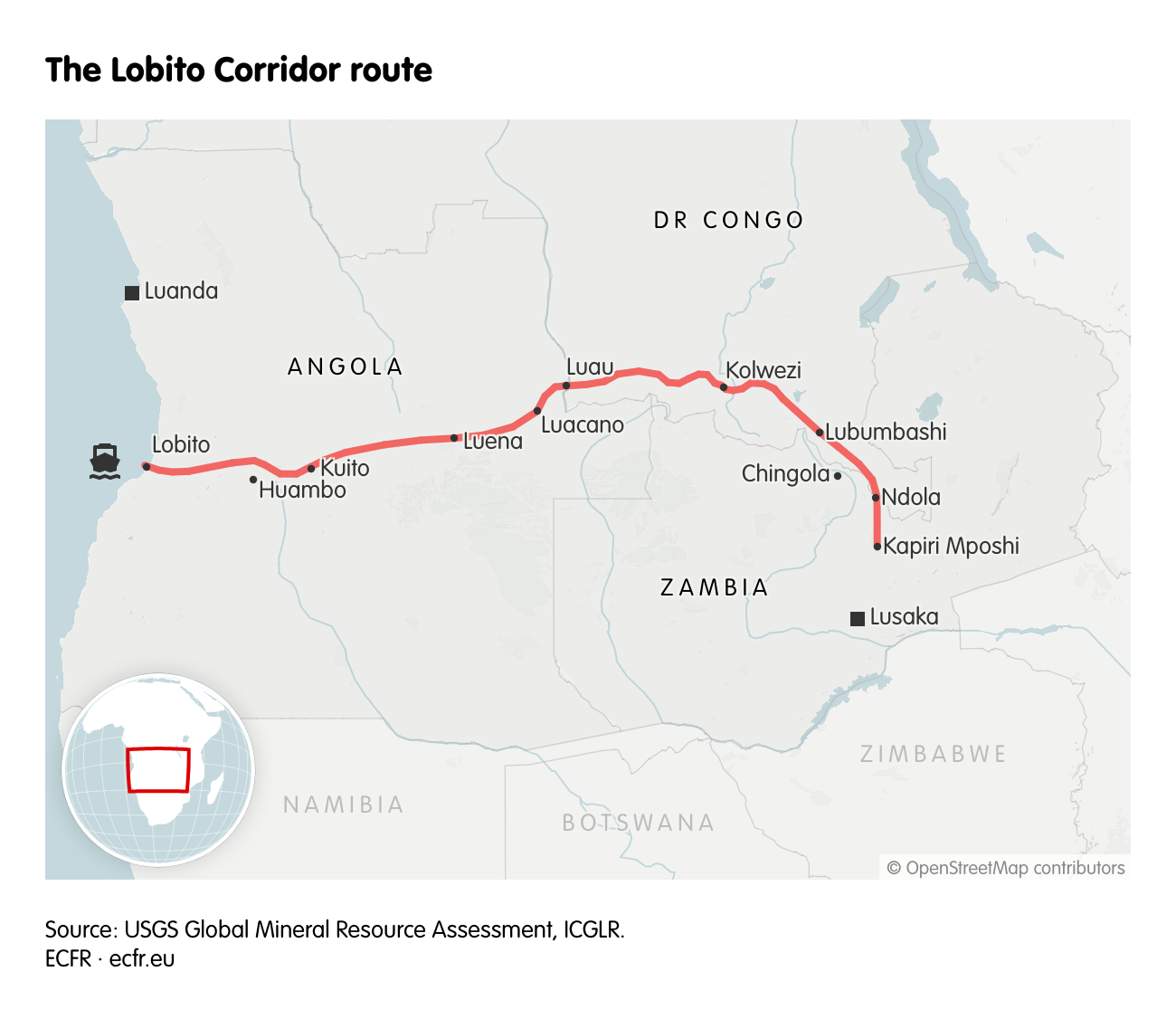
The US investments on offer also promise to reinforce Africa’s role as an upstream supplier of raw or semi-processed minerals rather than a site of industrial transformation. The Lobito Corridor illustrates this dynamic particularly clearly. Framed by Washington as a strategic alternative to Chinese-controlled logistics routes, the corridor channels US finance, technical assistance and political backing into a rail and port system linking the copper and cobalt heartland in the Democratic Republic of the Congo and Zambia to Angola’s Atlantic coast. For the US, the project strengthens supply chain resilience and geopolitical positioning. While this infrastructure offers improved market access, and the African countries involved may strengthen their diplomatic standing either as mineral producers or transit states, America is more focused on securing mineral access than supporting Africa’s domestic transformation.
The US withdrawal from climate goals and global climate governance has widened the space for Washington to renew engagement with African oil and gas producers. This is particularly as it searches for more oil and gas markets to power an explosion of data centres to preserve its technological supremacy, including as the world’s AI superpower. ExxonMobil recently signed a memorandum of understanding with Gabon to undertake offshore oil exploration, potentially providing an important boost to Gabonese efforts to revive the oil sector.
What this means for Europe
Compared with Europe’s normative and regulatory-focused approach, today’s US offer is more selective, less predictable and more tightly linked to American domestic political and industrial objectives. While it will unlock more commercial investments in African countries, “America first” industrial policies overwhelmingly reward production inside the US rather than industrialisation abroad. This reduces the developmental upside for African partners and limits Washington’s appeal as a long-term transformation partner. In this context, Europe has an opportunity to differentiate itself by offering deeper, longer-term cooperation models that give greater recognition of African needs and interests, as well as upstream support that can enable transformative and structural change.
China
China has played an outsized role in Africa’s energy sector, building power generation plants, making solar panels and grid equipment affordable and accessible, and demonstrating an ability to deliver large-scale infrastructure projects with minimal bureaucracy.[24] For example, in Angola, Chinese loans totalled over $49bn between 2000-2024 (making up over 27% of total Chinese lending to Africa), which financed roads, railways, dams and power lines that enabled post-war reconstruction. Similarly, Kenya’s flagship Standard Gauge Railway (SGR) from Mombasa to Naivasha was funded by Chinese loans. In South Africa, Chinese firms have provided generation equipment and some transmission infrastructure, either as suppliers or original equipment manufacturers. Through these and other projects, China has demonstrated a willingness to finance transformative infrastructure projects that can enable broader development by improving connectivity and access to markets.
Critically, China’s provision of affordable solar panels and grid equipment has made renewable energy accessible to African countries at scales previously impossible. This technological availability—combined with willingness to finance deployment—has enabled countries to add solar capacity far more cheaply than Western technology would allow. And, in addition to boosting access to renewable energy technologies, China is also the largest purchaser of oil and gas from many African producers, buying around 72% of Angola’s oil exports and almost 75% of Gabon’s oil and gas, creating key trade and economic dependencies on China.
Beijing’s approach to using all and any sources available to expand energy access welcomes investment opportunities across fossil fuels, solar, wind, nuclear and hydrogen, validating the dual-track approaches many African governments pursue. This stance is appreciated by African governments under pressure to expand energy access, create jobs and demonstrate progress to their populations. Referring to Chinese investments in Africa, Anna Thandi Moraka, South Africa’s deputy minister of international relations and cooperation said: “These are not abstract pledges, but strategic instruments which, if well aligned with Africa’s priorities under Agenda 2063, can accelerate our technological leap, close the infrastructure gap on the continent, and reposition the continent as a global hub of innovation.” Surveys show that many Africans judge Chinese influence more positively than that of the US or Europe.
China’s openness to investing in any energy source is also sometimes used by African countries to push against constraints presented by Europe. For example, South Africa leveraged China’s interest in nuclear—a sector Europe is sceptical of financing but which South Africa views as essential for baseload capacity and industrial competitiveness—to sign a memorandum of understanding with China National Nuclear Corporation. The agreement outlined a collaboration on small modular reactors and maintained an open procurement policy—including potential partnerships with Russia or Iran—to clearly signal that South Africa will not accept Western conditions that constrain technology choices.
China also has a growing number of mineral smelters and refineries in Africa, which indicates some willingness to support African industrialisation, not only resource extraction. While Chinese demand for African commodities—like oil, minerals and timber—remains substantial, Beijing is also increasingly financing processing facilities, manufacturing zones and infrastructure that enables value addition. However, this has mostly taken place where local processing has been mandated by host governments. For example, Chinese miners have indicated a readiness to establish manganese refining capacity in Gabon, in line with the government’s planned export ban on unprocessed manganese. For African governments, Chinese support for downstream development represents a qualitative difference from Western engagement patterns.
However, African governments are increasingly cautious about this relationship. China’s model comes with recognised trade-offs: financing terms can be opaque; collateralisation and loan conditions can heighten debt vulnerabilities; and environmental and social safeguards vary, with implementation dependent on individual contractors. For Angola, heavy debt burdens, weak local capacity and structural dependence prompted a recalibration of the relationship. Cooperation continues but on more selective terms.[25] As a result, the Angolan government is now seeking to balance Chinese infrastructure finance with diversified partnerships to avoid the concentration of dependency that characterised the reconstruction period. Angola’s approach reflects a broader African realisation that China’s willingness to finance at scale is invaluable, but must be managed strategically to preserve policy autonomy and avoid debt traps that constrain future choices.
Yet even as this recalibration takes place, Beijing has also demonstrated flexibility, pragmatism and a commitment to continued close ties with African countries. One key example is Chinese state entity creditors’ agreement to Nairobi’s recent request to convert Kenya’s remaining $3.5bn loan from SGR construction from dollars into yuan. This could potentially save Kenya around $215m on interest repayments. It also marks a key milestone in China’s endeavours to raise the renminbi’s usage internationally.
Beijing is also increasingly selective about what it chooses to finance in Africa and requires clear project bankability, partly as a result of tighter economic limits back home. This reflects a more circumspect posture after two decades of intense lending.[26] South Africa is a case in point. While South Africa engages China from a position of relative strength as an industrialised nation, Chinese state-owned enterprises remain cautious about direct financing and project development in South Africa’s complex regulatory and social environment.
Across these cases, African governments demonstrate sophisticated awareness of China’s role. China remains indispensable to Africa’s energy transitions, providing finance, technology and markets at scales others do not match. Yet African governments recognise that deep dependence on any single partner—even one as willing to finance development as China—creates vulnerabilities that constrain sovereignty. Angola’s recalibration, Kenya’s repositioning and South Africa’s use of Chinese engagement as leverage rather than primary partnership all reflect deliberate strategies to balance China’s advantages with conscious efforts to avoid new forms of dependency.
What this means for Europe
China’s model of engagement has reshaped Europe’s strategic position by raising African expectations about what meaningful partnership entails. Beijing’s willingness to finance integrated packages—combining extraction, infrastructure and local processing—reduces African governments’ tolerance for Europe’s more incremental and risk-averse approaches, and risks relegating Europe to a primarily regulatory or standards setting role. At the same time, African efforts to avoid excessive dependence on China limit Beijing’s leverage and preserve space for Europe as a strategic counterweight, albeit in more selective and sector-specific ways. This shifts Europe’s influence from agenda setting to being a provider of options, making its relevance increasingly contingent on its ability to pair norms and market access with tangible industrial and energy outcomes on the ground.
Arab Gulf states
The UAE and Saudi Arabia have rapidly emerged as some of Africa’s most flexible and politically agile partners in the energy sphere. They offer something Western actors increasingly withhold and China now provides less liberally: rapidly deployed capital for dual-track transitions that accommodate both hydrocarbon development and renewable energy expansion, as well as investment in mining. They use capital to build influence, targeting sectors that offer both economic returns and geopolitical payoffs: critical minerals, port terminals, digital and renewable infrastructure, midstream oil and gas and agrifood supply chains.
For African governments, Gulf actors present an appealing proposition: partners willing to provide liquidity, diversification and political optionality. But they also recognise the limitations: Gulf financing can be highly transactional, concentrated in elite-to-elite networks and narrow in its industrial benefits.
Gulf engagement offers mixed contributions in the electricity sector. Utility-scale renewable projects—such as Saudi investments of $2.76bn in South African renewable energy, or Emirati AMEA Power, Masdar and TAQA expansion across the continent—strengthen grid capacity, making more electricity available, particularly for urban areas and industrial zones, and potentially lowering costs through cheaper renewable generation. However, being commercially inclined, Gulf actors show limited interest in less profitable, last-mile infrastructure—such as distributed energy systems, mini-grids and rural electrification programmes—that extend electricity access to remote or low-income communities.
Gulf countries’ willingness to also help develop Africa’s hydrocarbon resources is of critical importance in easing the tension between development and climate action. To date, Gulf firms’ involvement has been primarily in midstream and downstream hydrocarbon sectors—refining, distribution and infrastructure—rather than in upstream exploration and production, although this may change in the future.
On industrialisation, Gulf countries have made commitments to invest in processing capacity in African countries, such as Emirati interest in manganese processing in Gabon. But little has yet materialised and there is cause to question whether they are genuinely committed to supporting value addition in Africa at a time when they are prioritising building out their own processing capabilities at home. Gulf states favour investments that create infrastructure and processing nodes that safeguard Gulf strategic interests in securing resource supplies, as well as export-orientated value chains that serve Gulf and Asian markets rather than African markets. Additionally, their existing investments in large-scale solar and logistics, such as the UAE’s backing of Angolan port modernisation, rely heavily on imported technology and expertise. This generates limited domestic industrial spillovers or technology transfer for African countries, restricting their ability to independently move up industrial value chains.
The bulk of Gulf funding, including from entities associated with the state, is generally directed to economically viable commercial projects. Yet both the UAE and Saudi Arabia have extended direct state support to some African countries too—for example, the UAE has given direct budget support to Kenya and both Gulf nations also provided fuel on credit to the Kenyan government in 2023 to help end fuel shortages. This support appears to come with fewer governance conditions than Western finance and less debt accumulation than Chinese loans, making it attractive for governments seeking to diversify funding sources. However, financing for areas that require grant or concessional funding, such as climate adaptation or biodiversity protection, is far less forthcoming from Gulf nations. As such, the Gulf presence does not necessarily enhance African leverage in securing concessional climate finance from traditional sources. However, it does reduce African dependence on that finance by providing alternative capital sources aligned with African “development first” approaches.
On diplomatic standing and climate negotiations, the Gulf states’ own dual-track approach to the energy transition—maintaining hydrocarbon revenues while investing in renewables and economic diversification—mirrors what many African governments seek: the ability to develop fossil fuel resources for fiscal stability and energy access while simultaneously diversifying. This shared position implies reciprocal validation in climate governance and shows that dual-track approaches are legitimate pathways pursued by multiple regions, rather than an issue of Africans resisting climate action.
What this means for Europe
Gulf nations’ openness to supporting both hydrocarbons and renewable energy development in Africa appeals to African countries looking to develop both sectors. It positions Gulf actors more favourably than Europe’s more limited clean energy offer. Additionally, the proliferation of large-scale renewable energy projects and new mining ventures undertaken by Gulf actors demonstrates greater ability to move commitments into action than European firms’ achievements so far.
Get used to African strategic hedging
African countries’ approach to the energy transition reflects a fundamental reassertion of agency within a global order designed by others and that often does not serve African interests. The transition is not primarily about ideological and climate-friendly emissions reduction—it is about expanding energy access, building industrial capacity, mobilising finance on better terms, consolidating sovereignty over resources and gaining diplomatic influence. African agency operates unevenly, but unmistakably.
Angola orchestrates a fragmented partnership ecosystem to avoid dependence on any single actor, leveraging hydrocarbon exports to Europe while building renewable energy and critical minerals processing capacity with diversified partners. South Africa uses its “too big to fail” status to push back against European conditionalities, exploring nuclear partnerships with China while extracting better terms from those wanting it to remain in the Western orbit. Kenya balances European development support with Gulf commercial agility and Chinese infrastructure financing, asserting its priorities in negotiations while maintaining multiple partnerships. And Gabon retains European interests in oil, gas and mining, as well as carbon markets, while leveraging more value addition from both European and Chinese mining and logging companies and courting engagement with the UAE.
This multi-partner pragmatism is not opportunism—it is statecraft. African governments learned from decades of dependency that reliance on any single external actor produces vulnerability. They now deliberately cultivate competing partnerships, using each to advance different objectives and leveraging competition to secure better terms. No external partner fully aligns with African priorities across all dimensions: Europe is self-contradictory on oil and gas; the US focuses narrowly on strategic minerals; China brings debt risks; and the Gulf prioritises commercial returns. African governments work with whoever delivers on their priorities, extracting value from each partnership while avoiding capture by any.
No doubt such structural hedging complicates Europe’s preferred model of stable long-term partnerships. Europeans cannot outspend China or outpace the Gulf. But they can strengthen their influence by adding where others cannot: institution-building, regulatory reform, concessional finance and industrial complementarity, as well as nurturing emerging sectors—such as biofuels and green hydrogen—that can integrate African production into European supply chains. Operating in this new world requires Europeans to accept African agency above all and learn to act more nimbly to draw together the right offer for the right context.
How Europeans should adapt their approach
For Europeans to support African countries to decarbonise their economies (in the ways that they have chosen) and remain strategically relevant on the world stage, European policymakers should take the following approaches when working with African counterparts.
Align with industrialisation, not just decarbonisation
African governments will not sacrifice energy access, job creation and industrialisation for climate targets—nor should they be expected to. Europeans should therefore accept dual-track transitions, supporting African industry through credible offtake agreements, and investing in enabling infrastructure. The EU’s CTIP with South Africa points in this direction. The bloc should replicate and deepen this approach with more African partners.
This realignment also means accepting longer energy transition timelines when rapid progress will cause political or economic harm and engaging realistically with the political economies of each African country, not with idealised models of policy reform. This is non-negotiable and requires Europe to accept African transitions will likely be longer than European models.
Leverage complementarity, not conditionality
Europe’s need to import processed minerals, battery precursors, biofuels and green hydrogen derivatives creates genuine Africa-Europe complementarity that China and Arab Gulf states cannot match. The former is more interested in retaining these products within its own value chains; the latter have no significant industries to absorb them. Europeans should capitalise on this now, by guaranteeing demand for African-processed products. This would support industrialisation that serves both African development and European supply chain diversification. Such a shift will help African countries move from being donor recipients to strategic economic partners.
Deploy capital more flexibly
European development finance institutions need greater power and flexibility to catalyse private capital. It is essential that they inject more concessional financing directly into companies undertaking projects of strategic importance to Europe (across critical minerals, biofuels, green hydrogen and renewable energy) and which are willing to serve European markets. They should make greater use of guarantees and offtake agreements and accept higher-risk profiles. Using grant funding strategically, combined with equity stakes—not just concessional loans—better aligns with African needs.
*
The stakes extend beyond Africa. How Europe engages with African energy transitions will demonstrate whether it can adapt to a multipolar world where multiple powers assert different priorities. If Europeans can support African industrialisation efforts and genuinely create opportunities for African states, businesses and communities that also feed into European supply chains, they will be able to maintain strategic relevance in the world and anchor partnerships that serve both continents’ interests. If Europeans remain rigid on the conditionalities they place on cooperation, slow to deploy capital and disconnected from African political realities, they will find themselves systematically outcompeted—not because they lack resources but because they failed to understand that the transition is about power as much as it is about carbon.
About the authors
Sarah Logan is a visiting fellow in the Africa programme at the European Council on Foreign Relations. Her main research interests are in energy and investment in Africa, with a focus on more fragile settings. She is an economist and lawyer with significant experience working with governments of countries experiencing fragility and conflict.
Maddalena Procopio is a senior policy fellow in the Africa programme at the European Council on Foreign Relations. Her main research interests are the geopolitics and international relations of the Africa region, in particular Africa-China and Africa-EU relations, emerging middle powers, Africa’s role in the global energy transition and eastern and southern Africa.
Acknowledgments
We would like to thank the European Climate Foundation for their generous support that allowed us to conduct extensive research. We are grateful to Adam Harrison, our editor, for helping us distil ideas and to Alex Vines, Africa programme director, for helping us challenge our assumptions. Above all, this paper owes its depth and insight to the many officials, diplomats, experts and thinkers across Europe, Africa and beyond who generously shared their time and ideas, making a significant contribution to this project.
[1] Interview with a representative of African Policy Research Institute (APRI), October 9th 2025.
[2] Interview with a representative of APRI, October 9th 2025.
[3] ECFR roundtable on energy and climate in Nairobi, Kenya, April 10th 2025.
[4] Interview with a representative of World Resources Institute (WRI), October 16th 2025.
[5] Interview with a representative of the University of Johannesburg (UJ), October 9th 2025.
[6] Interview with a representative of Climate Policy Initiative (CPI), October 10th 2025; Interview with IIED, November 25th 2025.
[7] Interview with a representative of IIED, November 25th 2025.
[8] Interview with a representative of IIED, November 25th 2025.
[9] Interview with African Conservation Development Group (ACDG), September 24th 2025.
[10] Interview with a representative of the Energy Council of South Africa, October 22nd 2025.
[11] Interview with a representative of the Energy Council of South Africa, 22nd October 2025.
[12] Africa Confidential, ‘Tanzania’s climate czar Richard Muyungi’, August 29th 2025.
[13] Interview with a representative of the China Global South Project, September 24th 2025.
[14] ECFR roundtable on energy and climate in Nairobi, Kenya, April 10th 2025.
[15] Interview with a representative of King’s College London (KCL), October 13th 2025.
[16] Interview with a representative of the Energy Council of South Africa, October 22nd 2025.
[17] Interview with a representative of CPI, October 10th 2025.
[18] Interview with a representative of CPI, October 10th 2025.
[19] Interview with a representative of CPI, October 10th 2025.
[20] Interviews with European diplomatic and private sector representatives based in Kenya or focusing on it, 2025.
[21] Interview with a representative of CPI, October 10th 2025.
[22] Interview with a representative of KCL, October 13th 2025.
[23] Interview with a representative of the Energy Council of South Africa, October 22nd 2025.
[24] Interview with a representative of KCL, October 13th 2025.
[25] Interview with an Angolan diplomatic official, November 12th 2025.
[26] Interview with representative of APRI, October 9th 2025.
The European Council on Foreign Relations does not take collective positions. ECFR publications only represent the views of their individual authors.