Flaunting mischief: Three aims of Russia’s airspace incursions
Russia’s recent incursions into NATO airspace are the biggest escalation with the alliance since the cold war. With it, Putin likely hopes to achieve three main goals

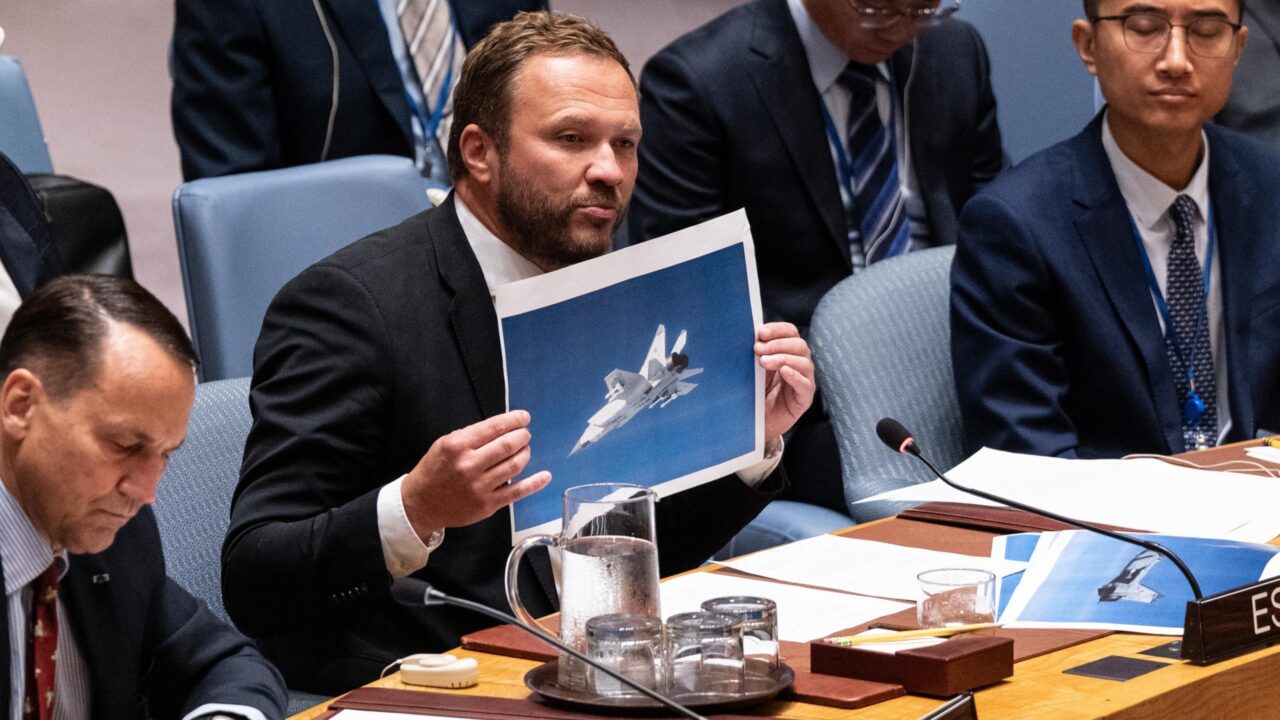
Emboldened after his meeting with US president Donald Trump in Alaska in August, Russian leader Vladimir Putin has intensified his grey-zone campaign against NATO’s European members. In just a few days, two dozen Russian drones entered Polish airspace, Russian fighter jets lingered in Estonian airspace and flew over a Polish drilling platform in the Baltic Sea, and suspected Russian drones caused flight suspensions at airports in Denmark and Norway.
NATO and the EU are now taking steps to bolster air defences along their eastern flank. Yet through these successive incursions, Putin has shown he is undeterred. After all, by flaunting mischief at low cost, Putin aims to leave Europeans—lacking resolute American backing—with only bad options.
Airspace intrusions and risky aerial manoeuvres are not a new phenomenon. They have long been a standard feature of peacetime military competition. In March 2023, to discourage Western intelligence aiding Ukraine’s defence, Russian fighter jets harassed and damaged an American reconnaissance drone in international airspace over the Black Sea, causing it to crash into the water. Since 2014 Russian fighter jets increasingly made unsafe close-range, low-altitude passes over NATO ships in the Baltic and Black Seas to discourage allied operations close to what the Kremlin claims as Russian territorial waters, including around Crimea.
In the post-cold war period, though, Russia’s post-Alaska airspace incursions are unprecedented in scope and intensity—with the downing of Russian drones over Poland marking a first in NATO’s 76-year history. In doing this, the Kremlin likely has three main goals.
- Sowing division
Trump’s initial reaction upon hearing of the Russian drones violating Polish airspace was that it “could have been a mistake.” Unsurprisingly, this drew sharp rebukes from Polish and other European leaders. NATO then held two consultations under Article IV and unanimously condemned Russia’s incursions into Poland and Estonia. Still, September’s events revealed allies’ diverging appetites for risk over the appropriate response. After all, engaging Russian aircraft, even if fully legal and legitimate, risks escalating a simmering crisis into a boiling conflict. Trump himself suggested that European allies should shoot down Russian intruders—but did not say whether he would have their backs. In this context, even the most vocal frontline leader might hesitate to force other NATO capitals to take a position on a more robust response, and maybe veto it. Failure to achieve consensus among the 32 NATO member states would hand a major victory to Putin and could pave the way for further corrosive actions to break the alliance for good.
- Gathering intelligence
Each airspace incursion puts NATO in a bind. If they intercept (and potentially engage) the intruders, they risk providing Russia with valuable insights about NATO’s reaction times and engagement procedures. If they ignore them, it risks inviting escalating Russian violations of allied airspace. Every bit of intelligence about the command-and-control arrangements of NATO Air Policing—the abilities of allied pilots and their aircraft, and the capabilities of ground-based air defence systems deployed in eastern-flank countries—gives Russian military planners a clearer picture of what NATO can bring to bear on them in a potential conflict and where weaknesses lie.
- Imposing costs and trade-offs
Air defence is a numbers game. During the night of September 9th to 10th, Dutch F-35 stealth fighters (costing €40,000 per hour to operate) likely used air-to-air missiles (which cost between €400,000 and €1.7m a piece) to shoot down Russian Geran drones (less than €50,000 per unit) to secure Poland’s airspace. Russia chooses the time and place of its incursions into NATO airspace, while the alliance must ensure the integrity of its airspace everywhere at all times. This structural imbalance means that NATO must spend more on defence than Russia does on offense. If Russian actions lead NATO to over-prioritise investments in air defence, it will leave them with fewer resources to spend on long-range weapons that can cause damage and deter Russia from escalating to war. Moreover, by exposing NATO’s air-defence gaps the Kremlin might hope to reduce Western leaders’ appetite for sending additional scarce air-defence assets and munitions to Ukraine or deploying European troops to back up a shaky ceasefire there.
With less (or no) American capability and capacity, the costs and trade-offs Europeans face are exacerbated
With less (or no) American capability and capacity, the costs and trade-offs Europeans face are exacerbated. And without US political leadership in NATO—which has often served to keep a lid on intra-European misalignments—Europeans will find it harder to coalesce around a common course to confront Russia.
European leaders’ first instinct was correct: to boost air defences along the eastern flank by deploying additional aircraft and ground-based systems. There are gaping holes in NATO’s integrated air and missile defence architecture, especially when it comes to defending against massed, low-cost drones. But they should not forget about the offensive capabilities that truly worry Putin and his military planners: long-range weapons that can strike at what they value most and hit back at Russia’s strategy of coercion.
This requires not only the right capabilities but also European leaders consistently demonstrating their tenacity to use them to impose costs and risks on Russia, even risking war, to sustain deterrence into the future. This is something European leaders have historically liked to leave to American presidents.
To take a page out of the cold-war competition playbook: they could conduct—riffing off NATO’s large-scale naval exercises of the 1980s—a combined exercise including British and French submarines, a Dutch frigate, and Australian and Japanese destroyers in the Western Pacific firing a large volley of cruise missiles at mock targets located at the same distance but in the opposite direction of Russian’s Pacific Fleet headquarters in Vladivostok, for example. This would send a powerful and unusual signal of capability, resolve, and multinational cooperation.
The European Council on Foreign Relations does not take collective positions. ECFR publications only represent the views of their individual authors.