The falcons and the secretary bird: Arab Gulf states in Sudan’s war

Summary
- Arab Gulf states have particular capacity to influence the outcome of Sudan’s conflict due to their wealth, financial ties to fighting groups and regional interests, which include securing access to Sudan’s agricultural, livestock and mineral resources.
- The states’ often conflicting pursuits in Sudan have fuelled the violence as they often back opposing sides to advance their goals.
- Saudi Arabia and the UAE view Islamists as a threat, while Qatar has backed these groups. Abu Dhabi and Riyadh oppose the prospect of participatory governance in Sudan.
- The UAE is the most influential external actor in Sudan, reportedly supplying weapons to the Rapid Support Forces while maintaining quiet ties with the Port Sudan government. Its relationship with these actors will be crucial in any peace process.
- Western countries have prioritised maintaining close relations with the Gulf in other regional matters—like Gaza, Iran and the Red Sea—over pressing these states for action and accountability on Sudan. Western reluctance to confront the UAE in particular has emboldened it further.
- Progress towards peace in Sudan will depend on Gulf cooperation. To support long-term stability in Sudan, European policymakers can benefit from a closer understanding of Gulf interests and engagement strategies.
A deeply geopolitical conflict
Sudan’s conflict, now into its third year, has wrought unprecedented devastation on the country and threatens even more instability in a critical region connecting the African and Arab worlds. While the country’s strategic value is vastly underestimated in popular and geopolitical discourse—press coverage frequently dismisses it as a “forgotten conflict”—Sudan rightly occupies the minds of policymakers working on the various regional contexts of which the country is a component, whether the Red Sea, the Sahel or the Horn of Africa.
Sudan’s strategic location, natural resources, vast arable land and importance for the trajectory of the region makes its conflict deeply geopolitical. It has drawn direct engagement from great powers like Russia and the United States, and from Sahelian and Horn actors such as Chad, Ethiopia and Libya. Yet, it is Arabian Gulf states—namely Qatar, Saudi Arabia and, significantly, the United Arab Emirates (UAE)—that have the greatest capacity to influence the conflict’s outcome.
For these young, wealthy monarchies—which import upwards of 80% of all the food they consume—securing access to Sudan’s agriculture, livestock and mineral resources is a virtually existential concern.[1] A successful civilian transition in Sudan could also serve as a powerful example to pro-democracy movements across Africa and the Arab world—an outcome the Arab Gulf states see as a direct threat to their own preference for autocratic methods of governance.
As a result, these states are key players in Sudan’s conflict, quietly backing opposing sides while pursuing their own national security goals and strategic advantages over one another. Given their deep pockets and extensive financial ties to the fighting groups, they have been central to the ebb and flow of violence.
Gulf states’ ability to cooperate seamlessly in some areas while remaining opposed on others is a fundamental component of their policymaking and has regularly confounded Western policymakers. The Gulf Cooperation Council (GCC), while an entity eponymously suggesting cooperation, has never acted with much unity. The main three member states—Qatar, Saudi Arabia and the UAE—often pursue their interests unilaterally. Even as they share key interests such as stability and secure shipping routes around the Arabian Peninsula, their inability to align on a common strategy is testament to their fundamental differences.
These Gulf states take a multipolar worldview, actively pursuing their national interests by building relationships across the spectrum of global and regional powers, avoiding fealty to any one bloc and managing often contradictory relationships across rival states. They see this approach as a logical response to the evolving global landscape—and, crucially, as a way to adapt to a partner in Washington they increasingly consider as unreliable. Yet, they also diverge in various ways, and this is especially evident in Sudan. Here, they compete over support for their preferred executors in government, the role of Islamism, control of Red Sea ports, and gold and agricultural exports.
The UAE is the most influential external actor in Sudan’s conflict, mirroring its adventurous and militarised approach in other regional engagements. A broad range of government officials, human rights groups, as well as multilateral and investigative press sources suggest that the UAE has supplied weapons to the paramilitary Rapid Support Forces (RSF) as part of its confrontation with the Sudan Armed Forces (SAF), though Abu Dhabi consistently denies these claims. Emirati support for the RSF appears partly driven by an interest in developing it as Abu Dhabi’s executor of its interests in Sudan. This support also seems influenced by the UAE’s animosity towards Islamist groups—with whom the SAF has a close and complex relationship—and by established links between RSF and Emirati leadership after collaboration on wars in Libya and Yemen. The RSF’s widespread abuses during the war have boosted domestic support for the SAF. The UAE also benefits handsomely from imports of Sudanese gold from both sides of the conflict.
In Saudi Arabia, crown prince Mohammed bin Salman’s primary focus is on delivering Vision 2030.[2] Because regional instability threatens these ambitions, Riyadh has been cautious about involving itself in regional conflicts, viewing such efforts as potentially expensive and risky. In strategic countries like Sudan, its main priority is to limit the spread of Iranian, Russian and Emirati influence and, like the UAE, to secure the supply of agricultural goods and livestock.[3]
Unlike Saudi Arabia and the UAE, Qatar is more receptive to the prospective return of Islamists to power, a pragmatic stance that has historically caused tensions within the GCC.[4] Its current interests in Sudan include trade in dairy, livestock and grain, but also reflect regional power calculations to counter the UAE and balance Saudi influence.
Ostensibly pressed by the recent reduction in Washington’s attention to Africa and the Middle East, European policymakers must be able to understand, and engage with, Gulf interests and their resulting policies if the Sudan crisis is to be sustainably resolved. This paper aims to illuminate the Gulf states’ worldviews and analyse their evolving engagement with Sudanese actors. It examines the commonalities and differences between these states’ approaches, paying particular attention to the UAE, and offers a set of recommendations for how Europeans can strategically engage with these actors to best support Sudan’s long-term stability.
Evolution of Gulf policy on Sudan
Gulf states’ interests in Sudan stretch back decades, marked by major investments in agriculture, energy and infrastructure. As a result, Sudan is arguably the most important country for these states in the Horn of Africa.
Omar al-Bashir, Sudan’s authoritarian ruler for 30 years, worked assiduously to balance relations with all three Gulf states—particularly following the heavy financial hit of South Sudan’s 2011 secession by referendum, taking with it 80% of Sudan’s crude oil production and its most profitable export. Simultaneously came the Arab Spring, prompting the Emirati and Saudi leadership to intensify their opposition against political Islam amid popular calls for more participatory governance in the region. This pitted the two countries against Qatar, which had developed relationships with Islamists close to Bashir (the former leader had come to power at the head of an Islamist junta). Echoing a dynamic that would come to shape the war over a decade later, Saudi Arabia and the UAE worked to strengthen their relationships with the Sudanese security services.
In the wake of the Arab Spring, these intra-Gulf differences have become more apparent. Emiratis and Saudis displayed zero tolerance for populist and Islamist politics in 2013, when the Egyptian army ousted Muslim Brotherhood president Mohammed Morsi—Egypt’s first democratically elected president—just a year after his watershed election. Over the following 18 months, Abu Dhabi and Riyadh provided massive financial backing to the new military government. In Sudan, Islamist influence runs deeper than in Egypt, extending into the security services, government institutions and the ruling National Congress Party (NCP). Increased hostility towards Islamists after the Arab Spring put Bashir in a difficult position between the two opposing blocs of his powerful regional benefactors. In 2015, he was forced to make a choice, turning towards Saudi Arabia and the UAE—formalised when he supplied 14,000 RSF and SAF troops to support the Saudi- and UAE-led war in Yemen—and away from Iran (whose diplomats he was obliged to expel), Qatar and Turkey.
This recalibration meant Bashir was able to keep his government afloat with continued funding from the Emiratis (and to a lesser extent the Saudis). With the onset of the 2017 Gulf diplomatic crisis—when Saudi Arabia, the UAE, Bahrain and Egypt severed relations with Qatar over its support for Islamist groups—Bashir was pressured by Islamists around him to maintain his Qatari connections, exemplified in March 2018 by a $4bn agreement with Doha to develop the old port of Suakin on the Red Sea. Bashir sought to avoid alienating either side of the fraught GCC split: this balancing act is a strategy now familiar to SAF’s leader General Abdel Fattah al-Burhan, who leads a government claiming legitimacy from the Red Sea city of Port Sudan.
Despite the external support, Sudan’s economy collapsed in 2018 under the weight of massive subsidies provided for key commodities. By October, the country was spiralling into economic crisis: bread, fuel and hard currency were increasingly scarce. For the first time, the Gulf states decided not to bail out Bashir and in December, the UAE halted fuel supplies to Sudan. They were angered at Bashir’s refusal to sideline Islamists, and to support Saudi Arabia and the Emirates in their feud with Qatar.
Massive country-wide street protests brought Bashir’s April 2019 ousting, with the autocrat ultimately removed jointly by the RSF and the SAF. Once again, Saudi Arabia and the UAE made clear their governance preferences, reprising their actions after the coup against Morsi in Egypt. They immediately promised some $3bn to the Transitional Military Council (TMC), which took over after Bashir’s fall, to stabilise Sudan’s economy. When street protests swelled anew across the country to demand a civilian government and reject the security forces’ ascent—and the UAE’s role in engineering it—the military and their regional backers acquiesced to the appointment of a hybrid, civilian-led transitional government in August 2019. As soon as this civilian government took office, the Emiratis and the Saudis halted further disbursement of the $3bn, critically undermining the popularly supported but desperately poor transitional government.
Instead of supporting Sudan’s civilian-led transition, which aimed to hold democratic elections after a little over three years, Abu Dhabi and Riyadh developed strong ties with Burhan and RSF leader Muhammad Hamdan Dagalo, better known as Hemedti, offering them extensive support. The fate of the transitional government would likely have been dramatically different had the Gulf backed them with the billions they had pledged to the military, which already dominated the most lucrative sectors of the economy, remitting little of this wealth back to the state. When Sudan’s transitional government was overthrown by the RSF and the SAF in 2021, Egypt, Saudi Arabia and the UAE refused to condemn the coup, calling instead for restraint and de-escalation. In the 18 months between the coup and the outbreak of war in April 2023, both Burhan and Hemedti were frequent visitors to Saudi Arabia and the UAE. Nonetheless, the Sudanese people’s phenomenal show of power, forcing the men with guns and their wealthy benefactors to accept a civilian-led transition, represented a clear setback for Abu Dhabi and Riyadh, which have shown their distaste for democratic governance in the region.
Since the lifting of the blockade on Qatar in 2021, Riyadh—as the peninsula’s hegemon—has sought to broker greater trust and cohesion across the GCC. However, mistrust remains in particular between Doha and Abu Dhabi.[5] For Gulf states, the war in Sudan is about power, competition and ideology, said a Western diplomat in Abu Dhabi. “If it was just about trade and economy, the main thing would be to stop the war”.[6]
Wartime engagement
State of battlefield play
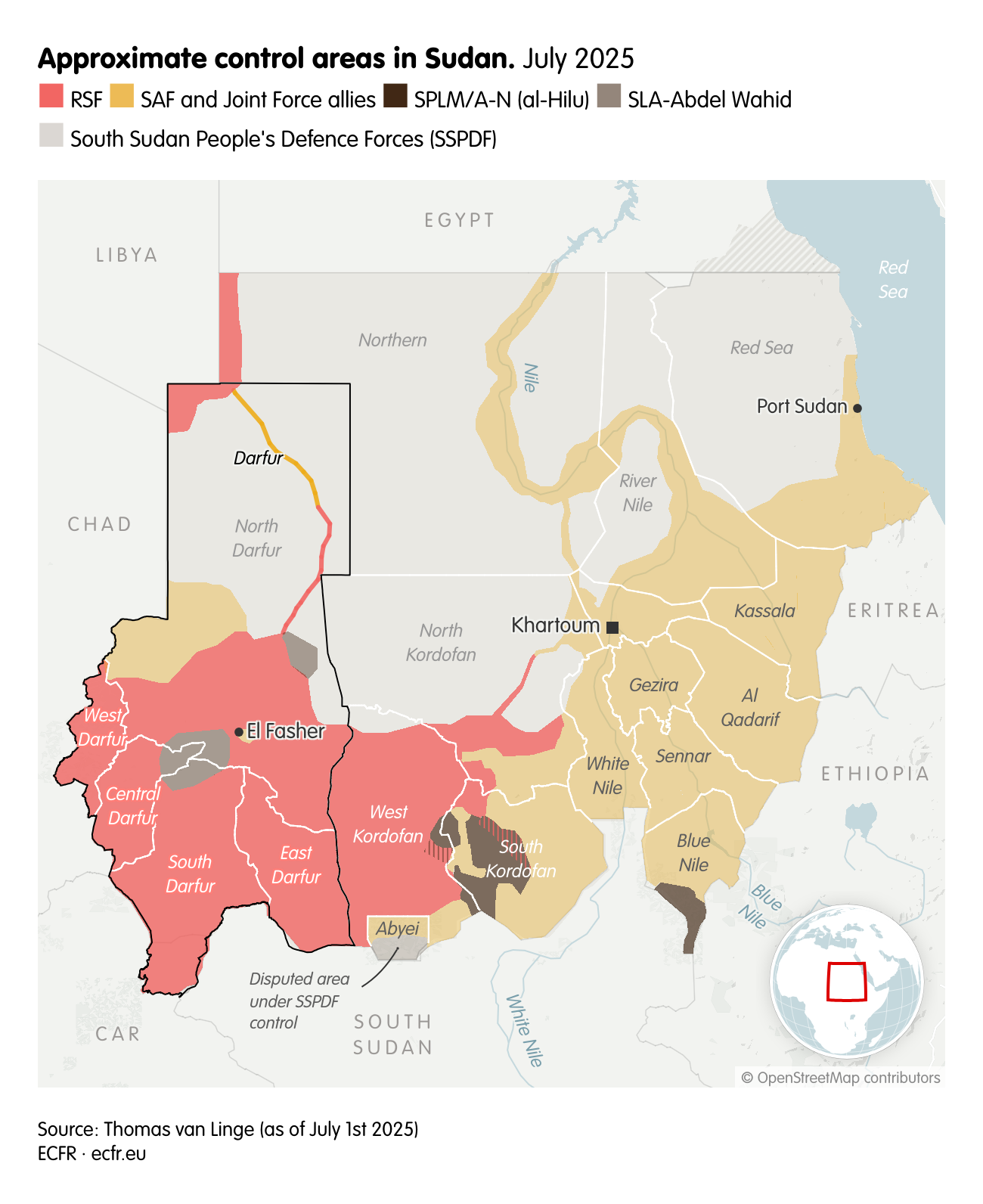
Sudan’s conflict broke out in April 2023, pitting the SAF—along with its allies, the NCP and a range of Islamist groups—against the paramilitary RSF. In the conflict’s first 18 months, the RSF swept through much of the country, capturing the capital Khartoum and key areas in Sudan’s agricultural and economic heartland as the army repeatedly capitulated.
Since late 2024, however, the SAF has retaken the capital and vital regions. It has been boosted by new Iranian and Russian weaponry, and by recruitment fuelled by fear and anger in northern, eastern and central Nile Valley regions over the RSF’s trail of egregious abuses. The recent introduction on both sides of increasingly sophisticated and long-range drone technology, as well as countermeasures such as jammers, has changed the conflict’s dynamics. They have allowed the RSF to strike key sites in Port Sudan, in the country’s far north-east, to where the military and de facto government retreated after being driven from the capital.
In March 2025, the SAF and its allies recaptured the symbolic but heavily damaged Presidential Palace close to the confluence of the Blue and White Nile rivers in Khartoum.
After a poor showing in the first year-and-a-half of war, the SAF is newly confident now that it has regained control of the country’s putative symbol of sovereignty.[7] While some diplomats privately wondered if the SAF’s recapture of Khartoum signalled the end of the conflict,[8] the RSF has since shown new determination, reach and technical capacity, declaring a revised set of objectives to capture western, southern and south-eastern Sudan.
The RSF retreated southwards from Khartoum and then westwards into its traditional base of Darfur, as well as into Kordofan and Blue Nile states. In February, in Nairobi, it struck a fragile but important accord with the Sudan People’s Liberation Movement/Army-North (SPLM/A-N) of Abdel Aziz al-Hilu, a powerful fighting force with a long-held political vision that had to date remained neutral in the conflict. To serve as a counterweight to the Port Sudan government, the RSF has also joined the newly-formed Sudan Founding Alliance, also known as Tassees—a coalition of various Darfur armed groups, community forces and a faction of the National Umma Party, in addition to the SPLM/A-N of al-Hilu. Tassees was rejected by a broad swathe of key international actors including Egypt, the European Union, Qatar, Saudi Arabia, the United Nations (UN) and the US. This surprised the RSF and its external backers, who had anticipated greater receptiveness to this alternative government.[9] The proliferation of areas of control by different armed actors and the ongoing disinterest in a negotiated outcome to the conflict highlights the prospect of a divided country.
The SAF’s retaking of the capital and other areas in the Nile Valley prompted increasingly public and material overtures from Cairo and Riyadh to help consolidate the authority and legitimacy of both the SAF and the Port Sudan government. At the same time, Egypt and Saudi Arabia are also raising questions about how Burhan plans to minimise the future role and power of Islamist groups, which have been integral to the SAF’s military successes.[10] The RSF’s ejection from Khartoum also appeared to catalyse Emirati outreach to the African Union (AU), presumably aimed at reanimating an African-led peace process to slow SAF’s battlefield ascendancy. At the same time, Saudi Arabia upped its overt engagement with Port Sudan, and with Chad’s transitional president Mahamat Idris “Kaka” Deby, with whom the UAE struck a deal to support the RSF, seemingly seeking to press home the advantage.
Momentum and frontlines in the conflict continue to be highly dynamic, with Gulf states and other external actors both driving and responding to these shifts. This approach to the conflict shows that most external efforts on Sudan are focused on delivering a military victory, although this outcome remains unlikely. The regional and geopolitical ambitions and security of many states and non-state groups are intertwined with the outcome of the Sudanese conflict. Even the mooted and feared partition of the country would hinge on the military balance, likely further incentivising all sides to fight rather than to seek a negotiated solution.
Gulf states’ responses to the war
Qatar
While Qatar appears to have recently reduced its attention on Sudan, multiple regional experts allege that Doha has funded the provision of weaponry to the SAF while also attempting to avoid provoking new tensions with its peninsula-mates.[11] Doha has led on humanitarian efforts, facilitating key cross-border access for aid in Darfur and exploring taking up a mediation role on Sudan—even as it is seen by Sudanese actors as a staunch supporter of the Port Sudan government due to its historical support of Islamist groups.[12] Unlike Riyadh and Abu Dhabi, Doha is viewed by diplomats and analysts as supportive or at least highly receptive to the ascent of Islamists that have generally (but not universally) associated themselves with the SAF.
This difference of opinion about the role of political Islam in the region was at the heart of the 2017-2021 GCC crisis and resulting blockade of Qatar. Riyadh and Abu Dhabi sought to press Doha to cease its support for Islamist groups in the region and its promotion of more participatory governance in Africa and in the Arab world, and to reduce engagement with Iran. Doha’s willingness to back Islamists in Sudan and elsewhere continues to fuel division and mistrust with Riyadh and Abu Dhabi, but is now more careful to avoid these differences lest they trigger another open and punitive GCC split.
Current Qatari interests in Sudan revolve around securing the supply of dairy, livestock and grain stocks; it is also important for Doha to maintain influence there to counterbalance Abu Dhabi and Riyadh.[13] Those interests remain, but Doha is now simply much more cautious about perceptions of its power projection, preferring to act as negotiator and convenor of last resort in various conflicts, including Afghanistan and Gaza.[14]
Saudi Arabia
Mohammed bin Salman is focused on delivering his ambitious Vision 2030 and the 2034 World Cup, and the diversification of the country’s economy away from hydrocarbons—but regional instability threatens Saudi megaprojects on the Red Sea and its prestige as regional hegemon. According to an African diplomat, while accommodation with Iran and the Houthis is key, Saudi Arabia also needs Sudan for Vision 2030, noting the country’s proximity, its agricultural and livestock exports to the kingdom, and the importance of maintaining a working relationship with a key Red Sea neighbour.[15] Bin Salman is unlikely to expend notable diplomatic or material resources to solve regional conflicts given the risk of entanglement, a view the Saudi government takes also on Lebanon, Syria and Yemen.[16] Power projection is a costly undertaking, as Riyadh seems to understand and as the UAE is discovering through its own entanglements in Ethiopia, Libya, Somalia, Sudan and Yemen. Abu Dhabi’s awareness of Riyadh’s cautious stance may be driving the UAE’s own increasingly adventurous engagement and sense of impunity on Sudan and other contested files.[17]
As such, Saudi Arabia has sought to adopt a middle-ground stance by outwardly retaining an even distance from both sides of the conflict, even as experts and analysts agree that Riyadh strongly favours the institutional continuity provided by SAF and the Port Sudan government.[18] Like Doha—and off the back of a UN designation by its Office of Legal Affairs of Burhan’s status as head of state—Riyadh would likely argue that the Port Sudan administration is the sovereign government in Sudan and therefore entitled to purchase and acquire weaponry on international markets. Current UN sanctions mean weaponry is not permitted to be transferred into the country’s western region of Darfur, which would impact RSF’s weapons acquisitions in particular, but also transfers going to the SAF and its Darfuri allies.
Saudi Arabia has been a key player in the most prominent attempt to resolve the conflict, convening jointly with the US in two rounds of talks in the Saudi port city of Jeddah. A greater priority for Riyadh, however, is limiting the influence of UAE and Iran in this strategic location.[19] As a matter of national security, Riyadh cannot afford to be flanked on both the east and west by its closest rivals.
The United Arab Emirates
The UAE is arguably the most consequential external actor in Sudan’s conflict, reprising its characteristic approach of bold and adventurous policy observable in its recent engagements in Ethiopia, Libya, Syria and Yemen.
Western lawmakers and diplomats, as well as African and Arab diplomats, UN investigators, human rights groups and media investigations assert that the UAE has likely provided weaponry to the RSF throughout the conflict through hubs in Chad, Kenya, Libya, the autonomous region of Puntland in northern Somalia, South Sudan and Uganda.[20] In December 2024, Colombian president Gustavo Preto said that hundreds of his country’s citizens had been duped into fighting in Sudan by a UAE-based private security company. Toward the end of the Biden administration, US officials confronted the Emiratis with intelligence evidence of this support, but were rebuffed and made no further effort to take the UAE to task. Referring to the RSF, US secretary of state Marco Rubio stated in his January confirmation hearing that the UAE has been “openly supporting an entity that is carrying out genocide”.
The UAE has consistently denied these claims, both publicly and in private discussions.[21] In April and May 2025, Abu Dhabi’s ambassador to Washington was reported to have spearheaded a coordinated lobbying effort against members of the US House of Representatives critical of the UAE’s Sudan policy.[22] Dozens of African, Arab, European and American diplomats, lawmakers, investigators, analysts and academics consulted during the course of the war have expressed incredulity at Abu Dhabi’s continued denial of its links to the RSF, a stance that diplomats say has increasingly undermined Emirati credibility in other areas.[23]
The West has been reluctant to openly challenge the UAE on its denials, given the American, British and European need for UAE cooperation on files such as Gaza, Iran and Russia, as well as a broader suite of economic, defence and technical cooperation alliances. A December 18th 2024 letter from former US president Joe Biden’s top Middle East and North Africa official, Brett McGurk, to senator Chris Van Hollen implied strongly that the Biden administration knew military support was flowing from the UAE to the RSF, but assured the senators that this activity would end.[24]
A key component of Emirati interest in Sudan is to add ports and logistics hubs to its network of strategic facilities along the Red Sea and Indian Ocean coasts. This infrastructure serves both commercial and geostrategic ambitions, such as controlling sea lanes and projecting influence. For years, ports along the Sudanese coast have been prized by various actors, with agreements for development of coastal infrastructure signed with Malaysia, Qatar, Russia, Turkey and the UAE—none of which have come to fruition. Abu Dhabi inked a $6bn multifunctional deal with the Sudanese government in 2022 to develop the Abu Hamad agricultural and economic zone in the country’s north, as well as a new Red Sea port, Abu Amama, which would be constructed and operated by Abu Dhabi Ports Group. In November 2024, Sudanese finance minister Jibril Ibrahim cancelled the agreement, citing Emirati support for the RSF.
The UAE benefits handsomely from Sudan’s wartime gold exports, which have surged since the onset of conflict as both sides step up mining to fund their war efforts. The RSF predictably sells most of its gold to Dubai but, notably, gold from SAF-controlled areas is also almost entirely sold to Dubai. The Central Bank of Sudan reported that in 2024 almost 97% of official gold exports from SAF-held areas went to the UAE, generating $1.52bn—almost half of Sudan’s total on-paper export earnings that year.
This reflects a broader trend of quiet but ongoing financial cooperation between the government in Port Sudan and the UAE. Notably, the Bank of Khartoum, on which the Port Sudan authorities rely for its export and import activities, and which hosts the most popular mobile money app in Sudan, Bankak, is partly owned by the Dubai Islamic Bank. Despite having the means to do so, the UAE has not chosen to visibly restrict Port Sudan’s financial operations. Additionally, according to the Ministry of Finance in Port Sudan itself, in spite of the war often being framed as being between Port Sudan and Abu Dhabi, the UAE remained the largest export market for Sudanese products overall in 2024. The UAE also supplied a fifth of all of Sudan’s total imports last year. These apparent contradictions offer some hope for engagement between the SAF and the UAE. However, the SAF has declined recent overtures, likely due to its ongoing battlefield momentum and opposition from Islamists and other key groups around Burhan which remain threatened by the UAE.
Consequences of Emirati engagement
A key point of blowback to alleged Emirati support for the RSF is the increase in popular support for the SAF and Islamist fighting groups, whom many in recaptured areas see as saviours following the extreme destruction, looting and sexual violence inflicted by the RSF during the first year-and-a-half of war. “What the UAE has done for [the] Islamists is great for them,” said one Sudanese civil society figure from Gezira, one of the states worst affected by RSF occupation, adding that many Sudanese are ready to countenance any protection at all from RSF depredations.[25] Aware of the previous regime’s record of systematic violence against large sections of the country, divisive governance, and economic disasters, civic actors consulted in eastern and central areas of the country have been at pains to stress that this embrace of the SAF as protectors should not be equated with any longer-term support for the army or the Port Sudan government.[26] Populations are also aware that the SAF and its allies have committed similar depredations during the war, adding to their exhaustion with armed actors forcefully controlling their lives and economies.
Even among the significant swathes of the population that view the RSF as the lesser of two evils—repelling Islamists, the NCP and the old-guard elite—the UAE is seen as a malign actor fuelling the conflict and destroying the country.[27] Outside Sudan, one senior African diplomat described the UAE as “merchants of chaos” in Sudan and the Horn of Africa.[28] In contrast, the less prominent roles of Qatar and Saudi Arabia—and perhaps their support for an institutionalised, de-facto government through the SAF and the Port Sudan government—have resulted in less public vitriol toward Doha and Riyadh.
The RSF’s rise to represent a viable alternative power centre in Sudan was enabled by a curious collection of actors, including Abu Dhabi and Riyadh. Bashir and his security forces were integral to bringing Hemedti to a position of economic and military strength as they sought to maintain control over the country in the final decade of Bashir’s rule by developing a counterweight to SAF. European support through its costly and controversial Khartoum Process, aimed at curtailing immigration to Europe via Sudan, was also integral to Hemedti’s rise. Had Saudi Arabia and the UAE not supported the RSF in the years before the war, the current conflict likely would not have occurred—at least not on the scale it has. At the same time, the RSF has represented a counterweight to an old-guard elite, including Islamists and the army, which mismanaged and divided the country since independence in 1956, presiding over millions of deaths in an essentially unbroken string of domestic conflicts.
Burhan in the Gulf states’ tug of war
While Gulf states are uniquely placed to press armed actors in Sudan to reduce or end the fighting, the success of any accord would depend largely on the internal calculations of the armed actors themselves. For many of those involved in the conflict, however, the war has provided opportunities for vast enrichment, allowing them to maintain influence and power which they might lose in the course of a peace process—including to direct rivals or to a more participatory system of government.
This is especially true for General Burhan. Because the sidelining of Islamists remains a central goal for the Saudis, Emiratis and Egyptians (and is opposed by Iran, Qatar and Turkey), a pivotal question is whether he will, or can, distance himself from Islamists fighting within and alongside the SAF.
Indeed, the relationship most in need of repair to reduce violence is between the Port Sudan government and the UAE. In December 2024, Turkey offered to negotiate on the Sudanese conflict, pointedly (and not unreasonably) noting that the party that needed to be brought to the table to sit across from the Port Sudan government and SAF was the UAE, not the RSF. In May 2025, the SAF declined to attend a parley with the UAE in the Egyptian port city of Sharm el-Shiekh, set up by Cairo, citing Abu Dhabi’s unreasonably high-handed preconditions dictated to the army.
As ongoing financial links illustrate, this relationship is not as broken as the public statements from the Sudanese Ministry of Foreign Affairs and some key senior figures in the SAF would suggest. Notably, it has not been Burhan, but rather other senior SAF figures such as Yasser al-Atta who have been stridently critical of the UAE’s backing of the RSF. Emirati officials acknowledge that Burhan finds himself in a difficult position leading the army and government while also dependent on various Islamist militias to remain competitive in the conflict.[29] Along with Egypt, the UAE has pressured him to reduce this reliance. However, accusations of Emirati support for the RSF have enabled Burhan to mobilise a broader domestic constituency by framing the war as one against Sudan’s external enemies, gathering a political bounce as chair of the Sovereignty Council amid Port Sudan’s struggles with legitimacy. It is uncertain how long Burhan can maintain this unsustainable balance between Islamists and anti-Islamist Arab states that ultimately unseated Bashir.
Alienating Egypt, Iran, Qatar, the Saudis or Turkey could jeopardise the SAF’s battlefield gains, especially given the relationship of Ankara, Doha and Tehran with its Islamists allies. Burhan will also understand the current and future financial imperative of not burning bridges with Abu Dhabi entirely. And even if he were to distance the SAF from the Islamists (who hold key positions throughout the army), he could not simply embrace the UAE without near-certain Saudi and Qatari disapproval.
Indeed, as SAF conquers more territory on the battlefield, public engagement with Riyadh has increased, driven by Saudi efforts to limit Emirati influence in Sudan. This has been publicly highlighted in extensive coverage on the kingdom’s Al Arabiya channel portraying Emirati involvement as central to the bloody violence.[30]
Cursory examination of such equations reveals the zero-sum approaches that Gulf states force on Sudanese actors. The implied insistence from Abu Dhabi, Doha and Riyadh on “choosing a partner” is particularly hypocritical given the Gulf’s—particularly the UAE—own “zero-problem policy”, characterised by avoiding confrontation within multi-layered alliances. It illustrates too the vast imbalance in power between Sudan and Gulf states.
Policies for peace
The Gulf has engaged in multiple peace initiatives on Sudan. These include the Saudi-US Jeddah process initiated in the first weeks of the war; a Swiss-American gathering on Lake Geneva in August 2024; the London conference in April 2025; and the Manama dialogues convening the Arab and American security services in January 2024 (perhaps the most meaningful known initiative to date given the heavy securitisation of the Sudan file in Arab states).
Due to the extreme centralisation of Emirati, Qatari and Saudi foreign and security policy, these efforts have taken place at levels far too low to generate meaningful joint action. Below the apex policymakers in Abu Dhabi and Riyadh, it is the intelligence services, with their superior access to ground-level information, that oversee Sudan policy.[31] In both Riyadh and Abu Dhabi, the Ministry of Foreign Affairs can make recommendations, but ultimately foreign policy decisions are heavily securitised and centralised with bin Salman and UAE’s president Mohammed bin Zayed respectively.[32]
Even as Saudi Arabia is viewed by diplomats and analysts as slower to formulate and execute policy—with more at stake given its size, population and economy—Riyadh “shows no longer term vision for the region”, bemoaned one Western diplomat.[33] By contrast, the UAE is famously nimble and audacious in its policymaking, even as President Mohammed bin Zayed and his trusted inner circle do not necessarily appear to have an overarching strategic plan, according to experts interviewed for this paper.[34] Instead, this very small group makes policy that is tactical and reactive, often leading to overcorrection and missed opportunities.
Competing interests
Food security
In the aftermath of the covid-19 pandemic, the UAE overtly shifted the focus of its foreign policy to an “economy-first” strategy, prioritising diversification away from hydrocarbons in anticipation of a post-carbon global economy. The same push is also notable in Saudi Arabia, which has been in many ways more successful in this pursuit, aided by its size and population. Both Gulf nations have pursued diversification while seeking to shore up food security in countries such as Sudan, which boasts vast arable land and livestock herds. This in turn has created competition between Riyadh and Abu Dhabi. Sudan has been the focal point of the UAE’s agricultural interest in East Africa, attracting some $10.2bn in Emirati investment in the sector, around 10 times the estimated amount coming from Saudi Arabia.
The UAE imports about 90% of its food and has aggressively pursued agricultural lands abroad in response to crises like the 2007-2008 global food price spike, the covid-19 pandemic, and the Russian invasion of Ukraine. These pursuits are driven in part by private firms often linked to ruling families, notably the Al-Nahyans of Abu Dhabi and the Al-Maktoums of Dubai. Other investors are companies owned by sovereign wealth funds such as ADQ, Mubadala and International Holding Company (IHC). IHC, chaired by Sheikh Tahnoon Bin Zayed, a brother of the UAE’s president, is Abu Dhabi’s largest publicly listed company. Bin Zayed also chairs ADQ and the Abu Dhabi Investment Authority, while owning Royal Group, a prominent private investment firm.
Emirati and Saudi discomfort with Iran in Sudan
Iran has long been viewed by Saudi Arabia and the UAE as the primary threat to their peace and security. While this concern may have receded slightly in light of recent Israeli success in defanging Hamas and Hizbullah, and Israel’s more recent strikes on Iran itself in June, Arab Gulf states remain cautious. Following these attacks, Tehran responded with calibrated military strikes on a US military base in Qatar, highlighting how the Arab Gulf could be caught in the crossfire of escalating regional conflict with Iran. Moreover, after the Houthi’s 2019 attacks on UAE shipping in Fujera and assaults on Saudi oil facilities and Abha airport, both Riyadh and Abu Dhabi were shocked when Washington declined to respond strongly, and concluded that US president Donald Trump would not have their back if they faced widening conflict with Tehran.[35]
The resulting sense of vulnerability prompted both states to seek improved relations with Tehran. While these efforts reduced immediate tensions, Tehran told Abu Dhabi and Riyadh that, if the two countries were ever used to facilitate attacks against it by Israel or the US, it would strike the two Gulf capitals, and their oil and gas facilities.[36] In March, Iran deployed new missile systems to Greater Tunb, Lesser Tunb and Abu Musa islands near the Strait of Hormuz, suggesting they were ready to strike at Saudi Arabia and the UAE in the case of an Israeli attack.[37]
While Iran did not fire at Saudi Arabia or the UAE in response to Israeli and US attacks against it in June, its limited retaliation against US facilities in Qatar was a stark reminder of the Arab Gulf’s vulnerabilities. For its part, the SAF is likely to see the American and Israeli attacks on Iran as a signal that partnership with Iran is antagonising for Saudi Arabia, the UAE and the US. But Israeli and American strikes on Iran are unlikely to materially adjust Tehran’s stance regarding Sudan; there is no suggestion that the SAF will be unable to continue to acquire Iranian weaponry.
The SAF’s recent battlefield successes, after 18 months of retreat, have in large part been the result of Iranian support, particularly the acquisition of Mohajer-6 drones. These, like the Turkish Bayraktar TB2s, have starkly shifted the momentum of the conflict.[38] The RSF has also begun to deploy its own new generation of longer-distance drones, with success—though more recent provision, allegedly by Iran and Russia, of higher tech jamming equipment and countermeasures has begun to mitigate the effects of these drones.[39] This support had afforded Tehran a new opportunity to secure a lasting foothold in Sudan, including the potential development of a Red Sea naval base.
However, the SAF may now be more inclined to limit overt cooperation with Tehran in the wake of military aggression by Israel and the US. Such a foothold would theoretically enable Iran to disrupt globally critical shipping routes in both the Red Sea and the Strait of Hormuz. Additionally, such a foothold on the Sudanese coastline would give Iran direct access to the Saudi port city of Jeddah. In February, Sudan’s then foreign minister, Ali Youssif, met Iranian president Masoud Pezeshkian, formalising the relationship between Port Sudan and Tehran.
Political Islam and governance
Contentions over the role of Islamism in the Middle East, particularly political Islam, represent a key source of division in the GCC—specifically between Qatar on one side, and Saudi Arabia and the UAE on the other. In Sudan, these differences have been particularly acute, even if recent developments suggest a possible reduction in their prominence, with Doha increasingly cautious to avoid antagonising its neighbours.
Following the Arab Spring, and the 2012 election of the Muslim Brotherhood candidate Morsi in Egypt in particular, concerns over political Islam have become closely linked to Emirati and Saudi discomfort with participatory governance. Such systems are a threat to both states’ worldviews and forms of rule. Both appear to prefer centralised leaders with whom they can develop direct, personal relations and who can enact business and security deals without the messiness of competing domestic interests.[40]
Abu Dhabi and Riyadh are cautious that an elected government in Sudan could see a loss of control of Sudanese policies towards them, and a potential turn towards rival regional actors such as Iran, Qatar or Turkey. They worry too about growing public discontent among Arab youth, particularly in Sudan, fuelling a contemporary version of the Arab Spring and see the military and the use of force as key to limiting the spread of this sentiment.[41]
This visceral fear of Islamists is a central tenet of Emirati decision-making. The Abu Dhabi leadership firmly believes that the growth of Islamist forces poses a clear threat to both their own stability and that of the Arab world. Mohammed bin Zayed is said to regard political Islamism as a tool used by regional rivals such as Iran, Qatar and Turkey to project power and weaken Gulf monarchies and secular republics alike. Abu Dhabi also has a history of conflating the Muslim Brotherhood with more extreme ideologies of the kind espoused by Al-Qaeda and the Islamic State group.
Its approach to suppressing Islamism and defeating pro-democracy movements in Sudan closely mirrors a pattern seen in Egypt, Libya, Tunisia and Yemen: backing authoritarians and military governments to violently quash popular demands for participation in decision-making and governance.
The UAE has been the most forceful in this pursuit. In countries where it disfavours the formal structures and personalities of the central government, such as Libya, Somalia and Yemen, Abu Dhabi has built relationships with separatist groups operating in peripheral territories. These separatist groups do not aim to capture the state but to break from it. This proxy strategy has allowed the UAE unique control of key territories at relatively low cost. A key reason the UAE is unlikely to support the rise of civilians in Sudan is that it would signal to other armed entities in the region that the UAE is not a reliable backer. Ironically, the Emirati choice of the RSF as executors of Abu Dhabi’s strategic interest in eliminating Islamists from power in Sudan—an oft-touted reason for the UAE’s rejection of SAF—highlights a potential lack of Emirati due diligence, as the RSF contains senior Islamist figures at its highest levels.[42]
Saudi Arabia, leaning into more institutionalised power structures and figures, is slightly more open to working with participatory governments in the region, but worries that such governance systems may enable the rise of Islamist political groups. However, because Riyadh genuinely seeks regional stability both to support Vision 2030 and to maintain its profile as the Gulf hegemon, it is more willing to countenance whichever version of governance and stability works best.
Qatar’s support for Islamist groups in the region is more pragmatic than ideological.[43] Its relationships were developed over time with the Muslim Brotherhood and others—and Doha has often supported them with financing, weapons and diplomacy—but the Qatari elite also views Islam “as having an abiding, irrefutable, and irreconcilable place in the Arab world”, making its exclusion from governance an anomaly. While Doha’s support for political Islam does not indicate a preference for democratic progress, the UAE still views Qatar’s long-standing stance as a significant threat to regional stability.
Complicating Qatari efforts to project a less active role in backing to Islamist groups, the leader of Islamist militia Al-Baraa ibn Malik stood in front of the Qatari embassy in Khartoum in March 2025 thanking Doha for its backing. Like Turkey, Qatar has been hosting former Islamist members of the Bashir regime, who have been “crucial to providing the financial networks, weapons and military equipment needed for the SAF’s war effort”.
All evidence suggests that Abu Dhabi, and perhaps also Riyadh, are highly unlikely to allow a more participatory government in Sudan. A successful civilian outcome would provide dangerous inspiration to populations elsewhere in the region—perhaps even at home—and could facilitate the political rise of well-organised Islamists or other forces seen as unfriendly to their interests.
The way forward
While the war in Sudan has gained momentum and a range of rationales both inside Sudan and regionally, Sudan’s collapse and descent into economic and social ruin spells longer-term trouble for each of the Gulf states. With their financial and geopolitical links to the main belligerents, they remain uniquely positioned to reduce or halt the conflict. But achieving this would require a sea change in Gulf thinking and approaches both to Sudan and to each other. This can only happen if these countries collectively perceive how destructive and futile their current approaches to the war have been.
However, it is unclear how much accurate information is reaching Gulf policy leaders and the degree to which they care. To begin moving the needle positively in Sudan, Gulf states would need to engage with each other, with the EU, the UK and the US, and with the warring parties. This could involve agreeing with these actors on a shared framework for the way forward, combining both sticks (through financial pressure) and carrots (the unpalatable but perhaps necessary soft landings for key armed actors).
Is change possible for the UAE?
The experts and diplomats consulted for this work were adamant that the UAE is unlikely to shift from its fundamental stance of seeking a military (or military-backed) government, citing a recent history of undermining democratic movements in the region. For them, Sudan is simply the latest in a series of regional misadventures that have not evidently borne fruit for Abu Dhabi. “The UAE just want their thing,” asserted a senior Gulf analyst when asked if the UAE would review their approach to Sudan and change course. This sentiment was echoed by a senior Western diplomat: “They won’t stop [until they achieve their strategic goals]”.[44]
These strategic goals, however, are not always clear. While mid-level Emirati officials insist the UAE is willing to see a democratic outcome in Sudan—“Whatever the Sudanese want, they should have”, one official insisted[45]—the prevailing sense among diplomats and analysts consulted for this work is that the UAE’s actual policy on Sudan is made and known only at a rarefied level in the country’s narrow policy apparatus.
But even as the Emiratis have shown resolute loyalty to groups like the RSF, Khalifa Haftar’s Libyan National Army in Libya, the Southern Transitional Council in Yemen and to Bashar al-Assad in Syria, Abu Dhabi has also some limited history of adjusting its approach in response to changes in contexts comparable to Sudan’s. The fall of Assad represented a clear setback for the UAE, but Abu Dhabi has adjusted, with Syria’s new Islamist president Ahmed al-Sharaa already visiting the Emirati capital twice since seizing power. In Yemen, the UAE has also recalibrated its approach as the Houthis have consolidated control in the north, shifting from providing troops on the ground to more indirect political and diplomatic support to its southern-based partners. Even if none of these shifts have changed their high-order trajectories in these countries, they show that the UAE is capable of adapting when the context threatens its interests.[46]
The role of the West
The degree to which Africa and the West can push for a more conciliatory Gulf approach to Sudan will go a long way towards dictating the future trajectory of the conflict. African, American, British and European reluctance to meaningfully confront the Gulf for its role in Sudan’s war has emboldened these states, particularly the UAE. As one analyst observed, “the UAE worked out long ago that these conflicts will never be big enough priorities in Western capitals to actually lead to any kind of cost being imposed on them, and I think they have more ease with reputational hits than in the past”.[47]
This reticence to take the UAE and the other Gulf states to task on Sudan appears borne of the need in Brussels, London and Washington to maintain financial relations with the Gulf, just as they did amid the economic challenges brought about by the covid-19 pandemic, as well as the need for Gulf partnerships on Gaza, Iran and Red Sea security. Signalling the inviolability of American partnership with the UAE—and the disappearance of any meaningful attempt to press Abu Dhabi on its role in Sudan—in 2024 Washington designated the UAE a “Major Defense Partner”, a title the country shares only with India.
The vast and critical economic links between the US and UAE mean that Sudan did not garner sufficient attention from key US policymakers under the Biden administration—and is unlikely to do so under the second Trump administration, either. Emirati investments in the US already amounted to around $1trn before the early 2025 pledges of a further $1.4trn. The UAE is also the largest importer of US goods across the Middle East and North Africa.
Avowed Western neutrality in the Sudan conflict suits both the Gulf states as well as Western capitals seeking to limit any tensions with Saudi Arabia or the UAE. Faced with pressing economic concerns at home, and the ongoing struggle to find reliable allies in east Africa and the Horn, the West—the US and the UK in particular—has perhaps overlooked the more problematic aspects of UAE foreign policy in their effort of maintaining a crucial relationship, not least given Abu Dhabi’s increasing ties with China, India and Russia.
Abu Dhabi has been repeatedly identified in UN Panel of Experts reports as contravening UN Security Council resolutions on Libya, Sudan and Yemen. Despite these findings, the UAE has avoided any censure, highlighting the reluctance of the five permanent members of the Security Council to hold Abu Dhabi accountable and the key relationships the UAE has developed with all five. As one veteran journalist pointed out, the impunity has been emboldening: “The lesson of Libya was that people were willing to look the other way”.[48]
This lack of accountability on alleged weapons transfers will have terrible, long-lasting consequences far beyond Sudan’s porous borders. Weapons proliferation poses an inevitable threat across the Sahel and the Horn of Africa, with weapons systems such as man-portable air defence systems (MANPADS) for shooting down airplanes readily observable among RSF’s arms stocks.[49] The resulting threat of such unfettered proliferation of armaments to European interests in the region and beyond are clear and manifold.
Given the potential for escalating insecurity and broadening the ability of groups to undertake violence in Sudan and beyond, the large-scale flow of armament into Sudan is directly antithetical to both Gulf and European interests. Arguably, Russia—with its ability to operate aggressively and adventurously to secure minerals and other extractives in unstable contexts—is the only external beneficiary of an unstable Sudan.
Persuading the Gulf
Given the conflict’s complexity, and regional and global repercussions, solving Sudan’s crisis is beyond the scope and capacity of any specific multilateral organisation.[50] Only a truly multinational diplomatic response can end the violence and support an advance toward a viable recovery from an epochal conflict that has profoundly rearranged geographies, economies, community relations and historical consciousness about Sudan—and may yet split the country.
As leaders or spoilers of future initiatives, Gulf actors hold a uniquely influential capacity to shape the trajectory and outcome of the conflict, making them crucial entities with which to engage for European and other stakeholders aiming to resolve the crisis. However, those Gulf states’ often-mutually-exclusive pursuits in Sudan are a key enabler of conflict. And given their direct involvement and the strong feelings elicited in the Sudanese population by their actions, many stakeholders question whether it is even appropriate that Gulf states serve as peacemakers or brokers in Sudan.
Yet, at the very least, policymakers need to cajole these states into either enabling or not spoiling any nascent peace processes, even as they will be on guard for initiatives that do not align with their strategic interests in Sudan. Despite tensions and disagreement among them, the most promising pathway for progress lies in direct engagement between Mohammed bin Zayed and Mohammed bin Salman on Sudan. This could catalyse and be the model for a more cooperative set of relations between the two regional heavyweights.
Even if Emirati claims that it has not provided support to the RSF are true, the UAE has not conducted itself in a manner consistent with being the peace-seeking regional power it insists it is. In multiple conversations in 2024 and 2025, Emirati officials claimed that they lacked the scope to influence the trajectory or outcome of the conflict.[51] However, if the UAE is serious about peace in Sudan, Abu Dhabi could use one of its many points of leverage, primarily financial pressure (given its hold on banking and gold exports) and its contacts with Sudanese military and political figures at the highest levels. Gulf states could also use their considerable collective convening power in the Arab world and in Africa.
Perhaps the primary limitation for Gulf states on spearheading a working peace agreement in Sudan is the prospect of having to manage and fund any accord in a context that looks inherently likely to slide back into conflict. “Qatar doesn’t want to be on the hook for agreements that it brokers,” said one experienced Gulf-based journalist, noting that Saudi Arabia and the UAE, busy with other priorities, will also not want to commit to potentially bottomless financial and diplomatic obligations.[52] Indeed, in 2011, Qatar spent billions of dollars to back the short-lived Doha Document for Peace in Darfur between the Sudanese government and a collection of anonymous rebel groups.
African states have also been ineffective in their efforts to respond to the Sudan conflict, despite bearing much of the burden resulting from the instability. In recent years, African states’ agency has been increasingly undermined by the dominance of Arab state actors, particularly Egypt and Gulf countries, in Sudan and the Horn of Africa. The Gulf is seen to use its wealth to influence regional dynamics, often directing actions of Horn states or their leaders, who are in urgent need of funds to prop up re-election campaigns and fragile national economies.[53] As a result, African nations and their multilateral organisations have been either unwilling or unable to push back on this leverage, ceding significant influence in shaping the region’s trajectory. At an early 2025 forum of African and European diplomats and experts, this was brought into stark relief, with participants acknowledging the rise of “Arab solutions to African problems”, a twist on the post-colonial call for “African solutions to African problems”.[54]
It is clear that while Gulf states will be needed to strongly support any initiatives, responses and solutions on Sudan must be internationally agreed so as to spread the burden of implementation responsibility and to limit spoilers.
Recommendations
Noting historical evidence of the failures and chaos of Sudan’s prior systems of power capture and governance, policymakers should urge the Gulf states to support the central role of civic actors in Sudan’s peace-making and recovery. In contrast with the armed actors—who have visited vast levels of misery on the country and have a long history of political and economic mismanagement and violent abuse of civilians—civic actors such as Emergency Response Rooms and other local-level civic actors have earned the trust of the Sudanese population through their selflessness and responsiveness to the nuanced needs of communities countrywide. Their active and impactful humanitarian response to the conflict has filled a gap left by the RSF and SAF, neither of which have shown the capacity or interest in undertaking administration or service delivery in areas under their control, even as both have claimed to be legitimate governing entities. Worse, these civic actors have been systematically targeted for arrest, abuse and killing by both sides of the conflict.
A Gulf pivot to support the protection of civic actors and the establishment of a credible civilian transitional government would not fully recover these states’ tarnished images in Sudanese minds, but it would boost medium- and long-term stability in the country, a goal all Gulf actors can agree on. Sudanese themselves both inside and outside of Sudan have urged Saudi Arabia and Qatar to push the warring parties toward peace, but only if the outcome removes power from the hands of military and old guard political actors.[55]
European policymakers should develop a deeper understanding of their Gulf counterparts’ worldviews, as well as the breadth and reach of their interests in areas such as trade, economics, governance, diplomacy and AI. This difficulty with understanding Gulf perspectives, as well as the perceived opacity of Gulf decision-making, has emerged repeatedly in literature and in diplomats’ testimony.
Given the imperative of Gulf states’ role in any peace process in Sudan, and the challenges in aligning their policies in a direction that benefits Sudan, a carefully sequenced set of meetings is essential. This process should first aim to develop a collective and cohesive Gulf policy, which can then be integrated into a broader international effort. The EU is well placed to facilitate this sequential initiative, given its studious maintenance of an equal distance from both sides of the conflict and its reputation as a supporter of freedom, peace and justice—values embraced by the Sudanese revolutionary and pro-democracy civic actors. Recognising that problematic realpolitik is likely to prevail, the EU should nevertheless act as the moral maximalist conscience of such a process, while ensuring continuous consultation with Sudanese actors.
First, senior intelligence and foreign policy figures from each Gulf state should convene in a process similar to the one initiated in Manama in early 2024. However, this time, the mini-process should focus explicitly on preparing options for consideration and uptake by a handful of apex policymakers aiming to minimise clashes of interests. These options would feed into development of a shared Gulf approach that will be fed into an African-Arab conference on peace in Sudan.
Policymakers in Brussels have expressed ambitions to take a more substantive approach to the Sudan file, but there is also understanding of the EU’s limitations. Upholding a moral high ground and providing a “north star” to other international engagements, including those with the Gulf, remains a valuable niche for the EU to maintain. In the medium to longer term, pro-democracy Sudanese actors may increasingly view the EU’s insistence on aligning with centrist and reform-minded voices as a source of credibility and legitimacy. To balance and contrast with the more influential and robust—but unpopular and divisive—approaches taken by Gulf states in Sudan, the EU should locate itself as a responsible longer-term stakeholder. To do so, EU policymakers must understand their limitations in shaping the Sudanese context in light of the massive influence wielded by the Gulf states, focusing on building on such comparative diplomatic advantages.
Gulf states’ engagement on Sudan remains narrowly focused on securing their immediate interests (or avoiding losing their gains). Some of these interests, like food security, verge on the existential for Qatar, Saudi Arabia and the UAE. African, American, British and European diplomats should impress on the highest levels of Gulf leadership—because it is only at these levels that policy gets made and implemented in the Gulf—the futility of pursuing a military outcome in Sudan. Instead, they must advocate a utilitarian, pro-peace stance that prioritises ending the war sustainably, placing civic actors as central to the country’s recovery and future decision-making while pressuring armed actors to end the conflict.
As one Western diplomat said after the recent London conference marking two years of the war, “Arab countries need to have serious, grown-up conversations”, illustrating the widespread Western and African frustration with the current approaches taken by Egypt, Qatar, Saudi Arabia and the UAE.[56] “The Emiratis really need to rethink”, said a senior African multilateral diplomat, expressing concern that Abu Dhabi appears prepared to double down on its approach in Sudan.
Through support to multilateral organisations such as the AU and Inter Governmental Authority on Development (IGAD), the EU can enhance African states’ influence in discussions with Gulf states. African multilateral diplomats have grumbled at states in the Horn for downplaying their own agency and accepting sweetheart deals with wealthy Gulf states.[57] Horn states supply critical resources on which Gulf states rely, specifically minerals and food. Both the AU and IGAD seek to take up a more prominent role on Sudan but are frozen in this ambition in large part by their member states’ own divergent roles in the country. The AU was particularly angry in the aftermath of the April 2025 London conference at which Gulf states’ own divisions over Sudan surfaced, stymieing the production of any cohesive conference output.[58]
Sudanese civilians need long-term support from the EU to develop the political strength required to reassure the UAE and Saudi Arabia that Islamists can be kept at bay. At the same time, Islamists are a deeply diverse group in Sudan and represent a genuine and important constituency that should not be barred from being part of government or society. While armed or violent Islamist groups should be outlawed and marginalised like any other armed or extremist group, a zero-sum mindset towards Islamists is not conducive for national recovery.
European, Sudanese and other African voices need to impress upon Gulf states the proven historical limits in Sudan of military solutions and peace agreements that privilege accommodation of armed actors who have simply fought their way to the table. Sudan’s armed actors have never been so dependent on Gulf states, creating a unique opportunity to exert pressure on them to shape Sudan’s future with a wholly different vision. Leaning on their propensity for adventurous policy, Gulf states must be urged to think in such fresh terms, a tough ask given this would be a wholesale departure from existing orthodoxy. But the consistent failure of their policies in Sudan provides a potentially strong basis for such arguments and the introduction of novel ways forward for a country that has been at war with itself for decades, destabilising a geopolitically critical region in the process.
About the author
Jonas Horner is a visiting fellow of the Africa programme at the European Council on Foreign Relations. He writes and provides advisory input on conflict, politics, and regional geopolitics in Sudan and the Horn of Africa.
[1] Author interviews with Gulf analysts, April and May 2025
[2] Author interviews with Gulf analysts and former US ambassador, April 2025
[3] Author interviews with Gulf analysts, April and May 2025
[4] Author interviews with Gulf analysts, Doha, April 2025
[5] Author interviews with senior Gulf analysts, Doha and Riyadh, March 2025
[6] Author interview with Western diplomat, Abu Dhabi, March 2025
[7] Author interviews with Sudanese security services, April 2025
[8] Author interviews with African and Western diplomats, Nairobi, April 2025
[9] Author interview with political figure close to RSF, Nairobi, April and July 2025
[10] Author interviews with analysts and experts, June 2025
[11] Author interview with senior Gulf expert, March 3rd 2025
[12] Author interview with Qatari official, March 20th 2025
[13] Author conversation with senior analyst at Doha-based think-tank, March 20th 2025
[14] Author conversation with senior analyst at Doha-based think-tank, March 20th 2025
[15] Author conversation with Africa multilateral diplomat, Nairobi, April 3rd 2025
[16] Author interviews with analysts and academics in Riyadh, April 2025
[17] Author interview with former US diplomat, March 12th 2025
[18] Author interviews with UN officials, Gulf and Sudan analysts and experts, Arabian Gulf and East Africa, 2023, 2024 and 2025
[19] Author interview with Gulf analyst and academic, March 28th 2025 and former US diplomat, March 12th 2025
[20] Author interviews with analysts, regional experts, multilateral officials and African, Arab and Western diplomats in 2023, 2024 and 2025
[21] Author interviews with Emirati officials in 2024 and 2025
[22] Author conversation with US government official, April 29th 2025
[23] Author interviews with African and Western diplomats in 2023, 2024 and 2025
[24] Letter viewed by author, dated December 18th 2024
[25] Author interview with Sudanese civil society figure, April 9th 2025
[26] Author conversations with Sudanese civic actors, 2024 and 2025
[27] Author conversations with Sudanese citizens from Darfur, eastern Sudan, Kordofan and Khartoum in 2019, 2020, 2023, 2024, 2025.
[28] Author conversation with African diplomat, April 7th 2025
[29] Author interview with Emirati official, May 6th 2025
[30] Author interview with Sudan analyst, May 14th 2025
[31] Author interview with senior Gulf analyst, March 3rd 2025
[32] Author interview with senior Gulf analyst, March 23rd 2025
[33] Author interviews with Western diplomat in Riyadh, March 2025
[34] Author interviews with Gulf analysts in New York and Doha, March 2025
[35] Author interviews with former US ambassador, March 2025, and Doha-based think-tank, April 2025
[36] Author interview with former US ambassador, March 2025
[37] Author interview with Western diplomat, Abu Dhabi, March 2025
[39] Author interviews with multiple Sudanese security force sources, April 1st 2025
[40] Author interview with Western diplomat engaging directly with senior Emirati and Saudi figures, Khartoum, 2021
[41] Sudanese civil society leader at confidential event, 5th March 2025
[42] Author interviews with Gulf analysts in Doha, Riyadh and Abu Dhabi, March 2025
[43] Author interview with senior academic, Doha, March 2023
[44] Author interviews with senior Gulf analyst, Riyadh, March 2025 and Western diplomat, Nairobi, April 2025
[45] Author conversation with Emirati diplomat, May 6th 2025
[46] Author interview with former European ambassador, April 1st 2025
[47] Author conversation with Horn of Africa academic, April 29th 2025
[48] Author conversation with confidential source, Nairobi, April 10th 2025
[49] Conversation with weapons expert, May 2025. Confidential weapons investigation document, August 5th 2024
[50] Author interview with senior European diplomat, November 27th 2024
[51] Author conversations with UAE officials, September 2024 and April and May 2025
[52] Author interview with Gulf-based Western journalist, Dubai, March 25th 2025
[53] Author interview with African diplomat, Nairobi, July 9th 2025
[54] ECFR Africa-Europe Forum, January 30th 2025
[55] Author conversations with Sudanese in Sudan, East Africa and the Gulf, 2023, 2024, 2025
[56] Author interview with Western diplomat, May 2025
[57] Author interviews with African diplomats, 2023, 2024, 2025
[58] Author interview with Western diplomat, May 2025
The European Council on Foreign Relations does not take collective positions. ECFR publications only represent the views of their individual authors.