The bear behind the ballot: Moldova’s election in the shadow of war

Summary
- Since Russia’s full-scale invasion of Ukraine in 2022, Moldova has been Russia’s second most important target, with hybrid war stopping just short of direct military intervention.
- After three tense votes rife with Russian interference, Moldova is gearing up to elect its next parliament in September that will see it through until 2029—the eve of the country’s possible EU accession.
- In the parliamentary election, President Maia Sandu’s pro-European party, PAS, will run up against a variety of political parties supported by Russia. These range from outwardly pro-Russian to ostensibly pro-European parties designed to chip away at PAS’s vote.
- In the uphill battle against Russian interference, the EU should support Moldova by spending its allocated funding more wisely, fighting misinformation, communicating the benefits of EU integration and providing Moldova with a clear path to accession.
The battle at the ballot box
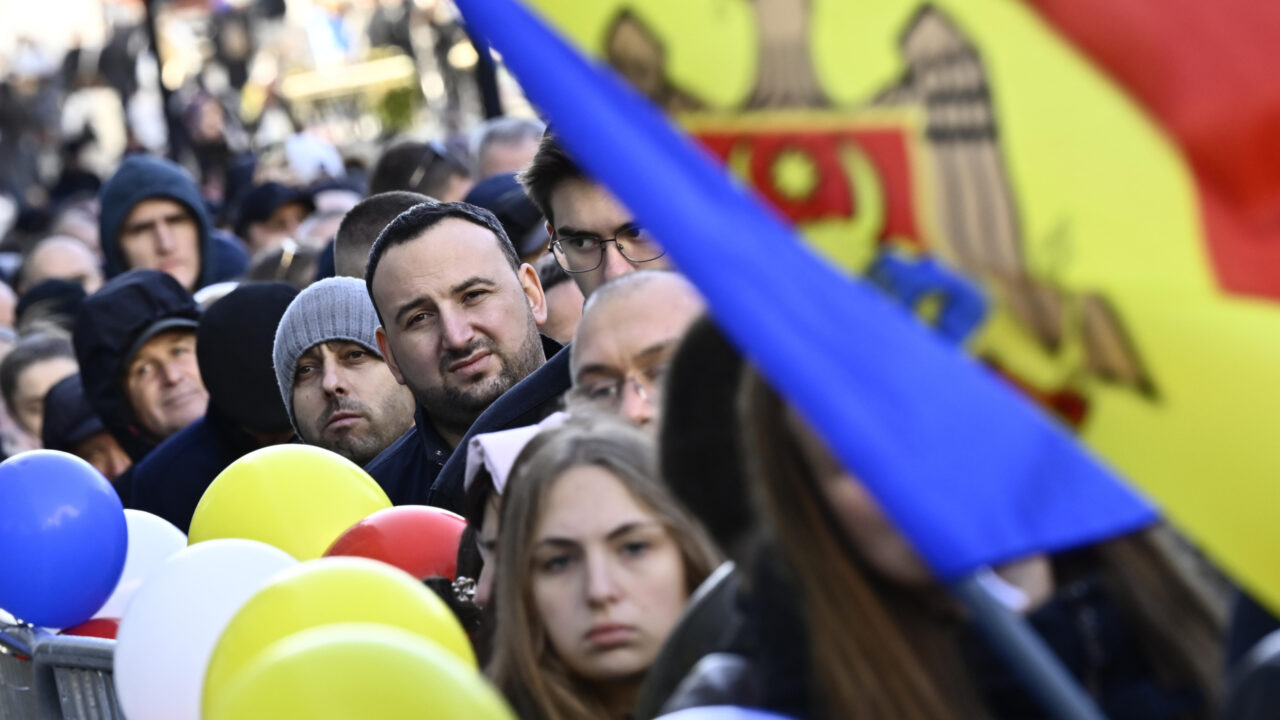
Moldova’s elections have become a nail-biting test for its European future. In the country’s 2023 local elections, President Maia Sandu’s pro-European Party of Action and Solidarity (PAS) fared reasonably well with more than 40% of the vote, yet pro-Russian politician Ion Ceban was re-elected mayor of the capital, Chisinau. A year later, Sandu was narrowly re-elected with 55.4% of the vote, while the referendum to add a commitment to joining the European Union to the constitution was an even narrower victory at 50.4%.
In all three votes, Moldova’s pro-European political forces faced unprecedented interference, organised by Russia and fugitive Moldovan oligarchs from the old regime. According to the prime minister Dorin Recean, Russian agents bought votes and oligarchs organised anti-Western protests.[1] Oligarch-owned media popped up as quickly as it could be banned. Deepfakes and disinformation flooded Moldovan social media. As things stand, Sandu and PAS have held on.
Moldova’s next parliamentary election is scheduled for September 28th. For Russia, it is the fourth round in its struggle to derail Moldova’s pro-European course; officials in Chisinau are already warning of a rise in Russian preparation in the lead up to the vote.[2] The outcome will determine whether Moldova will have a pro-European parliament able to meet the timetable for its possible entry into the EU by 2030. If the parliamentary majority swings towards Moldova’s pro-Russian political forces, however, the country’s accession will fatally slow down or derail entirely.
This would be bad news for Moldova and the EU. The country’s accession would greatly strengthen the EU’s security posture in its eastern neighbourhood and protect Moldova. And, with Chisinau onside, the EU could develop a more integrated and coordinated response to Russia’s hybrid war and potentially a hot war in the future. It would also be an important signal of strength and resilience for Ukraine’s own accession as well as that of other candidate states: the EU could show it is still capable of enlarging and that the goalposts to accession have not moved.
For the moment, however, Moldova remains in limbo. Its current commitment to accession gives the country strong links and benefits, not least significant amounts of EU funding for economic and democratic development. But until it joins the bloc, it remains somewhat out in the cold when it comes to Russia. As the Kremlin seeks to undermine Moldova’s move westwards, the country risks becoming stuck at the EU’s doorstep, not reformed enough to be let in.
This paper will sketch out the landscape of Russian interference in Moldova in the run up to this consequential election before outlining the possible political futures ahead. The paper ends with five recommendations for EU policymakers to help Moldova fortify its democracy in the lead up to September’s election. PAS needs a parliamentary majority to be able to pass the reforms necessary for the country’s EU accession to proceed. But this will be difficult unless the election takes place on a level political playing field.
Russia’s other warfare
Maia Sandu was first elected president in 2020, and PAS won the parliamentary election a year later. In a blow to the Kremlin, their victory ended a corrupt decade for Moldovan politics, dominated by oligarchs like Vlad Plahotniuc and Ilan Shor and led by pro-Russian president and Socialist Party leader, Igor Dodon.
Russia’s full-scale invasion of Ukraine in February 2022 made neighbouring Moldova a key target. As Russian forces advanced north then west out of Crimea, they directly threatened a territorial carve-up of Odesa, Transnistria and Moldova. Thanks to the Ukrainian counteroffensive, that threat had receded by the summer of 2022. Instead, Moldova became an indirect second front. In the three years following the invasion, Russia has made clear that it sees Moldova as part of its “Russian World”, closely tied by geography, history and the Orthodox faith. While Ukrainian forces kept the Russian army away from Moldova’s border, the country became a testing-ground for Russia’s tools of influence aimed at making this myth a reality. The Kremlin joined forces with the oligarchs of the old regime and began an intense hybrid war on Moldova to undermine the newly pro-European government in Chisinau, its reforms and its support for Ukraine.
The Russian invasion prompted the EU to drop its incremental approach to Ukraine and Moldova, granting both candidate status in June 2022. Despite the pressures of war next door and two million refugees (127,000 of whom remain, making up 5% of the population), Moldova responded by picking up the pace of reform. In December 2023, the European Council decided to begin accession negotiations with Moldova, six months before the same decision was made with Ukraine. (Georgia’s accession process, on the other hand, was effectively halted in 2024 as a result of Kremlin-influenced democratic backsliding.)
Meanwhile, Russia’s recent attempts to bring Ukraine and Moldova into the “Russian World” through both hybrid and conventional warfare have had divergent impacts for each country’s self-perception. In Ukraine, the invasion has discredited and destroyed most of Russia’s levers of political influence, including its political warfare techniques such as propaganda, disinformation and economic influence. After three years of brutal war, Ukrainian society is now firmly anti-Russian.
Moldovan society, however, remains more split on Russia. There is a noticeable divide between Romanian and Russian speakers, with the latter consuming more Russian media. The difference is particularly noticeable in the Gagauzia region and the Russian-controlled break-away region of Transnistria—both of which have mostly ethnically Russian populations and have largely pro-Russian views. Meanwhile, nostalgia for the Soviet Union makes the prospect of once again joining Russia appealing for some.
Russia’s invasion of Ukraine has only lightly bruised its perception in Moldova. Comparing an April 2025 poll to one from October 2021, those who want Moldova’s foreign policy balanced between Russia and the EU has dropped 8% to 47%, while those who want it to be pro-EU has increased 9% to 27%. Yet those wanting the country to align exclusively with Russian has fallen just 3% to 15%. Separately, some Moldovans are anti-Russian but do not vote for Sandu simply because they are disappointed with her government’s pace of reform and what they perceive as the EU’s lack of support. In this fragile and polarised context, Moldova’s resistance to political warfare is much weaker than Ukraine’s. Russia’s sizeable popularity gives it hope of rebuilding a pro-Russian or at least neutral constituency on Europe’s borders, as its conventional war grinds on elsewhere.
A brief history of Kremlin influence
Those in government in Chisinau have an idea of what they are up against. According to one high-ranking Moldovan official interviewed for this paper, “we are in the third year of a medium-term [Russian] plan”.[3] As they saw it, Russia first tested its proxy actors in Moldova’s 2023 local elections, then refined and increased support in 2024. Now in 2025, it is planning to make the final decisive push by backing both major opposition forces and using them “as a tram to pull others [parties] along”.[4]
Russian interference in Moldova was not always this sophisticated. In the 2010s, Russian foreign interference operations in Moldova were often run by Russia’s Federal Security Service (the FSB) and spin doctors linked to Kremlin-affiliated think-tanks. Its strategy relied on a long-term plan to “win back” Moldova into political alignment with Russia—similar to its relationship with Belarus.
But as Moldova’s EU course became more entrenched, the Kremlin went in for broke and updated its tactics. As part of this, it grew its local expertise by working closely with networks of Moldovan oligarchs. The most prominent among them, Shor, has a long history of influencing and bribing in politics, media and the judiciary—not least his role in Moldova’s biggest bank fraud.[5] And, helping Russia’s push, the then top-five television channels in Moldova included more-or-less direct broadcasts of Russian channels Channel One, RTR and NTV-M, plus two Moldovan oligarch-owned channels.
Come the spring of 2022, it became clear Russia was unable to take Moldova by force. Instead it kept up the pressure by massively increasing its investments in its hybrid war against Moldova. This included small-scale subversion such as testing attacks on government buildings and astro-turfing protests. Russia also restricted its energy supply, causing a soar in electricity prices and prompting Moldova’s rapid diversification away from complete dependence on Russian gas. Above all, the Kremlin’s efforts doubled down on election interference, including vote buying, helping create political parties and Russian-backed NGOs, and running disinformation, particularly online.
In the 2023 local elections the Kremlin put its new methods to the test. It helped create vote-buying networks fronted by Shor, spending around $55m on the campaign. Pro-Russian opposition forces built up influence in specific regions, most notably in Gagauzia where Evghenia Gutul was successfully parachuted in as governor. There were also pockets of strong Russian influence in neighbouring towns like Orhei and Taraclia.
The Moldovan government responded. It banned the Shor Party and its successor, the Chance Party, was eventually de-registered. Six television channels had their licences suspended and 23 websites (including RT and NTV) were banned. Despite these efforts, a torrent of pro-Russian propaganda still made its way to voters. PAS won 32% of mayors, down from 52.8% in the 2021 general election, while the pro-Russian Socialist Party won 16% of mayors, and the allegedly Russia-backed Ceban won Chisinau.
In 2024, Russia stepped it up a notch. The Kremlin put former prime minister Sergey Kiriyenko, part of the presidential administration, at the helm of the hybrid warfare against Moldova. He effectively began running an entire “alternative foreign ministry” focused on operations in Russia’s former Soviet neighbours. With expanded resources, this has grown to include Abkhazia, South Ossetia and Donbas in the last year.
In that year’s presidential election and referendum, a Russian-backed network—essentially a pyramid scheme with layers of commanders and distributors—bought 130,000 votes, according to Moldovan prosecutors.[6] Bank cards from Russia’s Promsvyazbank and “tourists” flying in bags of cash were the preferred methods of delivering money. While this made it difficult to trace, Moldovan police confirmed $15m was transferred from Russian bank accounts to voters in September alone. According to the prime minister Dorin Recean, the price of a vote reached as much as €200, a huge sum in Moldova, while total operations came to €200m.[7] The Moldovan police even accused Shor himself of spending $39m on votes. Some prosecutions began, but Moldova’s legal system could simply not keep up with the scale.
Success is hard to judge. But 50.4% voted in favour of the EU referendum when polls shortly before showed 67% had a positive view of the EU. Russian vote-buying operations seemed to have some success in Chisinau too: turnout in the capital went up by 65,000 or 24%, while Sandu’s in-country vote dropped 41,000 from 2020.
Kiriyenko’s tactics suggest he is impatient for success. Recently, he has been largely responsible for making Russian influence more aggressive and visible, and for working through oligarchs like Shor. In some ways, the sheer obviousness of these bulldozer tactics has been counterproductive, helping Moldova make its case that this is not just normal internal political opposition, but that there is clear foreign influence at play. Both Maia Sandu and Dorin Recean have openly called out—and evidenced—the Kremlin’s efforts, something which may not have been possible if it went a subtler route.
The worst could be yet to come
The Kremlin is likely confident its tactics are paying off—reflected in Moldova’s limited countermeasures and the growing impact of its influence operations. Following this trajectory, it will probably escalate its efforts significantly come September. As a senior Moldovan official interviewed for this research warned, “we are preparing for something twice the size as in 2024”, with another adding that that Russia is likely to adapt and innovate further as it becomes “super responsive” to Moldova’s counter strategies.[8]
The message
As part of this, Russian propaganda themes are becoming increasingly multifaceted. While anti-Ukraine narratives are present, the more common angle is along the lines of “don’t drag Moldova into the war”. This has helped elsewhere: Georgian pro-Russian party Georgian Dream labelled the pro-EU opposition as the “Global War Party” in its successful 2024 campaign. Similarly, Russian and Shor network propaganda attack “Moldovan globalists” for “selling national sovereignty” to America and the EU. But these narratives are not always consistent: they paint Moldova joining the EU as a loss of sovereignty, but at the same time argue the West will abandon first Ukraine and then Moldova.
Meanwhile, the pro-Russian non-profit Evrazia (Eurasia), backed by Shor, is becoming a key weapon for wielding Russian narratives abroad. Its purpose is focused on driving up anti-Western and pro-Russian sentiment in eastern Europe and central Asia through covert action and political warfare. As well as involvement in vote-buying, it works to amplify Russia’s propaganda tactics in the country. Instead of direct calls to join the “Russian World”, it attacks Europe as decadent and corrupt and subject to American neo-colonialism, encouraging those throughout the former Soviet Union to identify as Eurasian instead.
To target the approximately one million Moldovans living aboard, Russian propaganda takes a slightly different tactic. Its disinformation efforts aimed at those in Romania, for example, are not aimed to make Moldovans love Russia. According to a Moldovan security official interviewed for this research, they are simply designed to “make them to stay at home” on election day by fanning their frustration with life in the EU and turning them against European integration.[9] As part of this effort, Russia has also launched more campaigns to discredit Moldova within the EU and make the case against Moldovan accession.
The means
To spread these narratives, Russia has adapted and broadened its tactics in six key ways. First, it is increasingly targeting Moldova’s information sphere. After the invasion of Ukraine, the Moldovan government, via its Audiovisual Council, conducted reviews and suspended the most egregious pro-Russian television channels. This turned the top channels from pro-Russian to public and independent ones. But Russian and Russia-backed television and social media remains a powerful force. Russian and pro-Russian television is still available online, often on YouTube accounts, on the kompromat Telegram channel Salut MLD, and on Portal Kombat which shows live-stream quasi-television that looks professional and with the same content as the old channels.
On social media, Russian interference has significant reach. According to a representative of the Audiovisual Council, “TikTok is most toxic and the biggest territory for Russian FIMI [foreign information manipulation and interference]” in Moldova, while “Telegram is more an entry point to mass media”.[10] Facebook, on the other hand, is popular with influencers who are proxies of exile oligarchs like Shor and Viacheslav Platon. Some propaganda videos have had hundreds of thousands of views while studies show there is a “very high impact of Kremlin propaganda on topics such as security, Russian aggression in Ukraine, international relations and energy issues”. Despite these threats, the Audiovisual Council does not have a mandate to suspend content online. At the same time, Moldova’s size means internet and social media platforms do not necessarily listen to their complainants.[11]
In the lead up to the September election, the Kremlin is also pursuing a newer and wider range of online tactics. For example, it is conducting much earlier, more regular and more aggressive cyber-attacks. This is likely aimed at consuming Moldovan resources and finding spots of weakness. In Romania, Russia generated artificial traffic to the online pages of Bucharest mayor Nicusor Dan, which the algorithm detected, causing the site to freeze. Moldova expects similar attacks on their government accounts.
Second, Russian is sharpening its aim at civil society and independent media, which had pushed back against earlier phases of Russia’s hybrid war. Worryingly, Russia-backed parties in parliament have drafted potential measures against NGO activity and limiting the diaspora vote, echoing the playbook that shut down independent and Western-affiliated civil society in Georgia in 2024 by branding them as “foreign agents”.
Third, Russia is trying to weaponise the country’s largest Orthodox church, Metropolis of Chisinau and All Moldova, bypassing the relative neutrality of Metropolitan Vladimir, the current head of the Church. [12] Instead, it supports Marcel Mihaescu, the pro-Russian Bishop of Balti and Falesti in north Moldova. Priests are reportedly being trained by Evrazia in Serbia on how to use Telegram to target and propagandise their parishioners with pro-Russian content, exploiting the fact that polls consistently show the church is Moldova’s most trusted institution.
A fourth operation is aimed at targeting Moldova’s diaspora. In recent elections, Moldovans living abroad swung the vote for Sandu and the European referendum in 2024, with a big increase in turnout to 327,000—making up 19% of the total vote (77% voted yes in the referendum and 82% voted for Sandu). To counter this, Russia has worked on the “online penetration of the diaspora” with both fake and real accounts, including through the Kremlin’s disinformation network, Pravda.[13]
Fifth, Moldova is also heavily impacted by Russian influence efforts in Romania. After the invasion of Ukraine, Bucharest has helped reorientate its neighbour’s trade and energy supply away from Russia, taken in Ukrainian migrants from Moldova and assisted with countering disinformation. But Russian influence risks undermining this pro-European cooperation and sucking Moldova into the orbit of pro-Russian Romanians. In Romania’s recent presidential election, Russia reportedly worked with local social media companies via the digital advertising firm AdNow to support far-right pro-Russian candidates Calin Georgescu and George Simion; which is one reason why the original election in December 2024 was cancelled. To Brussels’s relief, Nicusor Dan won the rerun against Simion with 53.6% in May, and a month later he and Sandu announced new joint cooperation against Russia’s hybrid war. Despite the result, Moldova could still face a rising tide of pro-Russian forces in Romania, where there is a 285,000-strong Moldovan diaspora. Simion’s party, the far-right Alliance for the Union of Romanians, doubled its number of seats to 28 in the 2024 parliamentary elections.
Finally, Russia is becoming more innovative in how it brings in money for its influence efforts by making increasing use of cryptocurrency through former Soviet states, Gulf states and even the EU. Transnistria in particular is becoming a big site for cryptocurrency production, as Russian energy supply can be easily used here—and drained from crypto mining. With crypto, there may be up to 20 brokers handling the currency before it reaches its final beneficiary, making it incredibly difficult to trace and perfect for evading sanctions, covertly paying individuals or buying votes.
These tactics indicate that Kiriyenko has been tasked with a maximalist plan to “win back” Moldova. Moldova has some resources to resist on its own, but not enough for such a broad geopolitical gambit. This experiment is high stakes for Russia too, as it hopes to achieve a domino effect within the post-Soviet region. Kiriyenko’s role has already expanded to include Armenia in advance of its 2026 parliamentary election.
The many faces of the election
Besides information warfare, the Kremlin has been investing heavily in political warfare: sponsoring, shaping, directing and even creating a whole host of political actors. Some are more closely linked to Russia than others. As part of this, the Kremlin is dedicating a huge number of resources to shaping these politicians’ narratives. So much so that according to Valeriu Pasa, chairman of independent Moldovan think-tank WatchDog.MD, the Russians sometimes “treat them like influencers, not politicians”.[14]
In the lead up to the parliamentary election, therefore, Sandu has a lot to contend with. And it seems like she will not be making things easy for herself. In Moldova, parties need to win 5% of the total vote and blocs or coalitions need 7% to win parliamentary seats. Sandu’s PAS is running as a single party in the hope of getting an absolute majority. One reason is the party’s confidence in victory. Another is that strong representation of the party at all levels of Moldovan politics will be required to pass legislation necessary for EU accession. This is because PAS’s potential partners are unlikely to fully support the party’s European agenda. The strongest contender, Together, is a four-party coalition and a political patchwork: the Party of Dignity and Truth is unconvincingly pro-European, as is the Party of Change and Coalition for Unity and Prosperity. Besides, Together is not polling well. Another possible ally is Renato Usatii and his Our Party. He has been kingmaker in the past, but is a regional oligarch and has a history of being influenced by Russian security services.
Pro-Russian, more or less
The Kremlin, on the other hand, is playing a multilayered game going into the parliamentary election. It is running both “hard” and “soft” pro-Russian candidates, the latter to mimic centrist parties seeking good relations with all sides. Many of these parties’ main purpose is to take small bites out of PAS’s vote and deny it a majority.
But under Kiriyenko, who “wants immediate results, by whatever means”, some layers of Russia’s covert action are becoming not so covert. [15] Some parties are openly pro-Russian and have clear links to Moscow. Take Heart of Moldova led by Irina Vlah, whose 2015 campaign slogan was “To be with Russia is in our power”. Former prime minister Vasile Tarlev’s party, Future of Moldova, is anchored firmly in the past—Tarlev even has an “Order of Friendship” medal from Putin. Shor’s latest party, Victory, is not likely to even be registered to run because of criminal proceedings against him. All of these have at one time or another sided with Russia in public statements, with Vlah making occasional forays towards Europe, too.
Then there is the Socialist Party, under the long-term leadership of former president Igor Dodon. The party often allies with the Communist Party as the Bloc of Communists and Socialists. But for this election the Socialists are rebranding themselves as “sovereigntists”—not against the economic benefits the EU might bring, but against its political and cultural “domination”. Though even this seems to be on Moscow’s instructions. Other opportunistic political forces have picked up this and similar narratives, including another former prime minister Vlad Filat’s talk about the Moldovan “deep state”.
The sheer number of parties in the race is a key part of Russia’s strategy. For the final layer, it has supported ostensibly pro-European parties which could take votes off PAS and ally with the Socialists and others. Within this is the Alternative Bloc, a group that is nominally pluralist and centrist. It includes Alexandr Stoianoglo, Sandu’s opponent for the presidency in 2024. He claims to be both pro-EU and want closer ties with Russia—and his allies are reportedly linked to the FSB. Similarly, the US Treasury found that Kremlin political disinformation has supported the National Alternative Movement party, led by Chisinau mayor Ion Ceban. Ceban has since given up maintaining his pro-European veneer. His rhetoric now includes openly anti-EU statements. The other two ostensibly pro-European parties are the Party of Development and Consolidation, led by yet another former prime minister Ion Chicu, and Mark Tkachuk’s Common Action Party–Civic Congress. Tkachuk spent 2001-2009 as an advisor to former Communist president Vladimir Voronin, whose foreign policy “balanced” between Europe and Moscow.
A final sub-plot for the election is oligarch Vlad Plahotniuc, recently in Moscow, who has been testing out various parties for a return to politics. Most are remnants of his once dominant party, the Democratic Party of Moldova. One is Respect Moldova, led by onetime parliamentary chair Marian Lupu. Another candidate is the European Social Democratic Party (PSDE) which is seeking left-wing allies in the EU (who should be reminded to keep their distance). These parties remain on the fringes but may well ally with others in the lead up to the election.
Moldova’s possible futures
Going into the election, PAS wants an absolute majority to be able to pass the non-stop legislation required for EU accession. If they can achieve this, it would be possible to finalise the EU negotiating process in 2028; the EU could then reach a decision to invite Moldova to join in 2029, and the country could join the bloc in 2030. However, PAS is polling at around 38%. Given that its only potential partners are oligarch-influenced parties, a coalition government would tie the party’s hands and potentially block it from the necessary majority to pass enough legislation for EU accession.
But in Moldova, bread-and-butter issues are more important to voters than a potential EU accession in a few years’ time, even if the latter will improve the former. According to an April survey, 89% of Moldovans think the country is in an economic crisis and a third live below the poverty line. Yet many see PAS’s responses to these as mixed, a dissatisfaction that is likely amplified by Russian narratives aimed at discrediting the party’s track record. This sentiment could deny PAS an outright victory.
Because Russia has worked hard to fill most parts of Moldova’s political spectrum, including by supporting ostensibly pro-EU centrist parties, a successful hard-Russian revanche is a small possibility. More likely are two middle-ground scenarios. One is creeping pluralisation of the parliament that forces PAS to enter a coalition with other parties—the Alternative Bloc, the Socialists or Our Party—all of which talk of a more balanced policy between Russia and the West and are sceptical of EU accession. Another scenario is a PAS or PAS-led government, strongly committed to progressing the EU agenda, but that struggles to make progress without a big enough majority as MPs could be tempted to defect.
The uphill battle
Much of September’s election outcome will depend on the ability of Moldova and its Western partners to counter Russian interference efforts. Some work has been done so far. Thanks to the Moldovan government’s ban on channels not ratified by the European convention regulation, the situation is improved from 2022 when Russian television was directly broadcast.
Now, most Russian propaganda is online and therefore harder to ban. In response, Moldova has a Centre for Strategic Communication and Combating Disinformation (StratCom Centre) and an Information Technology and Cyber Security Service (STISC). But both are small operations, with little international reach. On the other hand, independent media has grown, helped by 60% of their funding coming from the West.[16]
The government has also played whack-a-mole with the most egregious parties and media. Several have been banned, not least Shor’s, though the Constitutional Court of Moldova has ruled against a ban on those associated with such parties from standing for others, so that they can reappear elsewhere. Rather, the authorities are pursuing a slow and steady rule-of-law approach. Judicial reform is also ongoing; but the system has started to take some symbolic actions, as with MP Alexander Nesterovsky who was arrested in April for channelling funds to Shor (and has since fled to Transnistria, reportedly with the help of Moscow).
How Europeans can fill the gap
To support Moldova in counter-efforts and give it the best possible shot at joining the EU, European policymakers should consider the following five recommendations.
Shoulder the cost
The sheer level of Russian interference in Moldova’s democracy is a costly endeavour for the country’s pro-European forces. Anti-disinformation operations require both personnel and money. Until January, Moldova was a big beneficiary of USAID and many civil society groups were 70-90% dependent on US funds. According to Valeriu Pasa, “the EU is doing a lot, but the American input was much higher than anyone else”.[17] However, because the EU expanded its assistance programmes since Sandu and PAS came to power, the US withdrawal was not as damaging as it would have been a decade earlier. In February, the bloc announced a €1.9bn reform and growth facility, but this is largely aimed at socio-economic reforms for accession, rather than actively supporting Moldova against Russia’s hybrid war. According to Pasa, the EU has also supplemented some American money since January, a good example being the civil society organisation, the Civic Coalition for Free and Fair Elections. Some additional EU and British funds originally intended for Georgia have recently been shifted to Moldova, where there is more hope for success.[18]
However, considering the scale of the challenge facing Moldova’s democracy, more will be needed to ensure Russian interference has minimal impact. For this, the EU will need to take the lead in funding Moldova’s democratic resilience in the lead up to September and well into the medium term. The bloc should work together with a coalition of the willing including Britain, Canada and Norway to ensure enough funds are allocated for Moldova’s media space and to strengthen the security of its election institutions, just as America withdraws. This money could come from the Reform and Growth Facility already allocated to Moldova or from the European Peace Facility, which is appropriately aimed at helping the EU “to prevent conflicts and strengthen international security and stability”.
Say it right
Strategic communications will be important. First, the EU should help PAS emphasise the interconnection between security support for Ukraine and Moldova. Second, it should outline the benefits of the EU’s reform and growth facility for Moldova, which will start twice-yearly payments in June with €400m. The EU’s communications should focus on driving home the message that Moldova’s future is with Europe, and that the EU is committed to Moldova’s accession and to defending its sovereignty. One way it could do this is by sending high-profile officials for visits on Independence Day on August 25th and on (Romanian) Language Day on August 31st—just a few weeks before the election.
The EU could also benefit from having better communications around projects it is already investing heavily in. For example, the EU has agreed to prolong the temporary liberalisation of Moldovan agricultural exports beyond July and its €1.9bn plan is helping with expensive projects like roads. For a relatively low cost, the bloc could use part of the funding from this plan to make clear to the Moldovan population the benefits of European alignment.
The EU should also legitimise pro-EU parties, not by crude endorsement, but by operating on the basis that Russian-backed destabilisation operations are not normal internal politics. As part of this, the EU and its member states should not fall into the trap of dialogue with fake pro-European actors as this will only serve to legitimise their efforts.
Support independent media
Support for independent media and new media start-ups can lead to fragmentation and overlap, particularly with online portals.[19] Rather the EU, together with its partners, should focus its funding on supporting the strongest media outlets, particularly investigative journalism. Moldovan political analysts have even argued that “independent investigative journalism won the 2024 election”.[20] For example, an undercover investigation of the nuts and bolts of the Shor vote-buying network in Ziarul de Garda just before the election helped discredit Russia’s role, prompted the authorities into action and potentially even shamed some citizens into not selling their votes.[21]
But independent television stations lack reporters and editors. According to Pasa, higher Russian wages are “extracting [sucking away] the workforce”.[22] Even the biggest new television channel, TV8, has a high staff turnover. In other words, a lack of resources, including capital, is a core reason as to why it is difficult to “efficiently compete with Russian propaganda”.[23] EU funding should therefore be prioritised for a smaller number of mass market projects rather than disperse and risk lower impact.
Safeguard against propaganda
To help Moldova’s STISC, which is focused on countering online misinformation, the EU could send a small cyber team to work with them. Through Moldova’s Digital Europe Programme association agreement it should be possible to work more closely with DG CONNECT, and gain access to the EU Cybersecurity Reserve which still has leverage over key technology companies. With this, the EU could talk to internet and social media platforms on Moldova’s behalf and help establish a hotline with platforms to report operations like the Russian attacks on Nicusor Dan. And, to take measures against online pro-Russian influencers who regularly upload and make money, the EU could cooperate on financial security with Moldova, following models of existing measures like in France and Spain.
To counter the Russian propaganda targeted at Moldova’s diaspora, EU member states could also pursue bilateral agreements with Moldova that help immigrants experience the EU as a smoother and more accommodating institution. Small but significant matters can make a difference, such as compatible driving licences and work in any country counting towards a pension. Moldova is working towards a “Roam like at home” deal with the EU, which should be accelerated.
Strengthen Moldova’s energy security
The EU reacted well to the recent winter energy crisis, when Russia stopped gas flowing to Moldova via Transnistria in an attempt to destabilise and undermine the government with high electricity prices. The bloc provided €30m in emergency assistance, while Moldova’s EU-funded Budget + Plus scheme will provide €250m until December 2025 for electricity payments to the vulnerable. The US Congress’s 2023 promise of $300m in assistance to help build energy security, however, remains on hold.
After diversification, 60% of Moldova’s gas now comes from Romania. From 2027, Moldova will be supplied by the Neptun Deep field in the Black Sea. But for the moment Russia is still capable of causing an energy crisis until three power lines are built from the west and the south towards Chisinau and the cities of the north.
In June 2025 Moldova passed a draft law for a €400m loan from the European Bank for Reconstruction and Development. However, Moldova still needs more electricity synchronisation with the European network, and more money to do it. As Chisinau will not be energy secure until it is built, the EU and its coalition of the willing could help nudge along the Indian company, KEC International, building the connector in the south.
Moreover, the separatist region of Transnistria, which has close ties to Russia, could still disrupt the trilateral arrangement whereby energy must go through the region to reach Chisinau. Or Russia could create a crisis by forcing Transnistria to cut supply. The EU should therefore keep the €60m offer of energy aid to Transnistria made in February 2025 on the table for next winter. At the same time, the EU can help facilitate a planned tender this autumn to build large renewable energy parks with battery energy storage, to increase Moldova’s renewable energy supply and reduce its dependency on (Russian) fossil fuels.
The (European) path ahead
While the possibility of EU membership in 2030 may seem distant, the steps to getting there are in the lifetime of this upcoming parliament. As Moldovans prepare to choose the representatives that will lead the country through the next five years, the EU should provide a clear finish line without changing the acquis. Perceived inconsistency and unreliability would only add fuel to the fire of Russian interference. Member-state vetoes, particularly from Hungary, could jeopardise not just Moldova’s future but the EU’s credibility which could result in Ukraine and other candidate countries drifting away from Europe. In the meantime, there are concrete moves the bloc can take to safeguard the country’s democracy against Russian interference and meddling, the benefits of which will stand well into the future. By standing firmly behind Moldova now, the EU can safeguard its eastern flank and show that enlargement is more than just a promise—it is a strategic necessity.
About the author
Andrew Wilson is a senior policy fellow at the European Council on Foreign Relations and a professor in Ukrainian studies at University College London. His topics of focus include Ukraine, comparative politics of democratisation in the post-Soviet states, and, the title of his latest book, political technology.
Acknowledgments
This policy brief was produced with the support of the Agence Française de Développement (AFD) Group. Its contents do not reflect the views of AFD; they represent the views of the author alone.

[1] Author’s interview with Moldovan prime minister Dorin Recean, in Chisinau, in person, October 3rd 2024.
[2] Author’s interviews with high-ranking Moldovan security officials in Chisinau, in person, May 1st and 2nd 2025
[3] Author’s interview with high-ranking Moldovan security official in Chisinau, in person, May 2nd 2025.
[4] Author’s interview with high-ranking Moldovan security official in Chisinau, in person, May 2nd 2025.
[5] Author’s interview with high-ranking Moldovan security official in Chisinau, in person, May 1st 2025
[6] Author’s interview with high-ranking Moldovan government official in Chisinau, in person, October 3rd 2024.
[7] Author’s interview with Moldovan prime minister Dorin Recean, in Chisinau, in person, October 3rd 2024.
[8] Author’s interview with high-ranking Moldovan security official in Chisinau, in person, May 1st 2025
[9] Author’s interview with high-ranking Moldovan security official in Chisinau, in person, May 1st 2025.
[10] Author’s interview with representative of the Audiovisual Council of the Republic of Moldova, in Chisinau, in person, May 2nd 2025.
[11] This point was made repeatedly by several Moldovan officials across interviews conducted for this paper.
[12] Author’s interview with high-ranking Moldovan security official in Chisinau, in person, May 2nd 2025.
[13] Author’s interview with high-ranking Moldovan security official in Chisinau, in person, May 2nd 2025.
[14] Author’s interview with Valeriu Pasa, May 1st 2025.
[15] Author’s interview with high-ranking Moldovan security official in Chisinau, in person, May 2nd 2025.
[16] Author’s interview with representative of the Audiovisual Council of the Republic of Moldova, in Chisinau, in person, May 2nd 2025.
[17] Author’s interview with Valeriu Pasa, in Chisinau, in person, May 1st 2025.
[18] Author’s interview with Valeriu Pasa, May 1st 2025.
[19] Author’s interviews with Moldovan media experts, in Chisinau, in person, May 1st and 2nd 2025.
[20] Author’s interview with Iulian Groza, executive director of the Institute for European Policies and Reforms (IPRE) in Chisinau, in person, May 2nd 2025,
[21] Author’s interview with Iulian Groza, May 2nd 2025.
[22] Author’s interview with Valeriu Pasa, May 1st 2025.
[23] Author’s interview with Valeriu Pasa, May 1st 2025.
The European Council on Foreign Relations does not take collective positions. ECFR publications only represent the views of their individual authors.