Pivot to Europe: India’s back-up plan in Trump’s world

Summary
- Trump’s attacks on India have prompted New Delhi to reassess its diplomatic strategy, leading to more hedging and an emphasis on what it calls “multi-alignment”.
- Tensions with the US will push India to pursue fence-mending measures with Beijing, but the underlying competitive dynamics in China-India relations are unlikely to change.
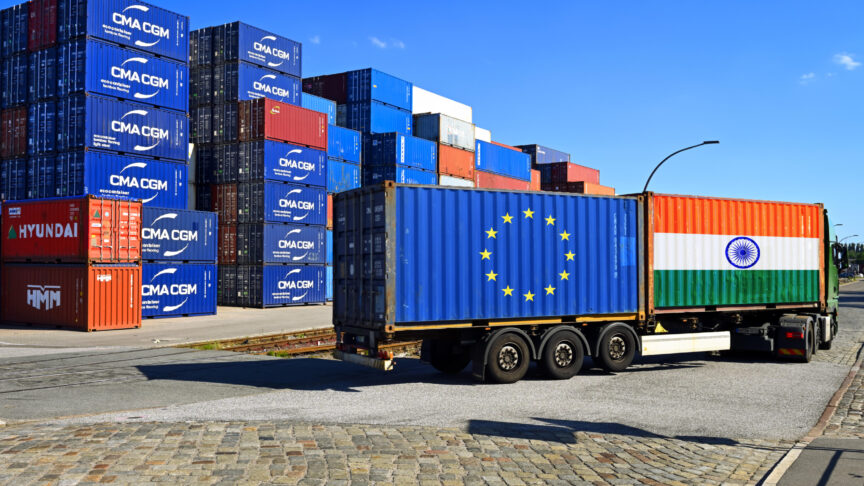
- It would be a serious mistake for India’s growing tensions with the US to push it to abandon Western ties completely; Europe offers a promising alternative to balance risks without the same geopolitical constraints as the US or Russia.
- Europe’s shift toward a more geopolitically serious and defence-oriented stance has positioned it as a more credible partner in India’s eyes, capable of delivering tangible security benefits and a broader range of technological cooperation.
- While Europeans remain concerned about India’s longstanding partnership with Russia, New Delhi has largely acknowledged that Russia’s strategic value is limited.
Between a coercive US and a threatening China
Since the early 2000s, India’s approach to geopolitics has been akin to a cautious gambler: slowly putting more chips on America while also avoiding full commitment or forsaking entirely its earlier principle of non-alignment. This strategy has paid off: it brought robust economic investment from the US, as well as defence cooperation and technological exchange. Driven by the threat of a rising China, New Delhi expected this trajectory to accelerate under Donald Trump’s second term as US president—not least given the apparent chemistry between him and Indian prime minister Narendra Modi.
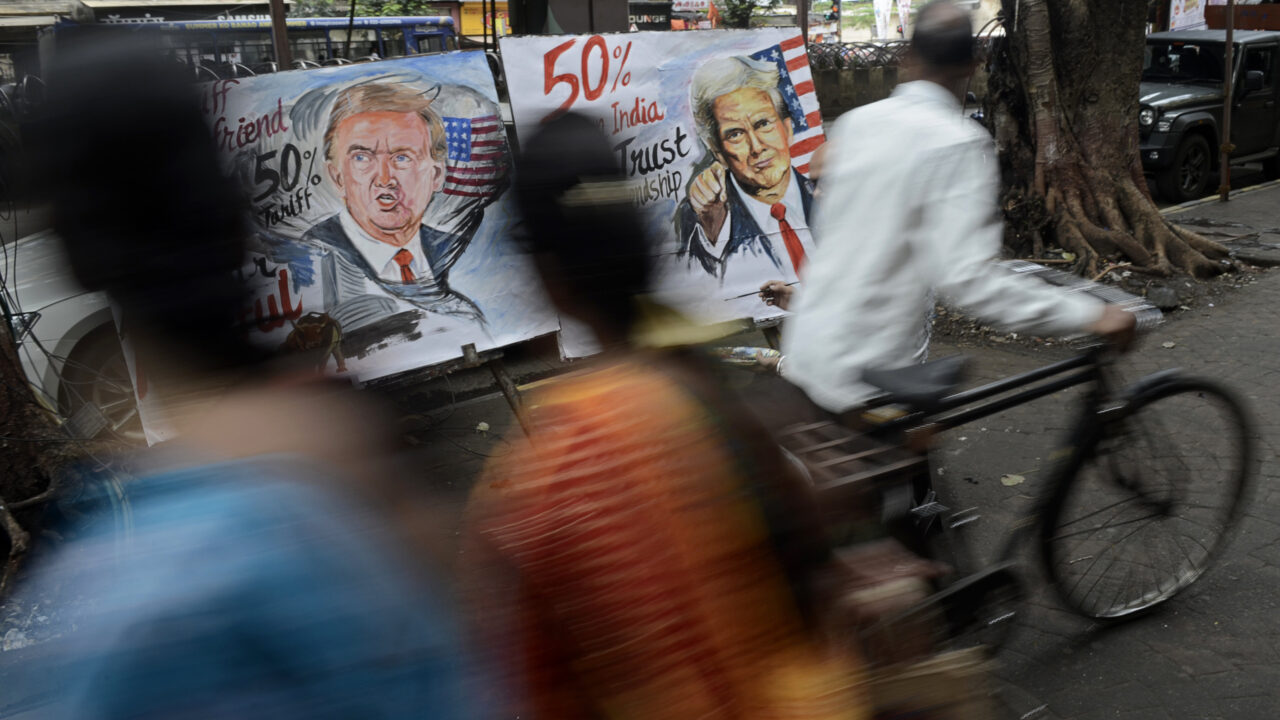
However, a series of recent developments have prompted India to reassess its American gamble. Trump’s intervention during border clashes with Pakistan—claiming to have broken a ceasefire, which India denied—irked Delhi’s diplomatic circles. Unexpected high tariffs as well as additional penalties for purchases of Russian oil have badly strained what was a flourishing relationship. At the same time, the China challenge has grown even more acute. After a period of tentative cooperation, including via the BRICS and the Shanghai Cooperation Organisation (SCO) in the 2010s, ties took a sharp downturn, notably following deadly border clashes in 2020. China’s expanding influence in South Asia—particularly through defence ties with Pakistan—has transformed the relationship from cautious engagement to outright competition.
As it seeks greater strategic autonomy, India has pushed for flexibility, preferring ad hoc partnerships over fixed alliances in a policy it dubs “multi-alignment”. This approach has its critics. Ashley Tellis, a respected analyst, recently argued that “seeking continued American support for itself while promoting a multipolar system that would limit Washington’s power is both counterproductive and unwise”. Tellis’s critique highlights a tension in pursuing American partnership in the short term and a long-term multipolar order that by definition limits American influence.
Trump’s recent coercive behaviour now threatens to push India further down this path of hedging, empowering those in New Delhi who were always sceptical of ties with Washington and preferred the comforts of traditional non-alignment. The risk is India will now double down on multi-alignment—doing more with Russia, mending fences with China and diversifying away from other Western partnerships tainted by American unreliability. This would be a strategic mistake. India’s recent emphasis on prioritising ties with advanced, technology-rich industrial powers had strong underlying logic. New Delhi needs partners who can deliver both investment and advanced capabilities in areas critical for its development and security. Any steps that increase dependence on China remains unwise, given ongoing border tensions and the risks of the weaponisation of vulnerabilities. Russia, meanwhile, is a declining power, increasingly consumed by its war in Ukraine and offering little beyond cheap energy and legacy weapons systems.
American hostility towards India should not drive New Delhi to shift away from the West entirely. Europe provides a promising pathway—one that can help India balance its risks without rapidly escalating tensions with China or necessarily undermining its vision of multipolarity. European partners offer substantial investment capital, diversified supply chains that reduce economic dependence on China and advanced defence technologies that do not have the same geopolitical strings as American or Russian alternatives. It is for this reason that India is right to hope that Europe, like India, will evolve into “a major pole in the global order”, in the words of Indian external affairs minister Subrahmanyam Jaishankar, serving both as an important partner and a potential counterbalancing force for its ties with both China and the US.
Historically, Europe and India’s relationship has underperformed, hampered by differences in political priorities as well as often incompatible bureaucracies that have struggled to find the right mechanisms to push closer cooperation. Some challenges have been practical, such as the inability to strike a major EU-India trade deal. Others are rooted in a more fundamental clash of visions of global order. India embraces a multipolar world, viewing it as the backdrop for India to eventually emerge as a great power; Europe views this prospect with mixed feelings, seeing opportunities but also fearing the erosion of institutions and norms that underpinned its influence and prosperity.
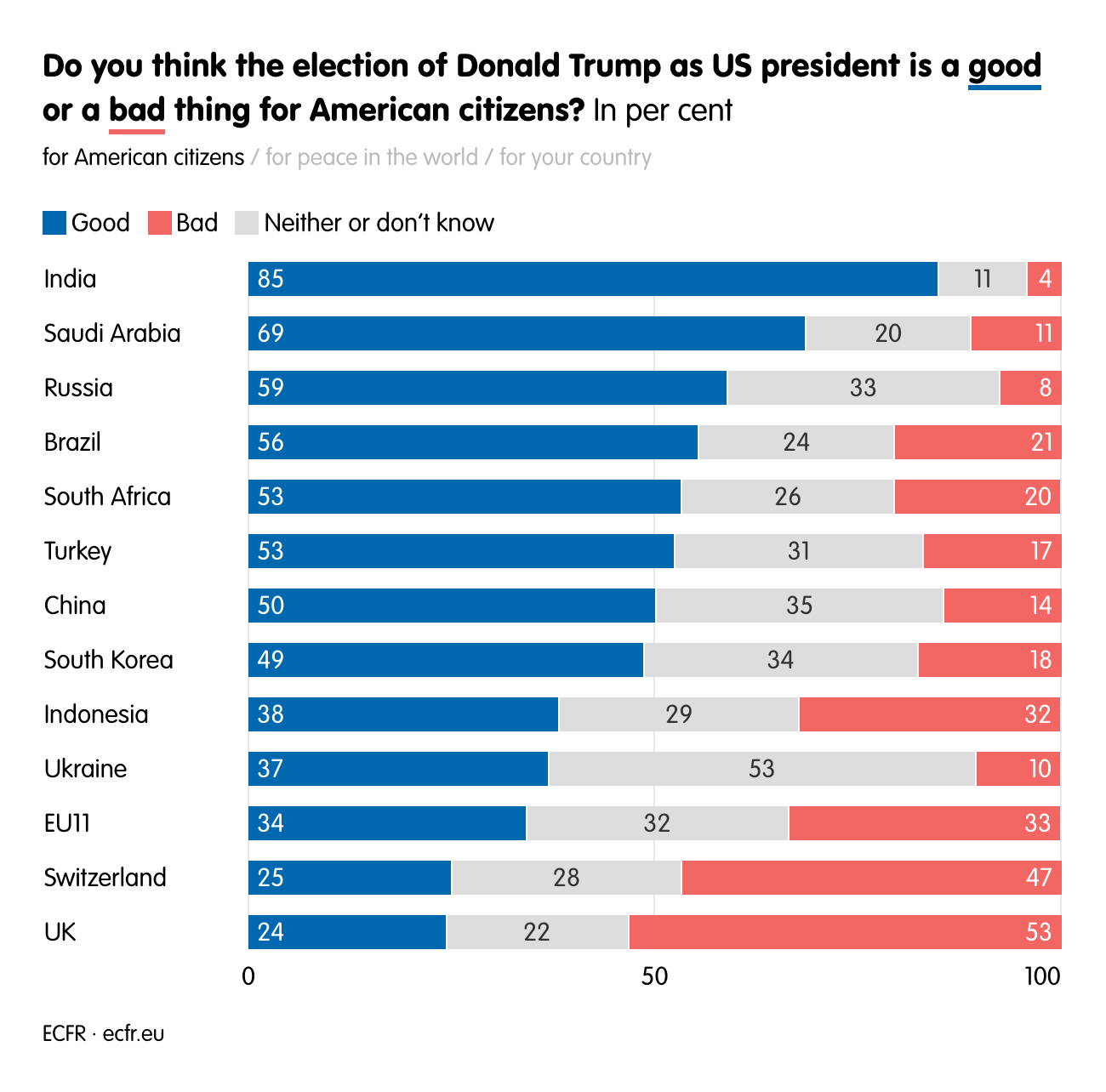
Under Modi, India rejects important components of the “liberal” rules-based order that Europeans often champion, favouring a more Westphalian model that prioritises sovereignty and non-interference in domestic affairs. India’s multi-alignment policy, in which it seeks partnerships with a diverse range of powers, also means maintaining ties with nations like Iran and Russia, which are problematic for Europeans. Over recent decades the result has been a relationship marked more by unfulfilled potential and mutual frustration. Until recently at least, Indians were also overwhelmingly positive about Trump. ECFR data from shortly after the election last year showed that 85% of Indians surveyed believed that Trump would be good for the US, the highest percentage recorded in the survey. This contrasted sharply with widespread European anxiety. Recent tensions have likely shifted Indian perceptions sharply, even if they may still be less sceptical than those in the EU or UK.
A convergence of factors has lately begun to create better opportunities for Europe-India cooperation, as both sides grapple with a changed international reality. Renewed leadership from 2024 injected momentum into bilateral relations. Modi’s re-election as prime minister saw India re-double its focus on finding new avenues to project influence while Ursula von der Leyen’s return as European Commission president brought fresh willingness to restart overtures as part of plans to build a new “geopolitical” Europe. Driven by the need to counter China’s influence, New Delhi is keen on partnerships with technologically advantaged industrial nations—an area in which Europe is an attractive prospect.
Meanwhile, Russia’s invasion of Ukraine has paradoxically strengthened the foundation for Europe-India ties. Initially, India’s refusal to condemn Moscow was seen as a significant barrier to deeper cooperation. But the war has also transformed Europe into a more battle-hardened and geopolitically serious actor. By investing heavily in defence and other forms of strategic autonomy, Europe has demonstrated the kind of resolve that earns respect from Indian decision-makers, who value power and capability in international affairs. This transformation has also allowed European leaders to engage with India on more equal terms. Europe’s need for partners could push it to play down its earlier habit of delivering lectures about democratic values, and instead focusing on more concrete areas of mutual interest.
Shared concerns about China provide a major factor pushing India and Europe together. Europe perceives China’s trade practices—with heavy state subsidies, forced technology transfers and overproduction—as a threat. India worries about not only border disputes but also economic dependencies, including in critical sectors such as manufacturing inputs, green technology and minerals. At the same time, engaging more closely with Europe, as opposed to the US, is likely more palatable to China—given that Beijing views ties with the US as threatening.
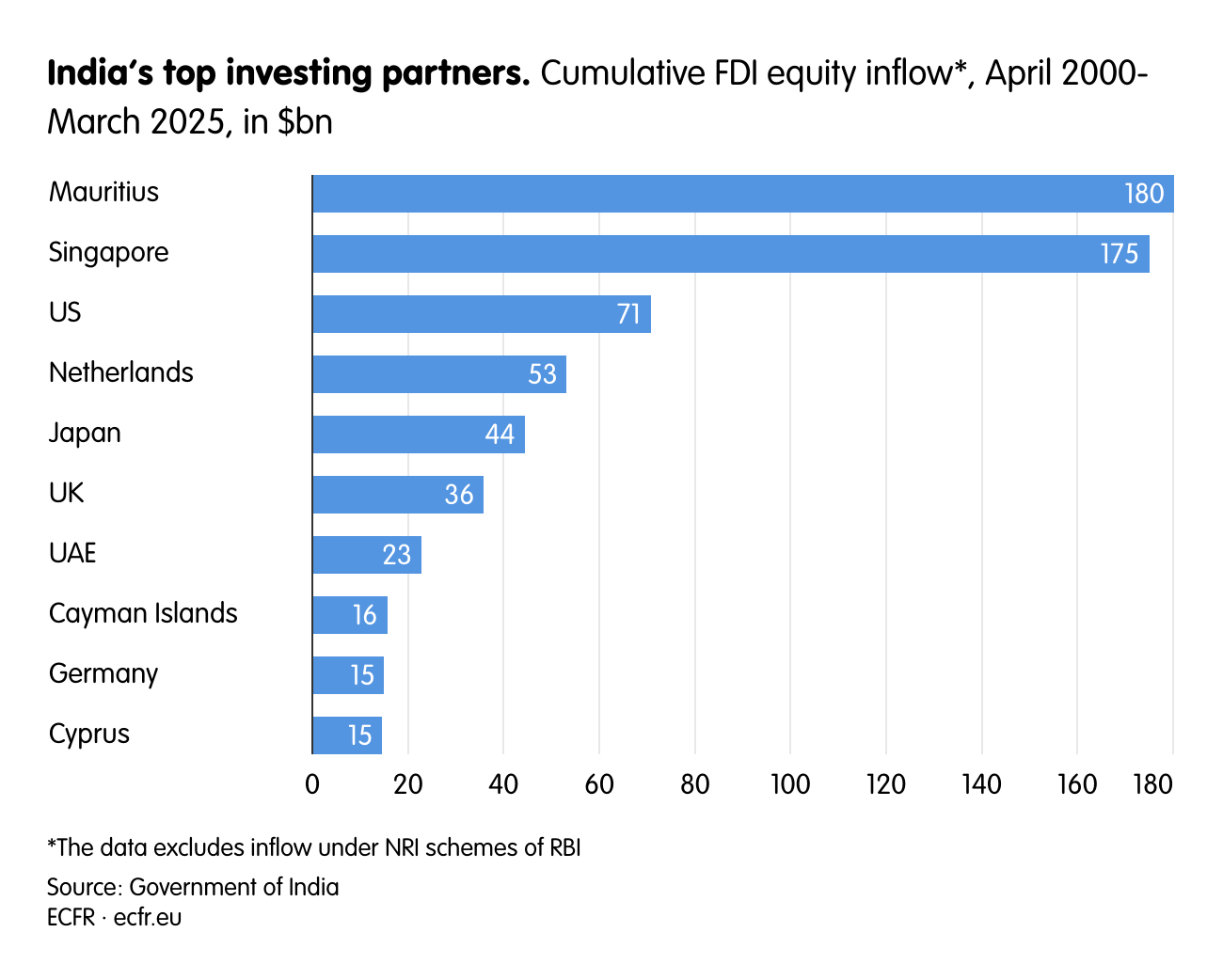
Capitalising on this momentum will not be easy, given the complex international environment. India has many suitors competing for partnership. Signs of a mutual desire to accelerate India-EU ties were clear earlier this year when von der Leyen travelled to New Delhi with the entire college of European commissioners to push broader cooperation across multiple sectors. A range of other encouraging developments, including the restart of the EU-India Trade and Technology Council, renewed momentum toward concluding a comprehensive free-trade agreement and plans for a major India-EU summit in early 2026. To develop this opportunity, Europe must develop a more sophisticated understanding of India’s long-term geopolitical worldview and strategic priorities. But it must also respond decisively to the window of opportunity created by India’s evolving response to the Trump presidency and its broader implications for global power dynamics.
This paper is the second in a series of portraits (the first being Brazil) from the European Council on Foreign Relations, examining major global middle and rising powers that are set to play significant roles in a shifting multipolar world—and become more important future partners for Europe, too. Using a common analytical framework, the series helps policymakers identify opportunities for new models of cooperation: it seeks to understand these powers’ geopolitical heritage, their visions of future global order and the kinds of partnerships they seek to forge.
The view from New Delhi
India’s strategic objectives have been broadly consistent since independence in 1947. They include faster domestic development, a stable neighbourhood in South Asia (and more recently in the wider Indo-Pacific too), and reform of the institutions of global governance to allow India greater influence and reflect its growing stature. Over time, the strategies and partnerships India developed to meet these objectives shifted from the original idealism of non-alignment to a more pragmatic updated vision of multi-alignment.
Indian views of global order have often cut across ideological divides. India shares with Western partners the objective of a broadly “rules-based” order, although it dislikes the Western idea of a specifically liberal order. In general terms, India supports conceptions of international law, territorial integrity and sovereignty—all values of traditional significance for decolonised Asian nations—while leaving scope for each country to define its own system of governance, free from externally imposed liberal norms. However, under Modi, there has been notable shifts inspired by theories of “Hindutva”, or “Hindu-ness”, with visions of India as a Vishwaguru (the world’s teacher) that seeks to be a Vishwamitra (friend to the world).
A brief history of Indian foreign policy
Indian ideas of global order have evolved through distinct phases since the country’s independence. Immediately after 1947, India emphasised fraternity with newly liberated post-colonial nations, shaped domestically by the political dominance of the ruling Indian National Congress party, Nehruvian ideals of socialism and a strong belief in multilateralism. This was the heyday of non-alignment, with New Delhi seeking to avoid replacing colonial domination with domination based on Cold War rivalry. It spearheaded the creation of the Non-Aligned Movement and played a prominent role in the landmark 1955 Afro-Asian Bandung Conference and the first Non-Aligned Summit of 1961.
A decade of greater pragmatism preceded the India-Pakistan war of 1971, during which New Delhi used military force to support East Pakistan’s independence that lead to the creation of India-aligned Bangladesh. An increasingly powerful Pakistan, supported by both the US and China, then pushed India towards the Soviet Union via the 1971 Indo-Soviet Treaty. Moscow’s economic collapse in 1989 left India without one of its most important geopolitical, trading and defence partners, forcing India to adapt to a new unipolar, US-led world. A balance of payments crisis in 1991 then led India to liberalise its economy, ending the era of state socialism and prohibitive red-tape often dubbed the “license Raj”.
A period of economic reform and integration into global markets followed 1991. Diplomatically, this included a greater emphasis on engaging with neighbours in South-East Asia through its “Look East” policy, subsequently upgraded to “Act East” under Modi in 2014. This aimed, albeit not always successfully, to develop ties with India’s increasingly prosperous eastern neighbours like Malaysia and Singapore, reorientating its foreign policy away from the more troubled region that India often calls “west Asia”, encompassing Afghanistan, Iran, Pakistan and the wider Middle East. India’s decision to conduct nuclear tests in 1998 marked another turning point, prompting many established powers, including the US and Japan, to impose tough economic sanctions. European responses were more divided: Denmark, Germany and Sweden suspended bilateral aid, for instance, while France—India’s first-ever strategic partner and with whom it would sign its first civil nuclear deal—refrained from imposing sanctions.
A rapprochement with the US followed soon after the tests, leading to a India-US nuclear deal in 2008. Under this arrangement, India agreed to allow inspections from the UN’s nuclear watchdog, with the US agreeing to cooperate with India on developing its civil nuclear capacities. This marked the start of a two-decade period of closer ties with the US, as well as with other US partners in Asia, such as Japan and Australia.
During this period, New Delhi also began to pursue a policy akin to what Modi’s administration would later call multi-alignment, seeking deeper engagement with established and emerging nations alike. At that time, it expressed optimism about its growing ties with China and other rising powers. This included via formats such as the BRICS grouping of large emerging economies, of which it was a founding member in 2008, and the China and Russia-led SCO, which it joined in 2017. Multi-alignment embodied India’s belief that a broader network of relationships was now the best path to defend domestic interests and meet international objectives, against the backdrop of an increasingly global and interconnected post-cold-war order.
Foreign policy in the Modi era
Under Modi, India continues to have a basically favourable view of a multipolar world, in which no single nation dominates the international system. This leaves middle and rising nations free to form multiple partnerships. The country’s ambitions have also expanded beyond South Asia, aiming for a broader global role that Jaishankar describes as becoming a “leading power”. By this, India means taking a position a step below a “great power”: one that develops relationships and exerts influence throughout the Indo-Pacific and beyond to other major centres of global influence. India’s leading power vision involves deepening military relationships, gaining a more central position in global supply chains and playing a more assertive role in global forums like the UN and the G20. It also means promoting Indian solutions to global problems, exemplified by its digital public infrastructure which powered India’s rapid digital development over the last decade.
Under Modi, these aspirations have also acquired something of a civilisational veneer. In this vision, India—or Bharat, to use its increasingly preferred Sanskrit-derived name—guards ancient wisdom rooted in its Hindu past that it can share with the contemporary world. This more civilisational, Westphalian approach to global power is one that India shares with both China and Russia, in which great civilisations have the right to manage their own internal affairs without interference. Viewed this way, the global system comprises a small number of great civilisational powers with respective spheres of influence, shaped in part through shared cultural, linguistic or ethnic ties.
Although more liberally minded partners might want to decouple this civilisational turn from economic engagement with India, Modi’s supporters view cultural and geoeconomic facets of power as intimately linked. In the worldview of the Hindu nationalist Bharatiya Janata Party (BJP), a more homogenous and culturally unified nation, led by its Hindu majority, provides a better conduit both for economic reform and development, as well as global geopolitical status.
China: A persistent rivalry
China’s rise has become a defining factor in India’s foreign policy in recent years, leading New Delhi to play down hopes of deeper engagement with Beijing—both bilaterally as well as through formats such as BRICS—amid rising bilateral tensions. Tensions have been driven largely by clashes along their long northern border, which turned deadly in 2020. China claims sovereignty over the north-eastern Indian state of Arunachal Pradesh, where it has been recently sinicising place names and drawing ire from Indian politicians. India, meanwhile, considers Aksai Chin in eastern Kashmir to be part of its territory, although it is controlled by China. A planned Tibet-Xinjiang railway has added to tensions between the two countries. The 2020 border clashes marked an especially significant turning point, leading New Delhi to retaliate via restrictions on Chinese foreign investment, banning apps such as TikTok, suspending direct flight routes and tourist visas, and leaving Chinese companies such as Huawei and ZTE out of its 5G rollout.
Recent tensions with the US are likely to see India consider modest fence-mending measures to improve ties with Beijing, potentially allowing limited Chinese investment in select sectors. This approach is similar to many other US partners in both Europe and Asia, many of whom have sought to stabilise ties with Beijing as they grapple with how to manage Washington. For India, this approach was clearly on display in August, when Modi met Xi at the SCO summit in Tianjin, enjoying a reportedly cordial bilateral meeting. Still, the fundamental competitive dynamics driving China-India tensions are unlikely to improve dramatically, absent significant changes of policy in Beijing.
India is also notably wary of China’s growing influence in South Asia, and especially its ties with Pakistan. Islamabad operates advanced Chinese-made JF-17 fighter jets and other advanced systems. In recent border clashes, Pakistan successfully downed a number of Indian aircraft, including French-made Rafale fighters, according to US intelligence reports. China has been a vital military and economic supporter of Pakistan, highlighted by projects such as the China-Pakistan Economic Corridor. Beijing’s maritime inroads around the Indian Ocean have also caused alarm, notably via growing ties in neighbouring Bangladesh, Myanmar and Sri Lanka, potentially associated with New Delhi’s weakened influence. This shift was exemplified in the Maldives in 2024, where India withdrew troops at the behest of the island’s more pro-China president.
Until recently these concerns about China had pushed India even closer to the US, helping New Delhi become one of Washington’s most valued partners in the Indo-Pacific during the Biden administration. India’s decision in 2017 to rejoin the Quadrilateral Security Dialogue, better known as the Quad—a security-focused grouping formed in 2007 with Australia and Japan that had been dormant for years—reflected a new willingness to engage with a US-led agenda of Indo-Pacific security. This deeper India-US relationship went on to span a range of economic and technological cooperation. Tech has been a particular focus, via formats such as the United States–India Initiative on Critical and Emerging Technology, launched in 2022, and the subsequent US-India TRUST (Transforming the Relationship Utilizing Strategic Technology). In the wake of Trump’s trade war with China, India hopes to attract US companies diversifying their manufacturing bases, as companies like Apple aim to use the country as a base to produce more iPhones for the US market.
Beyond the US, India widened its range of partners to include rising middle powers in economically or strategically significant neighbourhoods, for instance the Gulf Cooperation Council (GCC) nations and Israel in the Middle East, or Singapore in South East Asia. India seeks a range of outcomes from such relationships, including foreign direct investment, advanced technology acquisition, security in critical global supply chains, and access to energy resources, given India’s energy import-dependent economy. There has also been an uptake in issue-based mini-lateral engagement under Modi, including new formats such as the I2U2, an economic grouping consisting of India, Israel, the UAE and the US, focused on the Middle East. India has also sought to engage a wide range of countries in ambitious connectivity projects, such as the India-Middle East-Europe Economic Corridor (IMEC), while also seeking a leadership role in global multilateral bodies.
Russia: A partnership in flux
Despite deeper engagement with the US and its partners, New Delhi also maintains important relations with perceived Western adversaries, notably Russia and Iran. India’s cordial relations with Russia stretch back to the cold war, where Moscow acted as a trusted partner on issues such as Indian nuclear tests and tensions in Kashmir—in addition to being an important source of arms and energy, as well as technology and knowledge transfers in the fields of space and defence. India is also wary of pushing Russia closer to China, knowing it might need Russian arms if it ends up in a conflict with China. After Russia’s full-scale invasion of Ukraine in 2022, India refused to condemn Moscow and abstained from critical votes at the UN, leading to criticism in both the US and Europe. At the time, foreign minister Jaishankar remarked that “Europe has to grow out of the mindset that its problems are the world’s problems, but the world’s problems aren’t Europe’s problems”, underlining Indian irritation with perceived European double standards in dealing with international crises and reaffirming its commitment to multi-alignment amid Western pressure.
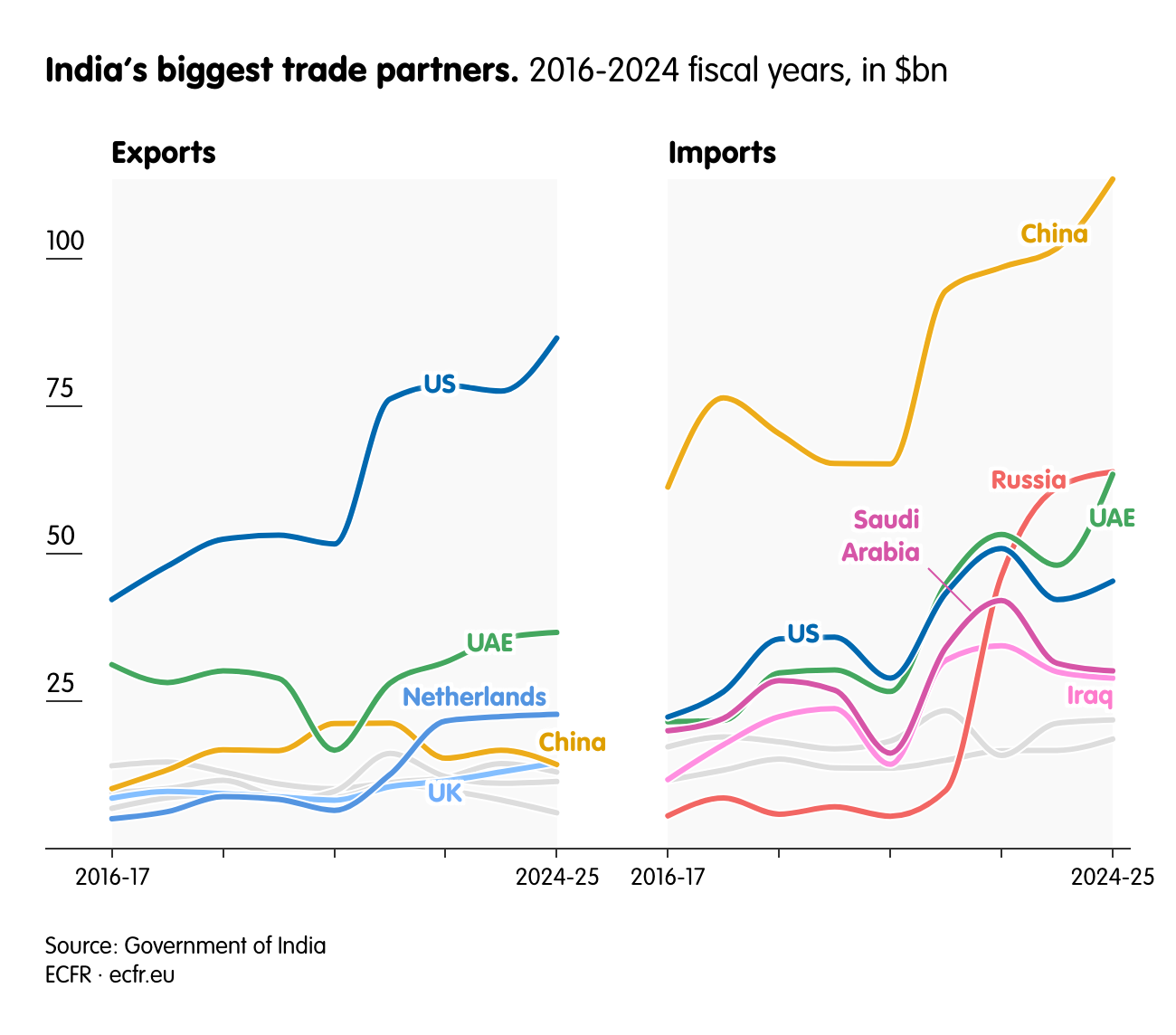
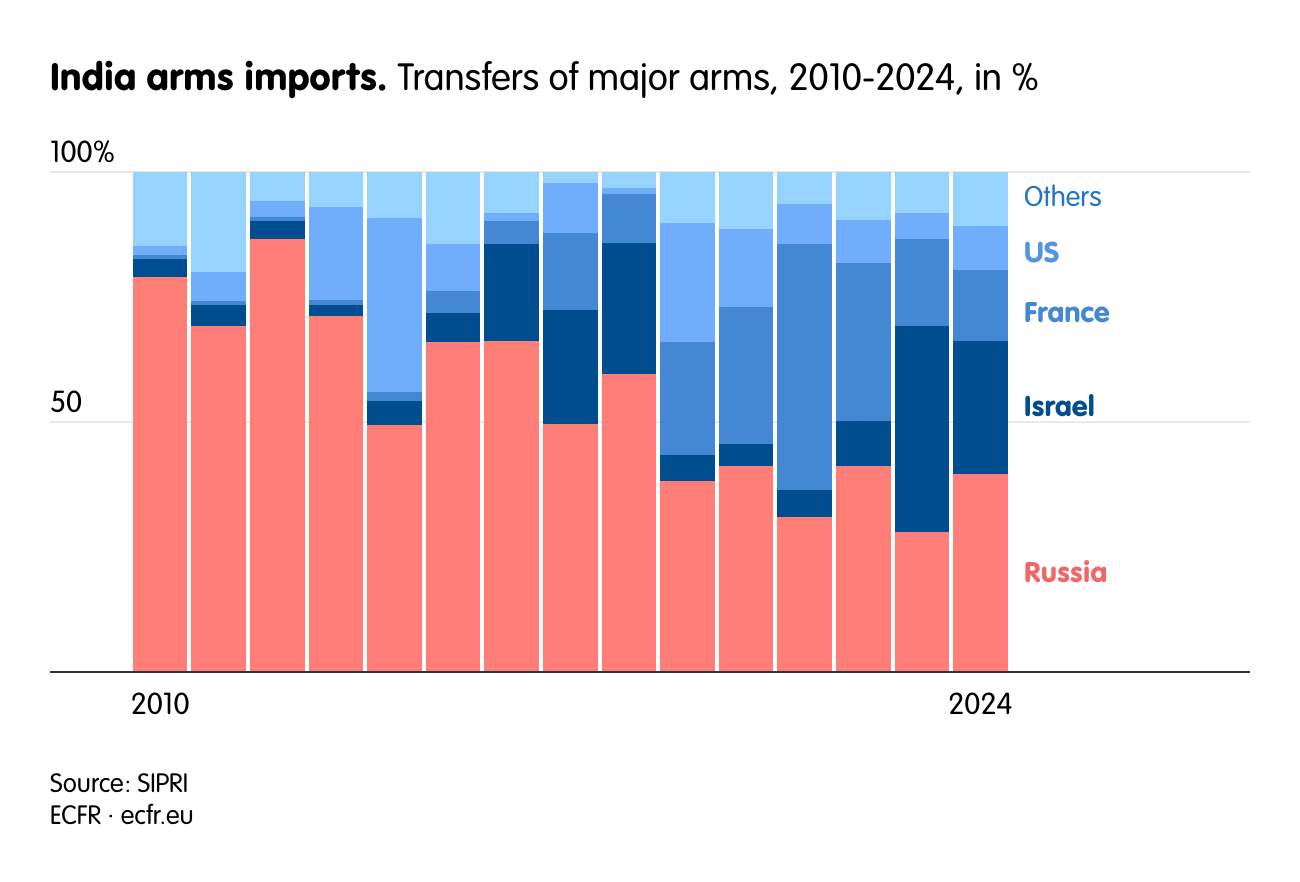
Europeans need to understand the changing nature of India’s partnership with Russia. Although the two sides have historically strong ties, New Delhi has of late generally recognised the declining utility of its partnership. Russia’s weak economy, focused on war, is unlikely to be a source of direct investment or cutting-edge technology. Indeed, Russia only entered India’s top 10 trading partners after it invaded Ukraine in 2022 and New Delhi benefitted from cheaper oil imports. Russia has traditionally been India’s largest supplier of arms, but in the last two decades its share of Indian arms imports has decreased. Modi’s choice of Russia for his first state visit after his re-election in 2024 underlined an enduring partnership, but this was followed by visits to Poland and Ukraine—the first of any Indian prime minister since Ukrainian independence in 1991—showing an awareness of the need for balance. All that said, India underlined the ongoing utility of its partnership when it used its ties to Russia to signal its displeasure over recent treatment by the US under Trump. Having been threatened with 50% US tariffs, Modi called Russian president Vladimir Putin, invited him to New Delhi and talked about deepening ties to Moscow—a clear diplomatic signal to Washington. Modi also met with Putin during his visit to China in late August at the SCO summit.
Trump’s America and Europe: crisis and potential
While Modi has enjoyed strong ties with recent US administrations, Trump’s second term is creating major complexities in India-US ties. Trump has repeatedly accused India of being a “tariff king”, running a trade surplus that reached $45.7bn in 2024. Estimates suggest Trump’s originally threatened 27% “reciprocal” tariffs would cause India annual losses of $7bn. In addition, Trump has threatened tariffs on BRICS countries, which would include India—potentially up to 100% on any nations that develop alternatives to the dollar and lower tariffs on those that align with “anti-American” BRICS policies. Trump has also shown little sign of supporting India’s manufacturing ambitions, suggesting he might add tariffs to smartphones not manufactured in the US, and telling Apple’s CEO he wants iPhones built in America, not India. This came after India showed itself to be amenable to negotiating, reducing tariffs on targeted import lines with symbolic value such as bourbon whiskey and motorcycles and also showing willingness to increase purchases of US defence equipment and liquified natural gas (LNG).
Trump’s response to cross-border clashes between India and Pakistan in May 2025 posed a further unexpected challenge. His claims that he “solved” the conflict through trade caused irritation in New Delhi and were sharply rebuffed by India’s top brass, while his subsequent invitation of Pakistan’s top general, Asim Munir, to the White House to congratulate him on defusing the situation was a further snub. Trump’s systematic hollowing out of central government institutions has also undermined the mechanisms that drove positive developments in the India-US partnership. This includes a far weaker National Security Council, which was central for improved cooperation with India during the Biden administration. Prior to Trump, other tensions related to India’s internal security existed, notably Washington’s critical response to allegations of planned Indian extrajudicial killings of a separatist activist on US soil in 2023.
This combination of India’s shifting relationship with the US and its ongoing antagonism with China creates particular opportunities for Europe. Traditionally, India’s engagement with Europe focused on bilateral ties with major nations, most obviously France, Germany and the UK, often ignoring other European middle powers and the EU itself. However, over the last decade, there has been greater mutual interest in developing a broader spectrum of European partnerships through high-level engagement, including with countries in the Mediterranean, central and eastern Europe, the Baltic and Nordic nations, and—as indicated by the recent European Commission visit to New Delhi this year—the EU as a bloc.
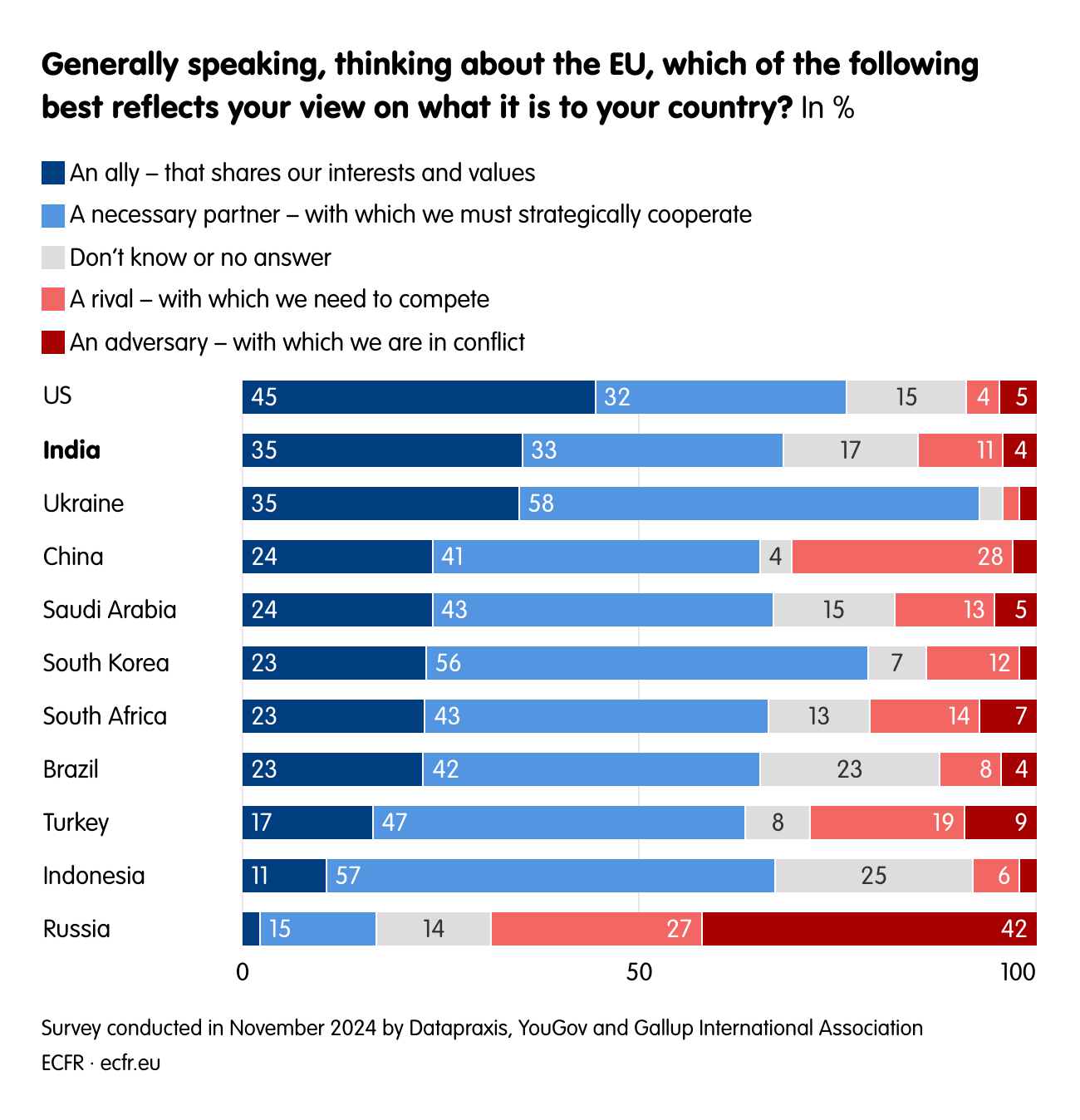
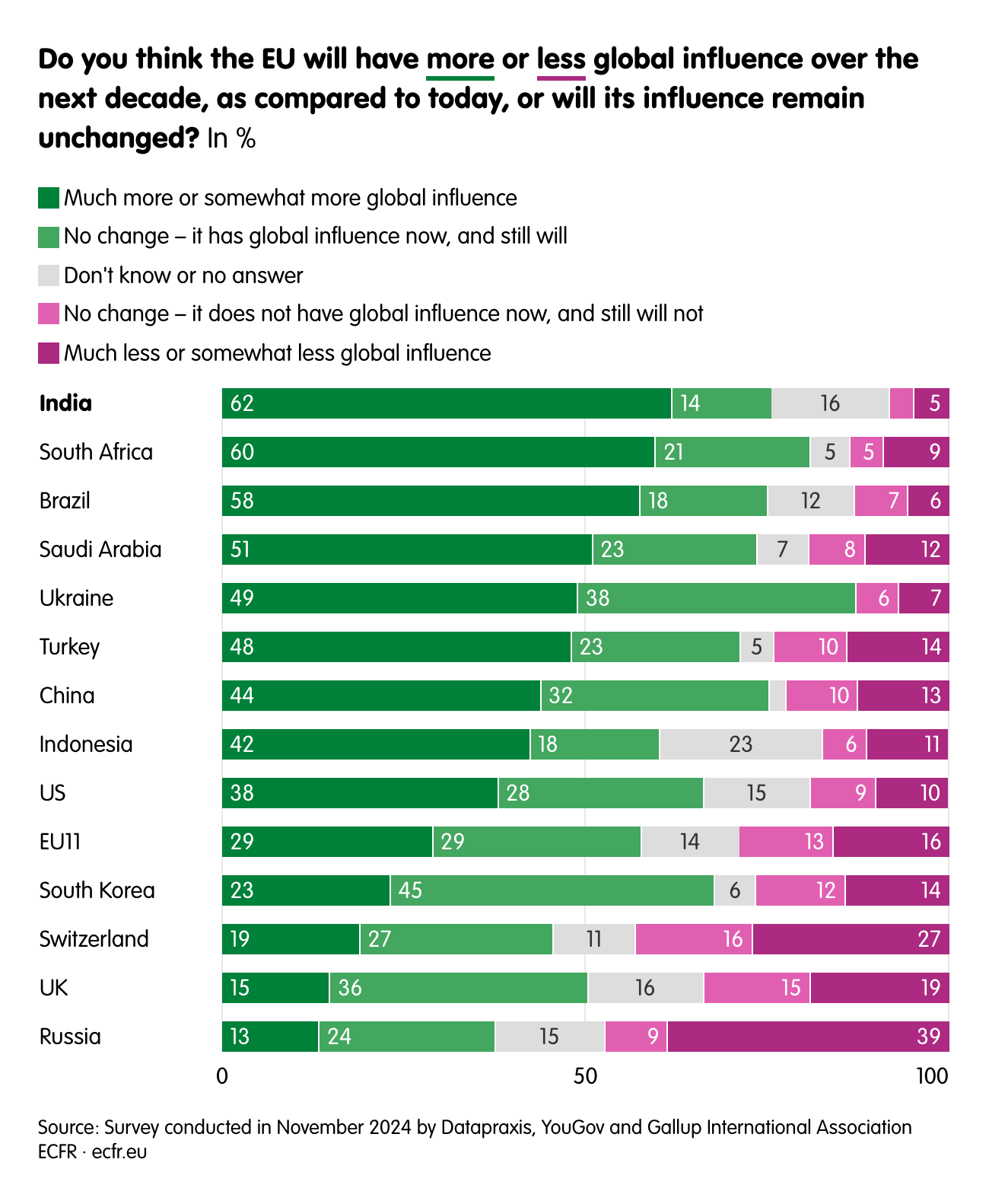
Indians generally view the EU positively. A 2024 ECFR poll showed that 35% of Indian respondents see Europe as an ally, ranking only behind the US and equal to Ukraine. Additionally, 62% of Indians believe the EU will be more influential globally in the next decade—the highest proportion among all countries surveyed.
As Europe reconsiders its traditional alliances in the wake of Trump and reassess its own security and strategic culture, it increasingly recognises shared interests with India. India’s aim of greater strategic autonomy aligns with Europe’s own efforts to adapt amid its own declining ties with the US. Jaishankar noted recently during a visit to Brussels that he hoped to “deepen [EU-India] relations in a multipolar world” in which “the EU is clearly a major pole”, echoing the wording of the leaders’ statement after the commission’s visit to New Delhi in February about a “shared interest in shaping a resilient multipolar global order”. This new momentum in India-EU ties sees both sides working towards the conclusion of a long-awaited free trade deal and a reworked strategic agenda, slated for the end of the year.
Sources of India’s global clout
In seeking leading power status, India seeks to capitalise on and expand its existing sources of global influence. Its growth potential makes it a valuable economic counterweight to China and an attractive partner for nations seeking to develop rapidly. Its sheer size and geopolitical position also make it an obvious collaborator for those seeking to balance between America and China. Meanwhile, India’s position as a technological innovator provides important sources of strength too, including its role as a developing AI and data centre hub. All of this is, in turn, reflected in India’s increasingly important position within global multilateral and regional mini-lateral forums.
Economic potential
China, the Asian growth success story of the first few decades of the 2000s, is slowing as it faces demographic challenges, as well as inefficiencies and severe fiscal imbalances associated with its state-led growth model. India, by contrast, has a demographic dividend, with a growing working-age population and a rising middle class. Hoping to replicate the export-led economic success of other Asian countries, Modi has set the target of $2trn worth of exports by 2030, split into $1trn each of goods and services. That target is likely unrealistic—exports would have to more than double in five years—but progress is being made. Hopes for deeper economic reforms continue to attract new investors. Modi’s team have also pushed initiatives to ramp up manufacturing capacities, for instance driven by a vision of India as Atmanirbar Bharat (self-reliant) and Viksit Bharat (developed). Recent steps have included a deregulation commission to eliminate red tape and the relaxing of rules to promote semiconductor manufacturing.
In recent years, India’s focus on building up its export-driven economy has pushed it to forge stronger international partnerships and attract investment. As a result, New Delhi has of late signed a spate of trade deals, including with Australia, the UAE and the UK, and European Free Trade Association countries. These are mostly “early harvest” deals, rather than full free-trade agreements; they do not touch on sensitive sectors. Even so, this new relative openness to trade deals increases India’s attractiveness as a partner, with trade negotiations ongoing with the US and the EU. Steps such as the launch of a Federation of European Business Interests, essentially a European Chamber of Commerce, in 2024 signal a recognition of India’s future economic potential.
After decades of protectionist policies, this economic momentum reflects a new openness for deeper global integration, in particular with geopolitically aligned nations. India’s technology sector continues to drive export growth, with software services and digital platforms attracting significant foreign investment; the pharmaceutical industry has emerged as a global manufacturing hub for generic drugs and active ingredients. The consumer goods market is experiencing rapid expansion driven by rising middle-class incomes and rapid urbanisation, creating attractive opportunities for both domestic companies and international brands. India has also made improvements in terms of barriers to business investment, jumping from 134th to 63rd position in the World Bank’s touchstone Doing Business index between 2014 and 2019.
Technological innovation
As New Delhi seeks to integrate itself into global value chains and innovation ecosystems, India’s role as a global technological centre continues to attract international partners. Existing strengths as a technology provider stem from cities such as Bangalore, Chennai and Hyderabad, which are world-class hubs for software development and R&D. Many of these centres grew prominent in a period when India became known as a global leader in back-office support and outsourcing. In recent decades, this focus has expanded to include more strategic technologies in areas like semiconductors, data centres and AI. To take one example, various divisions of the Tata Group, India’s largest conglomerate by revenue, have partnered with tech firms like America’s NVIDIA and Taiwan’s Powerchip Semiconductor Manufacturing Corporation (PSMC).
At a national level, India has pushed initiatives such as its Semiconductor Mission and its hosting of the 2026 AI Impact Summit as a follow-up to this year’s Paris AI Action Summit, where Modi was a co-chair alongside French president Emmanuel Macron. As part of this, tech co-operation and diplomacy now play an increasingly important role in India’s international partnerships. The US is the most obvious example, leading the way with the 2022 United States–India Initiative on Critical and Emerging Technology, or iCET. This was followed by the 2023 EU-India Trade and Technology Council and the 2024 UK-India Trade and Security Initiative.
India also promotes indigenous technological solutions, with particular emphasis on its digital public infrastructure, or DPI. Combining innovations in personal identification systems, digital payment platforms and welfare distribution, DPI has improved Indian domestic governance and public service delivery—such as allowing “unbanked” populations to access financial services. Although DPI’s applications may be more limited in developed countries, India believes it offers potential to less developed nations seeking to modernise digital infrastructure and governance. During its 2023 G20 presidency, India showcased its DPI achievements and released a declaration with Brazil and South Africa advocating for wider deployment of DPI. It also signed memoranda of understanding to share DPI expertise with eight countries, primarily in the global south, including Armenia, Colombia and Sierra Leone—demonstrating its commitment to technology diplomacy and south-south cooperation.
Leadership in multilateral forums and the global south
Under Modi, New Delhi has stepped up engagement in multilateral forums while also continuing to advocate for their reform. Like many countries in the global south, India believes the UN is a relic of a previous era that does not represent distributions of power in the post-colonial and post-cold-war era—let alone a possible multipolar era. India seeks to use these forums to highlight issues affecting developing countries, pushing for fair rules in areas like climate and trade, and positioning itself as a leader for the global south.
India seeks global south cooperation in multiple ways, such as the G20 presidency and its Voice of the Global South summits, online events that since 2023 have gathered leaders from over 100 countries The 2023 G20, held under the theme Vasudhaiva Kutumbakam (“the world is a family”), stressed sustainable development and reform of multilateral institutions. Granting the African Union full member status of the G20 during its presidency—on par with the EU—is one example of successful “south-south” engagement. New Delhi is now eyeing a bid to host COP33 in 2028. At previous COPs, India fiercely condemned deals in which richer, developed nations make weak pledges to combat climate change. As part of the Like-Minded Developing Countries bloc, a grouping of developing nations who cooperate within the COP climate process, India pushes for more ambitious climate finance commitments.
Under its multi-alignment approach, India now seeks a greater role in newer mini-lateral bodies. Most obviously, India reinvigorated the Quad in 2017. Modi’s address at the 2018 Shangri-La dialogue reflected India’s increased openness to engaging with the broader Indo-Pacific as a concept and region, even if he emphasised that India’s friendships were not “alliances of containment”—a nod to keeping reasonable relations with China. In general, India has resisted attempts to turn the Quad into a formal hard security alliance, preferring to use the body to focus on the provision of regional public goods, like vaccines or maritime security programmes.
Elsewhere, India has sought new partners through formats such as I2U2, an economic “quad” consisting of India, Israel, the UAE and the US. New Delhi views the Middle East as an important focus for diplomacy, with Israel and the Arab Gulf countries, in particular Saudi Arabia and the UAE, playing an especially important role as partners. The ambitious IMEC connectivity project—which would go from India via Saudi Arabia and Israel, and finally Europe through Greece’s Piraeus port—was launched on the sidelines of the India-hosted 2023 G20, reflecting enthusiasm about regional co-operation. Despite ongoing instability in the Middle East, the corridor has been bolstered by increased trade between India and the UAE, while the Euro-Mediterranean leg has seen Italy and France vying to be involved through their respective ports of Trieste and Marseille.
India’s multi- and mini-lateral engagements extend to China-led groupings, though not without significant complications. India is a founding member of BRICS and later also joined the Russia and China-led SCO in 2017. India is also the second-largest stakeholder in the China-led Asian Infrastructure Investment Bank and its biggest borrower. In all these cases, India seeks to play a balancing role, refusing to cede geopolitical ground to China and Russia and attempting to blunt moves by these institutions to foment anti-Western sentiment, instead preferring to position itself as distinctly “non-Western” rather than anti-Western. In theory, this positioning allows India to maintain strategic autonomy while maximising such benefits as may arise from cooperation with these bodies—although its participation can still raise concerns among Western partners about India’s true intentions.
Barriers to India’s rise
India’s path to global great power status has obstacles, not least its complex regional geography. New Delhi has maintained relative internal stability since independence in 1947, avoiding the coups and civil wars that have destabilised its neighbours. Even so, it faces many security threats along the extensive borders it shares with Pakistan and China—and has fought wars against both countries over recent generations. Today, both borders remain susceptible to flare-ups, with exchanges with Pakistan in May 2025 and clashes with China in 2020. India has a number of other challenges too: it struggles to replicate China’s export-led economic boom in a new era of slowing globalisation, hampered by complex domestic politics, limited pro-growth economic reforms and a lack of state capacity to execute critical policies.
Regional conflicts
Border disputes have been an especially significant hurdle to improved relations with China. China is one of India’s top trading partners, an important source of investment and manufacturing know-how—and New Delhi’s main security threat. Restrictions introduced after the 2020 clashes, including on Chinese investment and visas, curbed potential for closer economic co-operation. Beijing’s economic heft allows it to outstrip India in military expenditure, spending $314bn in 2024—over three times more than India. China is also developing a larger arsenal of nuclear weapons; in 2025, it had a total inventory of 600 warheads compared to India’s 180. This gap is projected to increase rapidly over the coming decade. Although nuclear escalation is a distant possibility, nuclear weapons quickly raise the stakes in any regional conflict—this was widely discussed during recent clashes with Pakistan.
India’s military limitations constrain its ability to project regional power. The country’s armed forces remain weaker than those of China, with modernisation efforts proceeding too slowly to close capability gaps. These deficiencies are pronounced in areas like air and naval warfare, where India struggles to match China’s technological sophistication. Despite hopes for higher domestic production and initiatives to boost defence exports, India remains the world’s largest arms importer. This dependence on foreign suppliers reflects limited local industrial capacity, requiring continued reliance on international partnerships.
Cross-border terrorism rooted in Pakistan remains another significant challenge, making counterterrorism a cornerstone of engagement with international partners. India also remains wary of Pakistan’s economic and defence co-operation with China. Chinese-made fighter jets, missiles and other equipment were successfully used in recent strikes against India, with a prominent Indian army official referring to Pakistan as China’s “borrowed knife”. This reflects general unease in New Delhi about Beijing’s in-roads in South Asia via economic and military co-operation with Bangladesh, the Maldives, Nepal and Sri Lanka. Bilateral relations between India and these neighbours have seen periods of deterioration over recent decades. As it has grown more capable, China has more avenues to capitalise on anti-India sentiment in the region and to offer itself as an alternative.
India’s attempts to counter perceived regional threats are also a factor in drawing its attention beyond the Indo-Pacific and towards the Middle East and the Mediterranean. Turkey’s support for Pakistan provides a partial explanation for a spate of high-level engagements with countries historically antagonistic to Ankara, including Cyprus (which Modi visited in June of this year), Greece (visited by Modi in 2023) and continuing strong ties with Armenia, which imports arms from India and has no official diplomatic relations with Turkey. Ankara has voiced strong opposition to IMEC, given its path would likely bypass Turkey via Israel and Greece—with Turkish president Recep Tayyip Erdogan stating there “can be no corridor” without Turkey.
Economic limitations
To realise its leading power aspirations, India needs to accelerate both hard power capacities and underlying economic growth. Here, the comparison with China is stark. Both countries were on par in terms of GDP per capita in the 1970s and India even edged ahead at points in the 1980s. However, starting in the 1990s, China began to diverge significantly and, by the 2010s, its GDP per capita was almost four times higher than India’s. This divergence has only widened in recent decades, with India’s nominal GDP of $4.19trn in 2025 dwarfed by China’s $19.3trn—an almost fivefold difference.
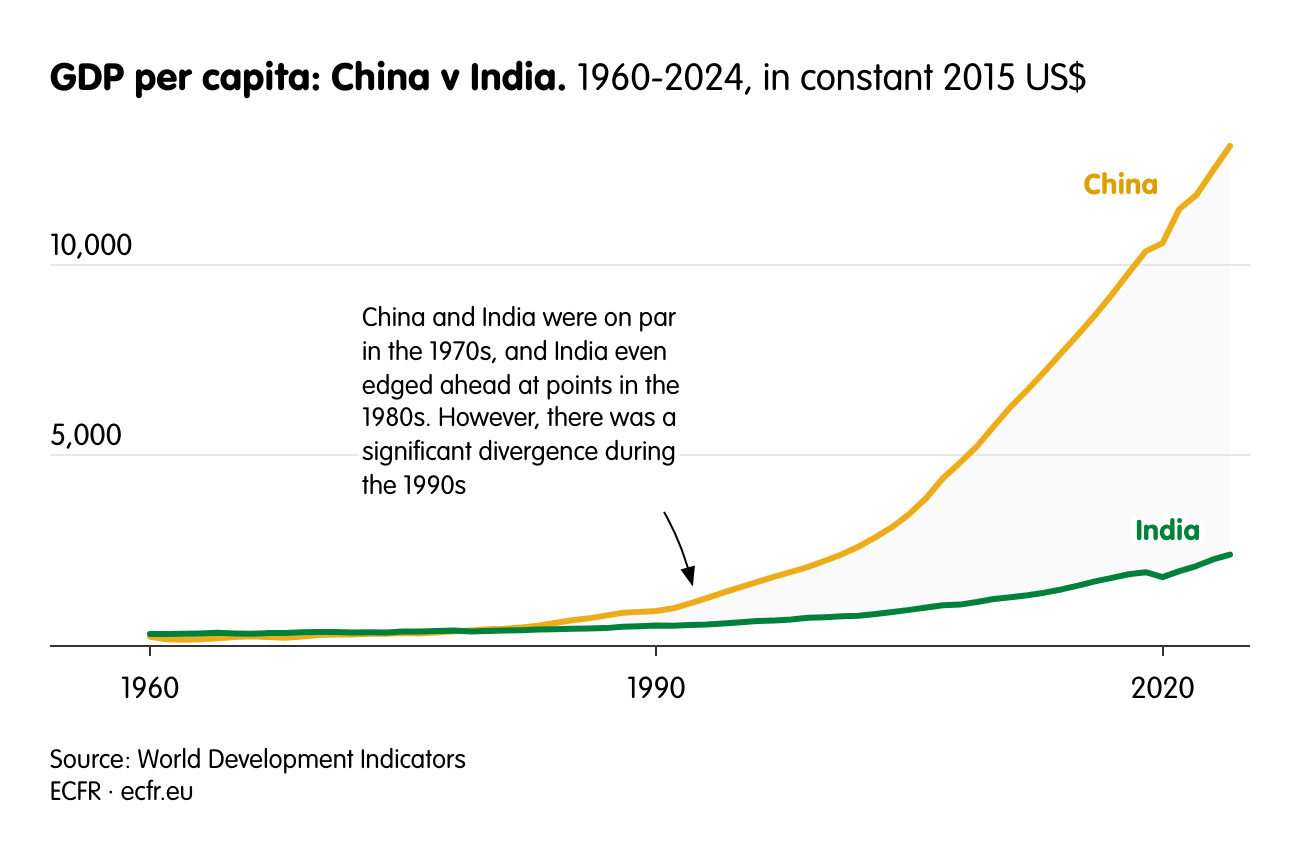
India is now the world’s fifth-largest economy, and many projections suggest it is likely to become the third largest by the middle of this century. But under almost any reasonable scenario, India will continue to trail China, despite its higher GDP growth rate. To take one example, were China to grow at the projected rate of around 4%, it would still grow by around a fifth of the size of India’s economy each year.
China’s economic dominance creates a range of other challenges. India’s manufacturing sector and infrastructure development remains heavily dependent on Chinese imports and supply chains, despite efforts to promote domestic production—especially in critical sectors like renewable energy infrastructure and green technology. This constrains India’s climate transition strategy. China’s strengths have also allowed it to develop a broader strategy of economic statecraft, in particular via the sizable Belt and Road infrastructure initiative. Though keen to position itself as a partner to the global south, India lacks comparable financial firepower, or indeed a true alternative vision of development and modernisation.
Elsewhere, India’s economy remains riddled with barriers to investment, driven by protectionist instincts and adopting a “tough” approach to trade negotiations. In multilateral fora, India is known for intransigence, holding up several World Trade Organisation reforms, for instance, with agriculture being an especially sensitive sector. Many political constituencies continue to view liberalisation with suspicion. New Delhi’s historical aversion to free-trade agreements has prevented it from joining regional economic blocs, notably the Regional Comprehensive Economic Partnership—a major 15-country regional bloc, which includes China and a number of nations in South-East Asia. All of this leaves a considerable gap between the reality of India’s development and its aspirations for global influence.
Elsewhere, India faces particular challenges with climate change and the energy transition. Currently reliant on coal to meet over half of its energy needs and highly dependent on energy imports, New Delhi seeks to transition to green sources such as solar and hydrogen in the coming decades. However, Indian policymakers bristle at attempts to make industry compliant with climate targets, viewing measures like the EU’s Carbon Border Adjustment Mechanism as forms of green “protectionism”. In a country where almost half the population depends on agriculture, climate change not only threatens livelihoods but also increases the risk of uninhabitable temperatures. As extreme weather events become more frequent and severe, climate adaptation requirements will strain government resources and institutional capacity.
Domestic governance
India’s final set of challenges relate to its complex domestic politics. Some observers describe India as a “state-nation”, where the government, through a federal structure, seeks to integrate a wide range of linguistic, cultural and religious identities. This helps it cope with political diversity but can pose governance hurdles. Although states play a limited role on foreign affairs, they can have a significant impact on economic development. In practice, this can become fractious. Several of India’s more economically developed states, such as Tamil Nadu and Kerala, are ruled by parties other than Modi’s BJP. Complaints about being denied funds from the centre and clashes with centre-appointed state governors are common. A long-deferred national census, now due to conclude in 2027, has heightened political divisions, given it could lead to a reallocation of electoral seats to Hindi-speaking heartlands in the north—BJP’s stronghold—at the expense of opposition-ruled states in the south.
In addition to state-centred friction, the federal model is often a challenge for business investors as important laws, like labour regulations, are decided at the state level rather than in New Delhi. Pro-business measures such as the introduction of a uniform goods and services tax in 2017 aimed to centralise and simplify tax laws, but implementation has been uneven. States such as Andhra Pradesh and Tamil Nadu have announced measures to attract foreign investment via ambitious manufacturing plans and defence industrial corridors, but these will have limited impact without support from the centre and overall simplification of red tape. One recent study found the construction of a solar plant required 2,735 compliance tasks, suggesting major barriers even for a country keen to establish itself as a leader in producing solar energy.
The ascendance of the BJP under Modi has defined the Indian political landscape in recent years, and the trinity of Hindi, Hindutva and Hindustan has gained prominence. Modi has roots in the Rashtriya Swayamsevak Sangh , an organisation generally considered to be a right-wing, nationalist volunteer organisation created before India’s independence with the intent of realising a Hindu Rashtra (Hindu state). At its most benign, Hindutva seeks to emphasise India’s ancient Hindu spiritual heritage in forms such as ayurveda (traditional Indian medicine). In practice, this agenda often comes with anti-Muslim sentiment, historical revisionism and singling out of other minorities. Modi has pushed ahead with a range of Hindutva-inspired domestic policies, including modifying curricula, renaming cities with perceived Muslim heritage and constructing temples. He has also overseen an increase in censorship through the blocking of websites and restrictions on foreign NGOs and scholars. Security concerns have also been used to restrict civil liberties: in 2024, for example, India had the highest number of government-ordered internet shutdowns globally. These moves are reflected in public attitudes, with research suggesting 85% of Indians support rule by a strong leader or the military. Western partners, including the EU, have previously been critical of the government’s record on human rights, although they are increasingly willing to look beyond this issue as they seek wider geopolitical partnerships.
Modi and his supporters see no contradiction between Hindutva and rising future geopolitical power. On the contrary, to this way of thinking, civilisational strength and unity is actually a precursor to India’s rise as a future great power. However, liberal-minded Indian thinkers are more alarmed by these developments, as India moves away from the kind of secular, multi-faith values enshrined in its constitution in 1947. Evidence pointing towards the degradation of core democratic institutions risks tarnishing India’s position as the world’s largest democracy—a core source of soft power that has historically differentiated it from authoritarian competitors like China, while enhancing its appeal to Western partners. A nation more polarised and fractured between its peoples and regions is also less likely to build the kind of strong, inclusive economic and governmental institutions that can underpin rapid economic development. Modi’s policies also risk intensifying internal communal tensions, notably with the country’s sizable Muslim minority, while exacerbating tensions with Muslim-majority neighbours like Pakistan and Bangladesh. This may force India to redirect scarce security resources towards managing domestic or regional challenges, rather than towards more pressing strategic threats emanating from China and elsewhere.
Towards a deeper EU-India partnership
India sees today’s moment of global upheaval as more opportunity than threat. Viewed from New Delhi, a multipolar future will protect Indian strategic interests, provide new opportunities for expanded influence and potentially even realise a more specifically Indian vision of global order. From almost any perspective, India will be a more influential voice in world affairs in the decades to come. But that positive long-term trajectory comes with more immediate challenges, which in turn explain how New Delhi approaches international partnerships—and why Europe should become a more attractive partner.
Managing China remains India’s central strategic concern. New Delhi has already begun to try and stabilise ties with Beijing. Deep-rooted structural tensions make a significant breakthrough in India-China relations unlikely, however, as border disputes, economic competition and broader geopolitical rivalry push India to balance Chinese influence. Trump’s return to Washington now provides a second structural challenge. Leaders in New Delhi perceive his recent policies as a direct threat to their interests. They also have belatedly recognised that the US under his leadership will be a far less reliable partner, calling into question a strategy of strengthening US relations as the primary response to China’s growing power.
To compensate for a diminished US partnership, India will double down on multi-alignment. This approach provides “geopolitical option value”, meaning the ability to maintain flexibility to respond to changing circumstances without being locked into alliances or rigid partnerships. It also allows for the widest possible array of relationships, from traditional powers like Russia to emerging partners in the global south. India’s vision of global order—part Westphalian respect for sovereignty, part reformed rule-based institutions, part civilisational pride in its ancient heritage—will remain central to this policy.
These changes mean India’s broader geopolitical calculations are evolving in ways that favour deeper engagement with Europe. European leaders share India’s concerns about Chinese economic practices and security threats. Trump’s return means both sides are struggling to deal with a far more capricious America. For those seeking stronger ties between the two sides, it is hard to imagine a better set of geopolitical circumstances—although there is no room for complacency. The risk is that Trump’s policies in Washington will now tarnish not merely the US but also European nations, given their historically close ties. Certainly, this is what New Delhi is likely to hear from China and Russia, given their critical views of the West in general.
European leaders’ recent accommodations to Trump—accepting the demand that NATO countries spend 5% of their GDPs on defence and endorsing a trade “deal” that leaves Europe worse off—may seem pragmatic. But these deals could also damage trust among countries who, like India, are being pressured by Trump’s aggressive tactics. As Europe urges India not to shift away from the West, it must do more to demonstrate its reliability as a partner. In particular, Europe must take care to avoid short-term policies that seek to win favour in Washington at the expense of its reputation with emerging partners elsewhere.
The economic foundation for deeper partnership already exists, albeit in underdeveloped form. European investment in India remains low, suggesting significant untapped potential. Long-awaited plans for an India-EU free-trade agreement should help to start this process, if it can be agreed in time for a planned Europe-India summit in early 2026. India and Europe have also agreed to develop a fully fledged defence and security partnership; while necessarily more limited than India’s partnership with the US, it still offers potential. European programmes like Permanent Structure Cooperation (PESCO), where select external partners can participate in specific defence projects alongside EU member states, can also help, allowing India to engage with European defence capabilities.
Technology cooperation represents perhaps the greatest opportunity for transformation of the India-Europe relationship. While India will maintain relations with countries like Russia, it sees greater geopolitical value in integration with advanced industrial economies, particularly through investment and technology transfer partnerships. Green technology cooperation offers opportunities to address climate change while building Indian industrial capabilities. Defence technology cooperation can provide alternatives to legacy Indian suppliers. America’s retreat from international leadership creates spaces that India and Europe can occupy, for instance in India’s hosting of next year’s global AI action summit. The EU-India Trade and Technology Council, despite its slow start, provides a plausible institutional framework for advancing cooperation in areas from AI to quantum computing and digital infrastructure, where European expertise and regulatory frameworks complement India’s large domestic market and growing technological capabilities.
There are of course many barriers remaining. Previous hopes for Europe-India progress have often fallen short. The two sides’ interests are far from perfectly aligned. Both worry that the other may decide to repair further their relationship with China, limiting space for more constructive ties with one another. Divisions also remain clear over Ukraine. Europe hopes for an unlikely Ukrainian military victory and a diminished Russia. India would welcome a future of less strained ties between Russia and the West, which would make its own ties with both sides less problematic. There is a risk that European measures used to target Russia, including secondary sanctions, could harm Indian interests. Beyond these strategic differences, bureaucratic barriers have also often frustrated progress in building Europe-India ties, as both sides struggle to find the right institutional mechanisms that deliver concrete results—whether at the EU level or with individual member states.
At the most basic level, future India-Europe cooperation should be rooted in a clear set of shared interests, underpinned by new European strategic seriousness. Europe’s response to Ukraine—and more generally the development of what von der Leyen has called a “geopolitical Europe”—have all led India to view Europe as a more credible international partner. As European nations bolster defence spending to adapt to a more serious geopolitical environment, they have convinced Indian policymakers that partnership with Europe can deliver tangible security benefits, in addition to economic and technological opportunities. When combined with the unpredictability of Trump’s return, this creates a basis for both sides to establish deeper cooperation—taking advantage of a window of opportunity that may not remain open for long.
About the author
James Crabtree is a distinguished visiting fellow at the European Council on Foreign Relations.
Acknowledgments
This report was researched and drafted with support from Anunita Chandrasekar. Both its author and researcher are grateful to those who provided input and insights during the research process, including Kanti Bajpai, Nisha Biswal, Rudra Chaudhuri, Pramit Pal Chaudhuri, Lisa Curtis, Hervé Delphin, Lindsey Ford, Phillip Green, Suhasini Haidar, Dhruva Jaishankar, Prashant Jha, Saurabh Kumar, Ashok Malik, Pratap Bhanu Mehta, Raja Mohan, Nandan Nilekani, Janka Oertel, Srinath Raghavan, Manisha Reuter, Ashley Tellis, and Milan Vaishnav.
This paper is part of the Middle Power Portraits series for the Re:Order project. It was made possible with support from Stiftung Mercator, but does not necessarily represent the views of it.

The first paper of the series focused on Brazil.
The European Council on Foreign Relations does not take collective positions. ECFR publications only represent the views of their individual authors.