The trouble with FCAS: Why Europe’s fighter jet project is not taking off
The disagreement over the Franco-German-Spanish fighter aircraft system, FCAS, shows that when it comes to building a European defence industry, political will is not enough

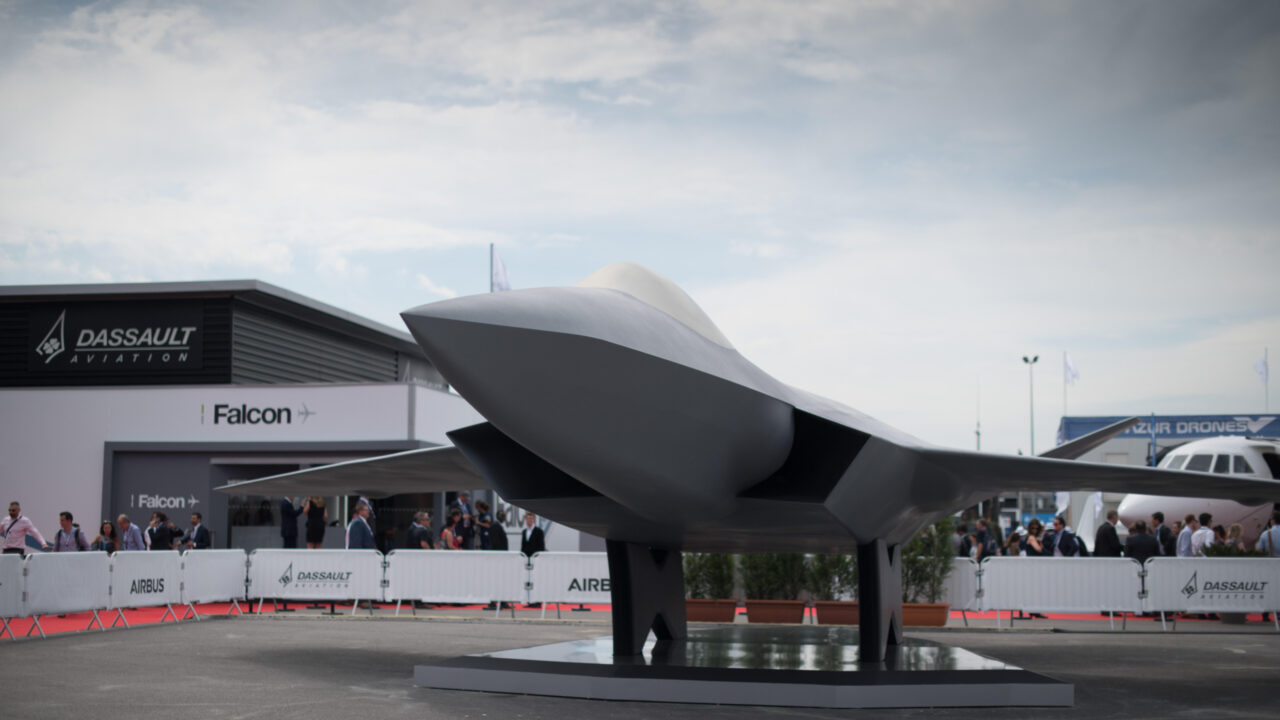
Before the end of the year, France and Germany will decide whether the €100bn Future Combat Aircraft System (FCAS) has any future. German defence minister Boris Pistorius was in Paris in late November to exchange with his French counterpart Cathrine Vautrin. Yet after the meeting, it was no clearer if the project to build a European fighter jet will survive. A day later, German chancellor Friedrich Merz welcomed French president Emmanuel Macron in Berlin for a meeting on European digital sovereignty. The pair appeared unified and laughing—possibly because again, no official statement on FCAS had been made.
For years now, FCAS has been synonymous with Franco-German troubles. The project was supposed to bring the two partners closer together and build a central pillar of Europe’s military sovereignty. Now, rumour has it that the fighter jet part could be scrapped. A fighter jet project without the fighter jet—while this sounds like the perfect metaphor for the state of Europe’s defence abilities, it could well be the only way to salvage the project.As the EU pushes a stronger and more unified defence industry, backed by €800bn, FCAS shows that political will and money will not be enough. Indeed, the drama around one of Europe’s largest joint defence projects could be a lesson on what not to do.
What is FCAS?
FCAS is a French, German and Spanish project to build a European sixth-generation fighter jet system. This generation typically includes improved stealth, use of AI and an ability to deploy cyber warfare. FCAS is supposed to replace the European aircrafts of the 4.5 generation like France’s Rafale, and Germany’s Eurofighter. The project was officially launched in in 2018 though the concept is older. Spain joined a year later but, in the debates, it has appeared as junior partner looking on while Berlin and Paris fight.
Crucially, FCAS is more than a fighter jet. It consists of three pillars: first, the jet itself, also known as Next Generation Fighter; second the combat cloud, a system to link all parts of FCAS with each other as well as with other systems; and third, the “remote carriers”, a swarm of highly autonomous, possibly armed drones.
The idea of FCAS was to build up Europe’s own technological capabilities, independent from America. Europeans have not built a fifth-generation aircraft and risk losing the technological expertise if they do not work on a sixth-generation jet and its accompanying elements.
The project brings together France’s Dassault Aviation, Airbus Germany and Spain’s Indra Systems, alongside secondary companies from all three countries and myriad smaller suppliers.
In an effort to ensure the functioning of the cooperation—especially with industrial partners that are competitors—an agreement was made on leadership. Dassault got the lead of the Next Generation Fighter while Airbus leads on the Combat Cloud and the Remote Carriers. (Spain’s Indra has the lead in the sensors sub-pillar.) France got the overall lead of the FCAS project, while Germany leads on the sister tank project, the Main Ground Combat System (MGCS).
Why are there so many issues?
From its inception, FCAS has been plagued by problems. In Berlin, an often-expressed sentiment behind closed doors is that France just wants Germany to pay for their aircraft, while the French feel that Germany is trying to steal their intellectual property and their market share in defence.[1] As France’s defence industry, especially its aircraft manufacturing, has long been a source of pride and a significant employer, Paris is taking the concern seriously.
This disagreement is loudest over the fighter jet pillar. Germany has more money (especially with the recent changes), while France has more experience in building fighter jets: Dassault built the Rafale by itself, while Airbus has only been one partner in the Eurofighter consortium. Vautrin, the French defence minister, noted in a recent interview that “Germany today has not the ability to build an aircraft”, a claim disputed in Berlin.
The main point of contention is over what “leadership” means. Dassault has been advocating for a model where the leader is completely in charge, meaning that little intellectual property is shared, and subcontractors are chosen by the leader. Dassault CEO Eric Trappier, has been very outspoken in his criticism of the project. “I don’t mind if the Germans complain. Here, we know what we’re doing. If they want to do it themselves, let them do it themselves”, he recently told the French press.
Airbus’s CEO responded in kind, proposing France leave the project. The German approach to project sharing is focused more on sharing knowledge and working together, exactly because Germany wants to acquire more capabilities in building a next-generation fighter jet. Given the gap in knowledge on aircraft manufacturing, the French see this as Germany trying to get their hands on French know-how.
Over time, new problems have emerged. On the German side, Russia’s invasion of Ukraine caused Germany to proclaim a Zeitenwende, or turning point. This led to the Bundestag freeing up a lot of money for defence acquisition and to a closer inspection of German defence capabilities and projects. Pre-2022, Berlin saw common European defence projects primarily as a way to improve pan-European cooperation. Since, Berlin has become more attentive to and knowledgeable on military matters—and it has begun questioning elements of FCAS. Berlin’s relationship with the defence industry has also changed: largely a pariah before the Zeitenwende, defence manufacturers such as Rheinmetall have gotten closer to the government and Berlin is more interested in pushing the industry’s interests.
Things look different in France, too. Most crucially, Dassault’s standing has grown as the Rafale fighter jet became an export hit—the United Arab Emirates ordered 80 in 2021. The Rafale has become France’s main military export: in 2022, the jets accounted for two-thirds of the country’s €27bn in arms exports. Losing this advantage would create significant economic problems in an already fiscally strained country.
The different stances on arms exports in Berlin and Paris are creating disunity. France generally approaches defence exports in a strategic manner. Germany, on the other hand, is reticent when it comes to exporting arms beyond its closest partners. The two are even managing to spat over the exact design of the aircraft with France wanting a lighter aircraft, able to start from its carriers, Germany favours a heavier system able to fly further.
What now?
Europe needs to build up its strategic sovereignty, and France, Germany and Spain need a fighter jet. Yet FCAS is stuck
Europe needs to build up its strategic sovereignty, and France, Germany and Spain need a fighter jet. Yet FCAS is stuck. The project is already delayed: the system was supposed to be operational by 2040, now that date has been pushed to 2045. A demonstrator aircraft was initially expected for 2027, a date impossible to be met now, as no work on said demonstrator has begun.
As fronts harden, the rumoured plan to go in different directions on the jet, while staying together for the rest, could be a way out of the impasse. But such a split will cause further discussions on the leadership question. As Airbus leads on both the cloud and the drones, it seems unlikely that France would accept continuing in this vein. Also, Dassault, as well as other French companies are already active in the drone market. It is therefore uncertain whether a cooperation on the remote carriers would be wanted. With the jet abandoned, it is possible the drone swarm to accompany it may go too, leaving only the cloud part of the original project remaining. While this is a worthy endeavour and a way to become more independent of the US, it is hardly the ambitious idea that FCAS was.
France, Germany and Spain would still need fighter jets. Dassault will want to go at it alone, but given French fiscal constraints, a purely national solution might not be as easy as Trappier would like. Germany is unlikely to build a jet by itself, but the alternative to join the British-Italian-Japanese GCAP cooperation will not be straight-forward as the project is already under way and Britain is taking the lead.
A partial failure of FCAS will send a problematic message; it looks as if despite political willingness, a truly European defence industry cannot emerge as long as incentive structures on industrial and economic interest are national and make compromises too costly. If it fails, even partly, FCAS will show that a European defence industry, and thus Europe’s strategic sovereignty, are still pipe dreams.
The author is a member of an Airbus working group on the responsible use of new technologies in FCAS, on a voluntary basis.
[1] Author’s conversations with German and French defence ministry officials in Berlin and Paris, throughout 2025.
The European Council on Foreign Relations does not take collective positions. ECFR publications only represent the views of their individual authors.