Support, tolerate, reject: The Russian response to Trump’s Ukraine peace plan
The draft US peace plan to end Russia’s war on Ukraine appeases many Russian demands. Yet Moscow will likely still find the deal unacceptable

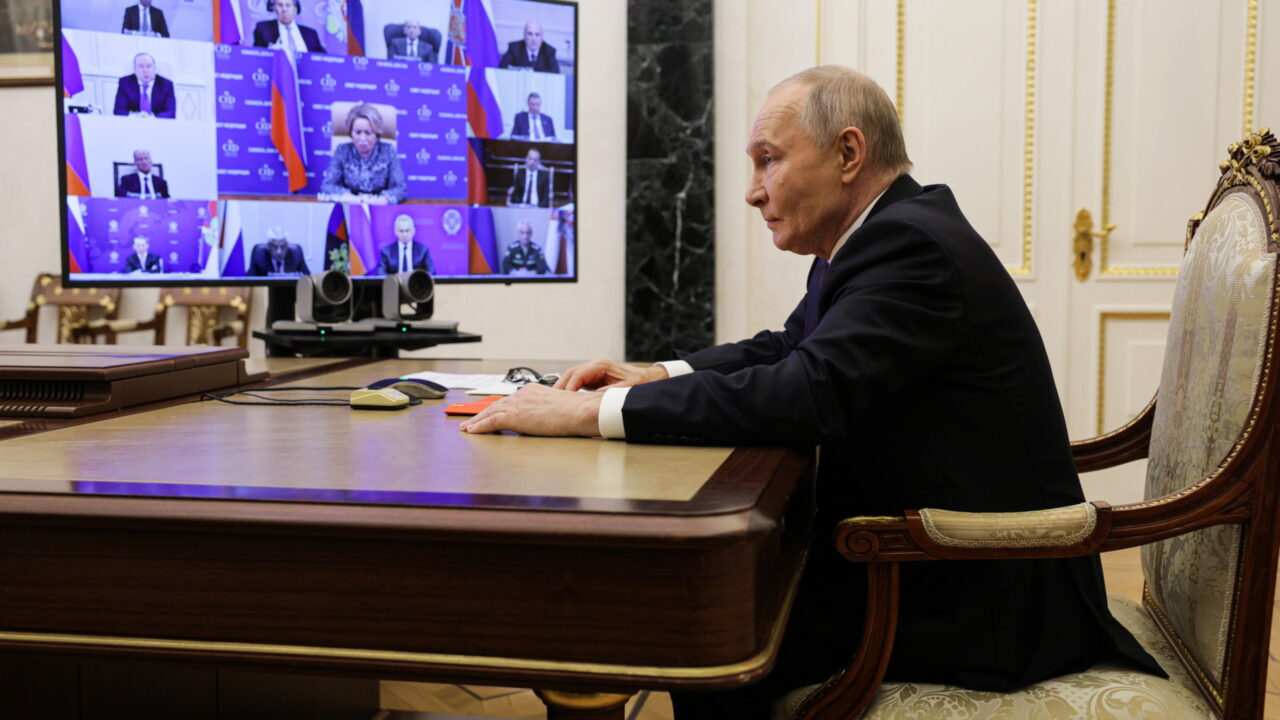
To read the commentary in Western capitals, one might think President Donald Trump’s leaked plan to end the war in Ukraine was Russia’s dream document. The plan is likely based on the ideas of Russian diplomat Kirill Dmitriev and compiled by US special envoy Steve Witkoff, who added in some American proposals. Even secretary of state Marco Rubio told US senators it is Moscow’s “wish list”.
Little more than 24 hours after the plan was leaked, Trump softened his deadline for Ukrainian compliance, calling it “not the final offer”. European governments, meanwhile, together with Canada and Japan, were quick to draft an alternative far closer to Ukrainian demands. Rubio has since appeared with a Ukrainian delegation to unveil an “updated and refined peace framework” that would “fully uphold” Ukraine’s sovereignty. Presumably, Americans will now have to travel to Moscow to discuss the updated plan’s provisions with Russia.
For all the talk, leaders in the Kremlin are likely dissatisfied with what was already on the table. The draft is often vague, contradictory and occasionally absurd. But it nonetheless is the first written outline of a possible endgame, and this makes it a useful guide to what Moscow would support, tolerate or outright reject.
The Kremlin’s likes and dislikes
A number of provisions go straight to the heart of Russia’s key demands: Ukraine’s NATO aspirations. Under the draft, Kyiv would have to enshrine a “no-NATO” clause in its constitution, while—depending on how one interprets the clumsy wording—NATO would refuse to accept Ukraine and possibly refrain from expanding anywhere else. No NATO troops are to be stationed in Ukraine, and Ukraine would reduce the size of its army from around a million to 600,000 troops.
Moscow would endorse the “no-NATO” part. But it would likely demand strict, legally binding commitments—for instance, a formal disavowal of the 2008 Bucharest NATO summit decision that Ukrainian membership was possible. However, a 600,000 strong Ukrainian army is unacceptable to Moscow, which demanded just 80,000 troops in 2022. Moscow might be willing to negotiate the precise number, but this cap falls far short of the “demilitarisation” Russian officials have insisted on since the war.
On Russia’s longstanding objective of “denazification”, the draft gives Moscow some rhetorical wins: the protection of the Russian language and of the Russian Orthodox Church in Ukraine.
Far more problematic for Moscow is territorial recognition. The draft only grants de facto status to Russia, freezes territory at the line of contact, and creates a demilitarised zone in the remaining Ukrainian-controlled part of Donetsk Oblast. While this is already unacceptable to Ukraine for violating its sovereignty, it would not be enough for Moscow, which seeks full legal recognition of its “gains”. For Moscow, de facto status means circumstances could change and Russian control of these territories could be challenged—not tomorrow, but perhaps years in the future, after Vladimir Putin is gone. A non-aggression pact would not alleviate that fear. From the Kremlin’s perspective, all of its military gains are already de facto Russian.
Security guarantees present another impasse. The document does not specify what Ukraine would receive under this deal. Russia will only accept guarantees in which it holds veto power and can effectively decide what is a breach of the peace treaty and what is an appropriate response.
The money and the mirages
The plan also outlines a curious American ambition: to profit from providing security and participating in Ukraine’s reconstruction. The document states that the US would use $100bn of frozen Russian assets for reconstruction and keep 50% of the profits. The remaining assets would be used for a “special US–Russia investment instrument for joint projects aimed at strengthening mutual interests and long-term stability”. All told, Washington would make use of some $300bn of Russian frozen assets. Moscow might grudgingly write off these funds if its other demands are met. In practice, it already operates as if this money is gone.
More important for Moscow is sanctions relief. Yet here the draft lacks a definitive framework, offering that they will be discussed and agreed upon individually and gradually. Moscow will certainly insist on a solid, binding plan for sanctions relief with guaranteed timelines that cannot be unilaterally revised by the US or EU.
The Kremlin might quietly smile, however, on the absence of the EU. The 28-point plan envisages no role for the bloc in shaping the agreement and has direct commands from the America to its Europeans counterparts. First, the EU must hand over all frozen Russian assets it holds. The US-backed plan also dictates that EU/NATO forces be stationed in Poland, requires the EU to spend $100bn on Ukraine’s reconstruction, mandates that the EU lift sanctions on Russia according to whatever timetable the US and Russia agree upon, and expects the EU to fast-track Ukraine’s EU integration while granting it no major role in Ukraine’s post-war security architecture.
And then come the oddities. At various points in the document there are some downright bizarre provisions. A clause stating that “if Ukraine unintentionally fires a missile at Moscow or St. Petersburg, the security guarantees become invalid” implies that attacking other cities would be acceptable, for example. Then there is an outright error in calling for the prolongation of the US-Russian nuclear arms treaty, START-1, which expired in 2009. (Moscow would, however, fully endorse continuation of the New START treaty, which expires in February 2026.) Such additions make the document appear a very rough draft indeed.
The rest of the plan is filled with either secondary topics that could be negotiated or slogans that carry no real weight. This would give Putin plenty of room to demonstrate “willingness to compromise” by agreeing with these points—while the critical points of contention would prove nearly impossible to resolve: territory, NATO, the size of Ukraine’s armed forces and sanctions relief.
The draft would give Putin plenty of room to demonstrate “willingness to compromise”—while the critical points of contention would prove nearly impossible to resolve
The real problem for Moscow—and everyone else
Moscow’s core demands towards Ukraine have not moved an inch.No matter how well drafted and thought out a European plan or any subsequent US draft may be, no plan with US, EU and Ukrainian involvement stands any real chance of being accepted in the Kremlin. This leaves two possible outcomes.
The first: Moscow torpedoes the proposal altogether. This would allow Trump not to blame Ukraine and continue support. The second: Moscow engages just enough to create at least a hypothetical opportunity of possible compromise. The latter, however, remains unlikely. Either way, even if to those in the West it seems like a gift to Russia, the 28-point plan still falls short of its longstanding wish list. The more probable scenario is that the US, the EU, and Ukraine reach some baseline compromise, only for Moscow to eventually reject the plan as insufficiently satisfying its core demands.
The European Council on Foreign Relations does not take collective positions. ECFR publications only represent the views of their individual authors.