From partners to rivals: What the Saudi-UAE rupture means for Europeans
Saudi Arabia and the UAE are experiencing a fracture in their diplomatic relationship. Europeans need to understand the potential impact on their economic and political interests

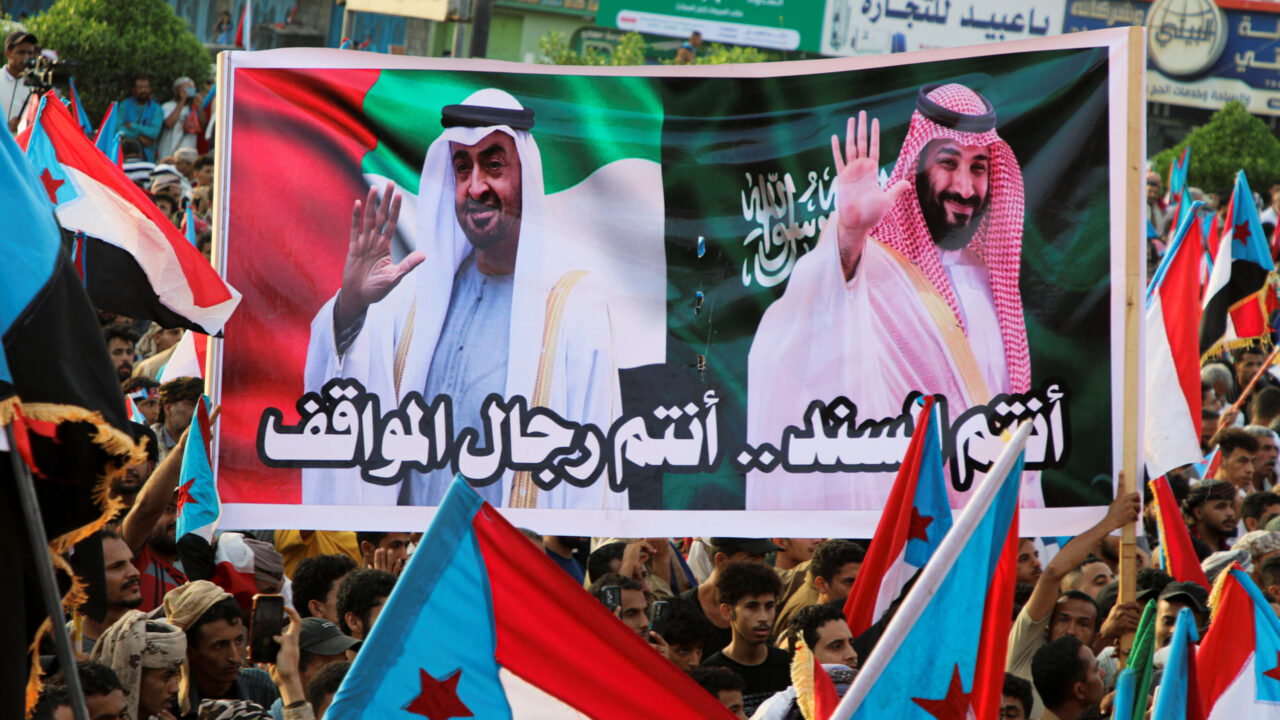
In December 2025, the UAE-backed Southern Transitional Council (STC) launched a major offensive in Yemen’s Hadhramaut and al-Mahra regions, seizing key territory across the south. Its close proximity to the Saudi border escalated tensions with Riyadh, which viewed the move as a threat to its national security, and as a break in its understanding with the United Arab Emirates.[1] Saudi authorities then called for UAE forces to withdraw from Yemen and carried out strikes on shipments and facilities apparently linked to STC operations.
But this rupture reflects a geopolitical divergence between Riyadh and Abu Dhabi which goes well beyond Yemen. A once tightly coordinated Arab Gulf partnership has given way to a geopolitical competition playing out across the Middle East, Africa and the Red Sea.
Now the two countries are competing for control of economic, mineral and energy resources—and for crucial technologies, such as AI. In all of these spheres, heightened Saudi-Emirati competition will directly impact European governments, which maintain strategic interests with both countries. Europeans need to avoid becoming arenas for the rivalry by approaching the rift in a balanced way—and by focusing on mitigating further regional conflict.
Broader geopolitical implications
Gulf vision fractures
In September 2025, after years of no contact, UAE president Mohammad bin Zayed visited Saudi crown prince Mohammad bin Salman following the Israeli strike on Qatar. Mohammad bin Zayed then visited Doha to explore the creation of a unitary and functional Arab Gulf front equipped to respond to shifting regional geopolitics. Now, however, the rupture has destroyed the rare momentum which existed for them to develop a “Gulf vision” across the wider region. The Saudi-Emirati strategic alliance, based on the already strained personal relations between their leaders, has collapsed.
With Iran weakened, traditional regional powers like Egypt struggling to lead and Turkey stretched across multiple geopolitical theatres, coordination between Abu Dhabi, Doha and Riyadh could have created an alliance through which the Arab Gulf states presented a united front to the rest of the world. But persistent political mistrust and second guessing, alongside mutual suspicion of parallel agendas, has eroded mutual confidence.[2] Recent developments in Yemen finalised the break—now the key theatre of conflict is the Red Sea and Israel’s growing presence here, through which it seeks to consolidate its hegemonic regional ambitions.
Saudi Arabia’s geopolitical calculation
Had the STC offensive in Yemen been successful, it would have gained control of the Bab al-Mandab Strait. Riyadh considers the group an untrustworthy proxy of the UAE: the STC has openly offered Israel normalisation and security cooperation in exchange for Israel supporting the STC’s independence aspirations for south Yemen. Israel already had an intelligence presence on the Yemeni island of Socotra, which until December was under UAE control. Israel also recently recognised the breakaway republic of Somaliland in exchange for military access, intersecting with a long-standing Emirati presence at the Berbera port.
Saudi Arabia is resisting pressure to normalise relations with Tel Aviv and believes strategic alignment between the UAE and Israel amounts to attempted encirclement
In Sudan, Saudi Arabia supports the Sudanese Armed Forces (SAF) and central government. However, the UAE backs the Rapid Support Forces (RSF), which controls much of Sudan’s informal gold trade and inland routes toward the Red Sea, and has relations with Israel. Saudi Arabia is resisting pressure to normalise relations with Tel Aviv and believes strategic alignment between the UAE and Israel amounts to attempted encirclement.
Riyadh will continue to pursue leadership across the Middle East with the objective of containing an increasingly hegemonic Israel—and to weaken Emirati reach. For example, it is coordinating an expansion of its defence alliance with Pakistan towards Turkey and pressing Egypt to restrict airspace for Emirati cargo flights that it suspects are supplying the RSF in Sudan. At the same time, Saudi Arabia is brokering the transfer of Pakistani fighter jets to the SAF.
Implications for the UAE
But the UAE also has substantial leverage across regional capitals, as well as international clout. Following the STC’s incursion, Egyptian and Turkish leaders first coordinated with Saudi Arabia—and then contacted their Emirati counterpart to ensure they maintained geopolitical balance.[3] Countries like Syria, Lebanon, Iraq and even Palestine—which depend on the Arab Gulf capitals for vital reconstruction funds and are enmeshed in Israel’s security agenda—risk being further destabilised by the pressure to take sides in the Saudi-Emirati rift.
The UAE has witnessed the STC succumb to Saudi pushback. Now Abu Dhabi may also opt for caution and seek immediate de-escalation, but it will not conform to Riyadh’s regional preferences or demands across the board. It may even quietly deepen its alignment with Israel as a strategic multiplier in the region—a country with resources, networks and influence—to multiply its partners’ reach. Closer UAE-Israeli alignment would enable Saudi Arabia to portray the UAE as aligning with a government culpable of committing atrocities against Palestinians—as an Arab consensus emerges that Israel, not Iran, is the region’s major destabilising actor. On the other hand, the UAE’s tighter alignment with Israel might secure political support from the United States.
Indeed, Saudi confidence to break openly with the UAE strengthened after Mohammad bin Salman’s visit to Washington, when the Trump administration convinced him that the president is unlikely to side with Abu Dhabi in the event of an Arab Gulf rift. However, Emirati networks in Washington have proven resilient before, even on extremely sensitive issues such as China and Russia. They will likely be able to weather any Saudi pressure campaigns which come their way.
What this means for Europe
Balance, not neutrality
Both countries will likely try to involve their international partners—including China, India, the US and key European states such as France—into this geopolitical competition. As such, Europeans should move carefully, like they did during the 2017 diplomatic crisis with Qatar.
While escalation is unlikely to result in another political boycott and economic embargo, European capitals should expect a similar trajectory: acute tensions in the short to medium term, followed by eventual recalibration and reconciliation. This will likely be achieved through a compromise moderately favourable to Saudi Arabia. But the UAE today is in a stronger position than Qatar was eight years ago. And Europeans may overestimate Saudi Arabia’s ability to organise regional outcomes, especially when confronted with Emirati countermoves.
However, balance does not mean neutrality. Europeans need to align with each country when their core interests are at stake. Saudi Arabia is presenting the UAE as supporting secessionist projects and political fragmentation via local proxies and parallel governance structures. Meanwhile, Riyadh increasingly favours state-to-state stabilisation—even with imperfect partners—as a means of reducing volatility and securing borders. This aligns better with Europe’s priorities.
In Sudan, Europeans should support current Saudi pressure to nudge Emirati policies towards accountability for RSF war crimes. On maritime security and smuggling, Saudi Arabia is poised to become a more relevant interlocutor than the UAE—but on piracy, the opposite is more likely.
Protecting trade and connectivity
A greater European role in Red Sea security will be necessary to protect connectivity and geoeconomics interests. Saudi-Emirati tensions mean progress over the India-Middle East-Europe Economic Corridor (IMEC) land route, which links Israel, Jordan, Saudi Arabia and the UAE, is unlikely. Now the Saudi-Emirati split also reinforces the idea that Europeans should support an additional branch of IMEC, which uses Oman as an entry point, as a good de-risking strategy.
Indeed, greater bilateralism can be useful for the European Union, too. It should utilise the new Strategic Partnership Agreement (SPA) process to prioritise bilateral engagement with both Riyadh and Abu Dhabi and encourage Saudi Arabia to respond to the invitation for SPA negotiations—matching the UAE’s positive response. The EU making bilateral, rather than region-to-region, overtures towards both Riyadh and Abu Dhabi means it will be in a better position to secure bilateral talks on everything from trade to sovereign AI.
Finally, Saudi-UAE competition might well turn reconstruction into an influence auction in Gaza, Iraq, Sudan, Syria and Yemen. European funds will likely remain indispensable, while European political influence declines. The EU needs to channel constructive competition in the region by matching funds with whichever parties offer sustainable reconstruction and governance support, and disincentivising projects designed primarily to accumulate political leverage.
*
The years-long Saudi-Emirati divergence has erupted under the pressure of rapidly shifting geopolitical conditions across the Middle East and North Africa. The dust is still swirling: protests threaten the stability of the Iranian regime and Israel faces another election in a matter of months, among other developments. Europeans need to remain alert to this constantly changing environment, while being flexible enough to adapt.
[1] Author’s telephone interview with senior Saudi and Emirati officials, January 10th-11th
[2] Author’s telephone interview with senior Saudi and Emirati officials, January 10th-11th
[3] Author’s telephone interview with senior Saudi and Emirati officials, January 10th-11th
The European Council on Foreign Relations does not take collective positions. ECFR publications only represent the views of their individual authors.