Strait talking: What’s behind China’s military drills around Taiwan
China’s recent military exercises around Taiwan highlight its escalating ambitions and hybrid tactics aimed at reshaping the region. Europeans must strengthen their cooperation with Taiwan—and each other—to ensure maritime security

At the Shangri-La dialogue in Singapore on June 1st, French President Emmanuel Macron’s speech was not only focused on the war in Ukraine and the recent changes to the global order. China’s geopolitical ambitions also took centre stage. He asked the crowd if Russia can take Ukrainian territory “without any restrictions, without any constraints…what could happen in Taiwan?”.
The answer to Macron’s question may not lie too far in the future. In early April, China conducted military exercises around Taiwan—these were far more confrontational in tactical posture and propaganda than previous drills. The April 2nd drill was codenamed Strait Thunder–2025A, abandoning the vague euphemisms of past years’, “Joint Sword”.
Alongside the drill, the Chinese armed forces, known as the People’s Liberation Army (PLA), released a series of posters and animated videos. One video depicted Lai as a parasite squeezed between a pair of chopsticks above a burning Taiwan. It accused the Taiwanese government of colluding with foreign forces—an unusually explicit targeting of the country’s political leadership.
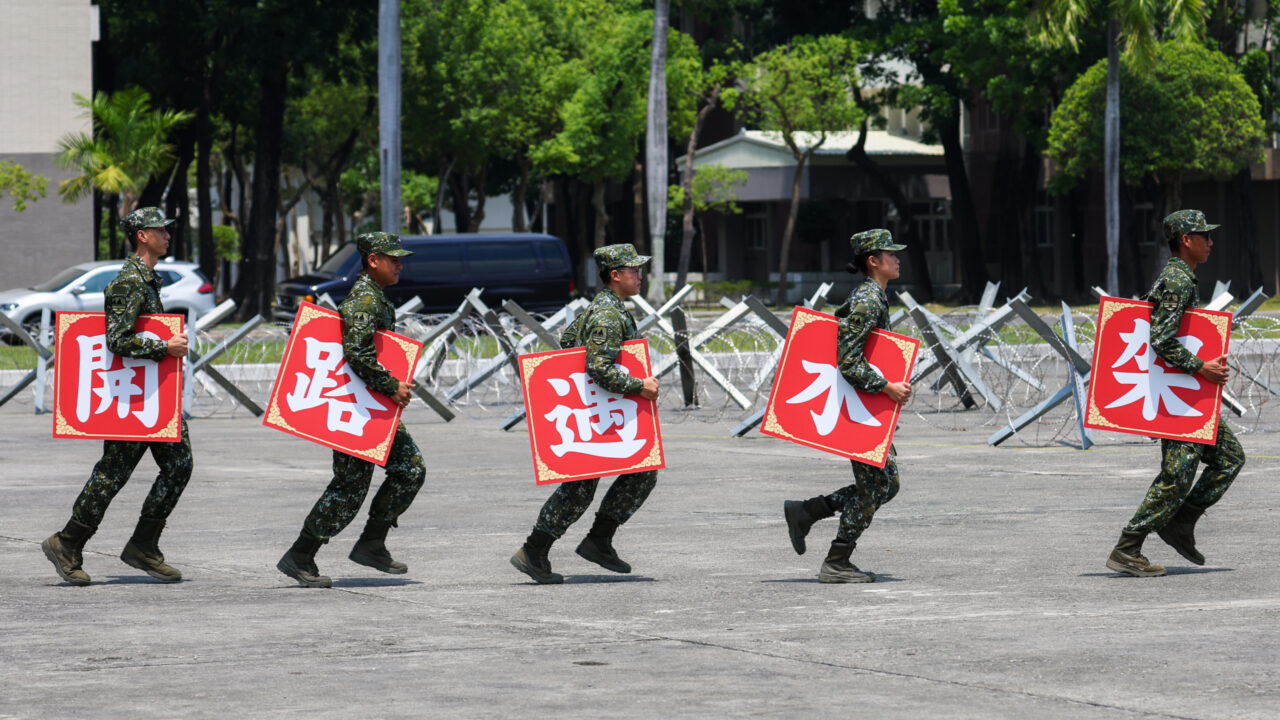
Militarily, China used the drills to demonstrate its joint operations capabilities, emphasing encircling and blockading Taiwan, with a notable escalation in both frequency and scope. Between April 1st and 2nd, 68 out of 135 aircrafts crossed the median line (the most since Beijing’s 2022 military exercise that followed US house speaker Nancy Pelosi’s Taiwan visit). Chinese naval forces came to within 220 nautical miles southeast of Taiwan, along with forces to the west which established a two-side blockade posture. For the first time Taiwanese authorities confirmed some Chinese coast guard ships entered the 24-nautical-mile contiguous zone around the main island.
Meanwhile, rocket forces simulated strikes on critical infrastructure, showing-off China’s precision-strike capability to target key energy and logistics nodes. Even if the drills were not the largest to date, the simulated attacks on key infrastructure and the expansion of coast guard operations signalled the PLA’s intent to develop more sophisticated, hybrid invasion plans.
Just the beginning
Behind China’s drills is a sequential and coordinated campaign of coercion across the western Pacific—driven by a strategic calculation that goes far beyond Taiwan. Rather than merely flexing its military muscles to its strategic rivals, Beijing is likely leveraging these exercises to test the international community’s tolerance threshold.
Rather than merely flexing its military muscles to its strategic rivals, Beijing is likely leveraging these exercises to test the international community’s tolerance threshold
As Macron alluded to in Singapore, China has been studying Moscow’s invasion of Ukraine closely, adjusting its own Taiwan contingency planning as the conflict develops. Among China’s top strategic priorities is avoiding international attention on Taiwan and deterring external intervention—just as Russia has not been able to do.
For Beijing, the drills can thus serve as a testing ground to assess how far Taiwan’s allies might go in response. After the recent drills, the European Union called for “restraint” and for any tensions to be resolved via “cross-strait dialogue”, while the US reiterated its “commitment” to Taiwan. Both however, stopped short of challenging Beijing’s claim that Taiwan is a “domestic matter” or its persistent attempts to exploit grey areas in international law and norms to control the Taiwan Strait.
Western states widely recognise the Taiwan Strait as an international waterway and hold that any unilateral attempt to alter the status quo through force is unacceptable. Yet, Beijing is steadily chipping away at this understanding by normalising short-notice military drills, propaganda offensives and law enforcement operations in the hope of blurring legal boundaries and reshaping the norms of maritime engagement in its favor.
As part of this, Beijing conducted its recent drills in a way that suggests any potential military action will test the international community’s definition of conventional warfare. Such an approach from China will make the decision on if and how to respond all the more difficult. For example, the drills combined blockade and anti-access operations designed to simulate the PLA’s ability to isolate Taiwan from external military and energy aid during wartime. Beijing also employed atypical measures that could fall under maritime law enforcement, among other grey zone tactics. Doing so challenged Taiwan’s jurisdiction over surrounding waters and normalised China’s maritime presence there. For Chinese ships to be in Taiwanese waters under the guise of ‘maritime law enforcement’ for example, signals its attempt to portray the Taiwan Strait as as China’s internal waters which makes the legal basis for supporting Taiwan more difficult.
Together, these actions amount to a challenge not just to Taiwan’s security. They threaten freedom of navigation, the security of global energy routes and test the limits of international law. The codename “2025A” suggests these drills are the first of many. While Taiwan remains the immediate focus, Beijing’s recent actions in the Yellow and South China seas—including building illegal structures and harassing foreign vessels—signal broader ambitions to assert maritime control through hybrid measures. Taiwan may be the frontline, but a future confrontation could span the entire west Pacific region.
Where Europe matters
While Beijing is rewriting the rules of conduct at sea, the international community needs to make clear that any attempt to alter the status quo in the Taiwan Strait comes at a cost. While military deterrence primarily lies with America as Taiwan’s largest military supporter, European states have a meaningful role to play.
Each time China holds military drills around Taiwan, the EU and the G7 reiterate their commitment to peace and stability in the Taiwan Strait and express opposition to coercive actions. These positions are regularly reaffirmed in high-level diplomatic exchanges and official visits. Still, there are ways to enhance the credibility and clarity of such signalling and to address China’s grey zone tactics.
The EU should start by aligning its internal positions. A shared assessment of Taiwan-related risks, and a subsequent pre-agreed response mechanism that specifies which diplomatic toolkits to use in a crisis scenario would go a long way. This response plan should begin with low-sensitivity, high-consensus measures like economic sanctions to more clearly signal European governments’ red lines beyond rhetoric.
Moreover, European navies—including France’s and Germany’s—have already increased their presence in the Indo-Pacific, conducting operations to safeguard freedom of navigation, including transits through the Taiwan Strait. The British Royal Navy has launched Operation Highmast alongside allied nations, including Norway and Canada, currently operating in the Red Sea. The fleet is expected to proceed toward Indo-Pacific waters. Their presence in the Taiwan Strait could serve as a further indication of growing international awareness and engagement regarding the situation in the area.
But hard military presence alone will not address China’s increasingly hybrid tactics, especially as navies do not always possess a clear legal mandate to respond to incidents involving non-military actors, such as coast guard or civilian vessels. The EU and major European governments should reach out to Indo-Pacific democracies including Taiwan to cooperate on issues like countering disinformation and maritime domain awareness. Europeans already have strong information sharing and maritime capability building cooperation with countries like the Philippines, have a security and defence partnerships with Japan and South Korea. These relationships can be built on to develop closer policy coordination and planning over Beijing’s threats to Taiwan, the Taiwan Strait and the west Pacific.
Europeans should waste no time. The chance of crisis could hang between a misfired missile, unintended ship collision, or accidental military encounter during drills. Such “accidents” could also serve as a cover of operation preparation or false-flag incidents aimed at manufacturing a pretext for war.
The European Council on Foreign Relations does not take collective positions. ECFR publications only represent the views of their individual authors.