Where does Liu Xiaobo’s Nobel leave Europe?
China’s anger over the award of the Nobel peace prize to Liu Xiaobo leaves the EU with a hard question to answer: Should it stick to its human rights principles or should it look to compromise on its values in pursuit of the world’s most important rising power?

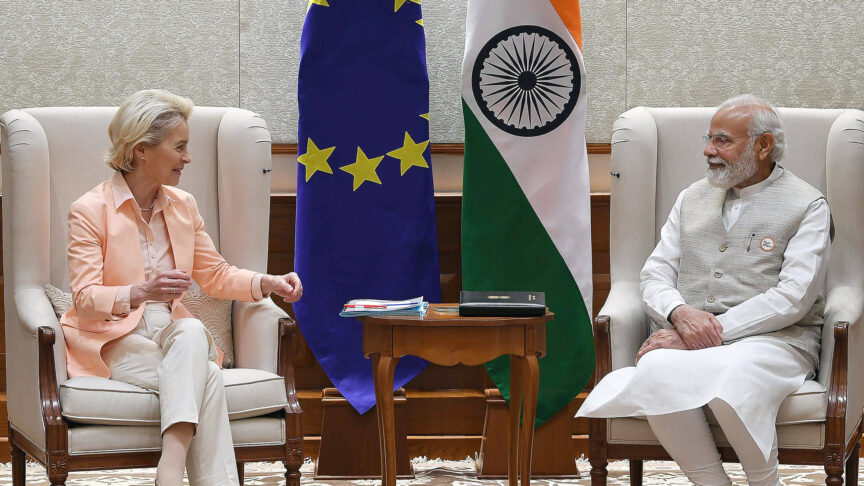
Did anybody notice this reference in Presidents Van Rompuy and Barroso’s statement on the EU China Summit last week?
‘We further had an open discussion about the rule of law and human rights, which for us remains an important element of the dialogue with China. We called for progress in this area, notably in the ratification of the International Covenant on Civil and Political Rights.’
Probably very few did: it was easy to miss amid the EU-speak, and hardly seems sincere given that China signed the ICCPR in 1998 and has been procrastinating on ratifying it ever since.
On the other hand we all noticed, and many applauded, the decision to award Liu Xiaobo the Nobel peace prize on Friday. The Chinese government reacted angrily arguing that this would damage Sino-Norwegian relations; that Liu Xiaobo is a criminal and this award “runs completely counter to the principle of the prize”.
No diplomatic stand on human rights is ever going to please everyone. Many EU officials working in the field of human rights argue that speaking out on individual cases of concern produces more damage to long term dialogue than positive results. But sometimes taking a clear, even tough line, is necessary in order to have some impact. Those close to Liu Xiaobo believe that the attention around his nomination for the prize contributed to an improvement in his treatment in prison – perhaps more than numerous enquiries about him in the context of EU-China human rights dialogues have done.
It doesn’t have to be the case that the decisions of an essentially undemocratic committee for a prize that is over a century old should represent more of a challenge to the Chinese government on human rights than the leaders of the world’s largest trading bloc seem able to do. And yet, because the EU fails to take a consistent approach, or back up what it says it stands for on human rights, that is exactly where we seem to be. Different EU member states’ interests in China seem to take precedence in the collective position at different times and in different meetings. And at every summit and human rights dialogue, when human rights actually are discussed, despite the EU’s rhetoric, the EU appears, outwardly, to have accepted that there are simply ‘technical difficulties’ in ratifying the ICCPR, or that the Chinese government view that human rights defenders are ordinary criminals is shared by the Chinese people. Frankly, the Chinese government can be forgiven for continuing as if the EU said nothing at all on human rights.
If, instead, the EU demonstrated in its wider negotiations with China that ultimately there were issues of fundamental principle on which it was not willing to compromise, China might start to believe that rule of law and human rights is indeed ‘an important element of dialogue’ for the EU. Of course, this might have wider implications for the way in which China worked with the EU. But these might not all be bad. If the EU cannot stand firm on respect for the very values on which it was based, then China is unlikely to take it so seriously in other areas of diplomacy.
What remains to be seen is exactly what the Chinese government’s threat of a worsening in Sino-Norwegian relations as a result of the Nobel Prize Committee’s strong decision will mean. But at least it is clear today where, in Norway’s list of priorities, values such as respect for human rights and the rule of law sit. Within the EU’s foreign policy, this is currently impossible to gauge.
Sign up for weekly e-mails from ECFR here
The European Council on Foreign Relations does not take collective positions. ECFR publications only represent the views of their individual authors.