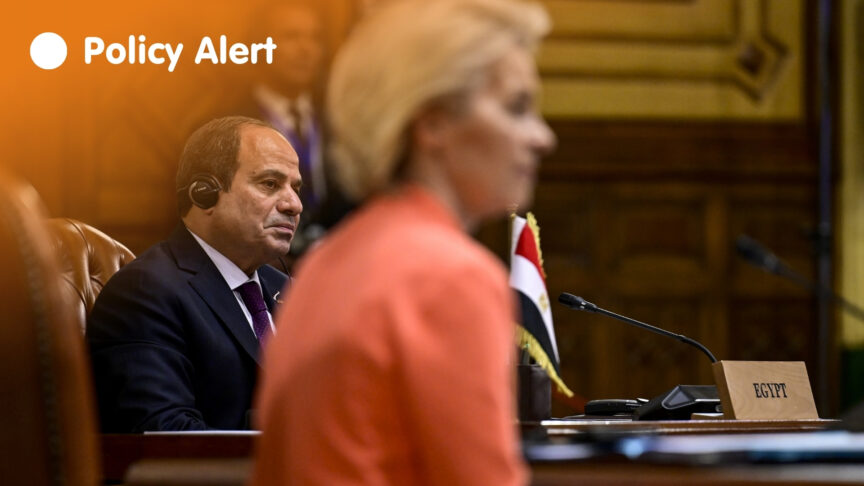
Aid with reform: How the EU-Egypt deal can succeed
The EU should release funding to Cairo only if it undertakes following meaningful economic reforms

The EU should release funding to Cairo only if it undertakes following meaningful economic reforms
Migration in the Mediterranean has been a crisis factor for Europe for decades. To shed light on the issue, the discussion will revolve around ECFR’s policy brief edited by Lorena Stella Martini and Tarek Megerisi, which examines the case study of the Central Mediterranean route to analyse European externalization policies, focusing primarily on migration to Italy.
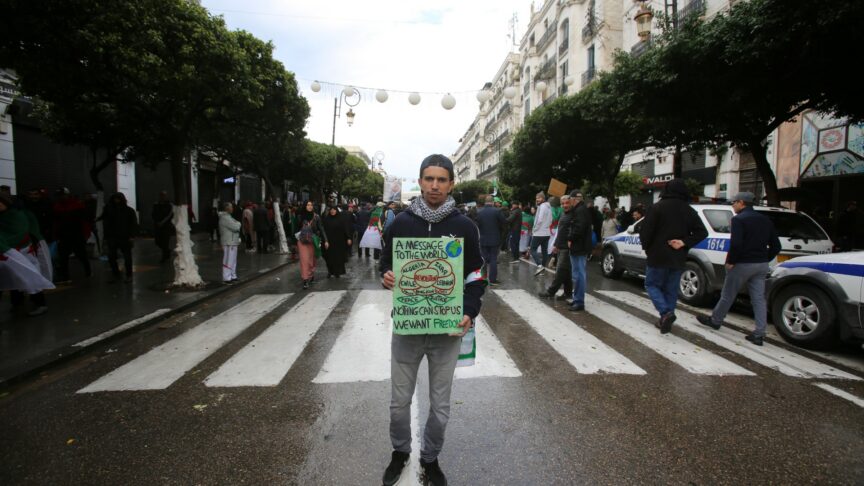
European states face accusations of neglecting the matter of human rights in their southern neighbourhood, and even of being complicit. Yet they are failing to maximise the influence they could bring to bear.
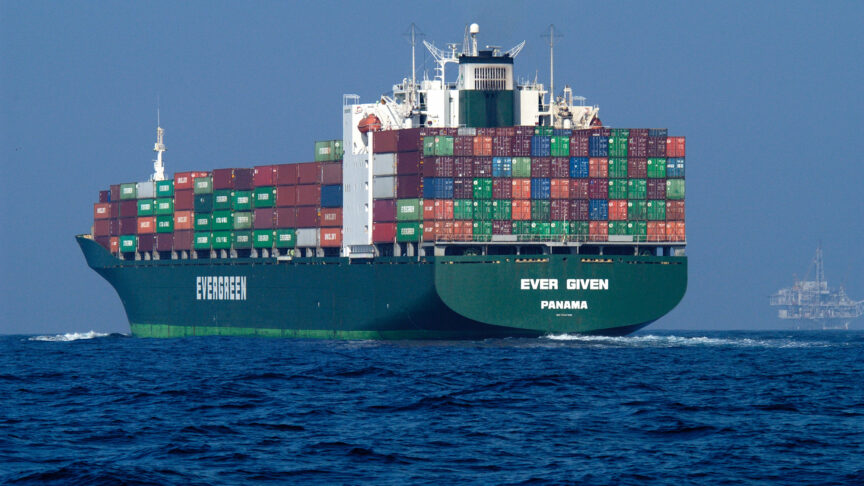
In a future, states will likely become more transactional and try to force changes in behaviour from others in exchange for the use of a platform or supply chain
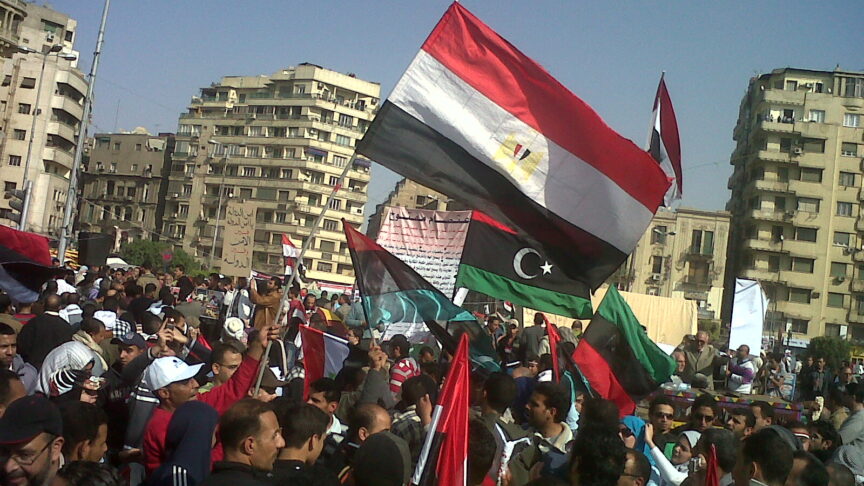
By facilitating a rapprochement between Cairo and Ankara, European governments could make progress towards their strategic objective of stabilising the Middle East and North Africa
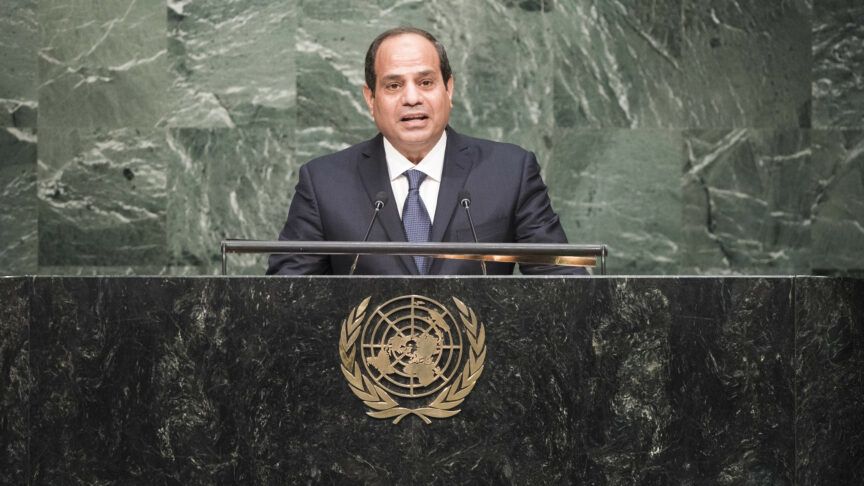
The Egyptian regime has shown that it is prepared to give ground on individual cases or pieces of legislation in the face of concerted pressure
Is France alone in the desert? ECFR experts Julien Barnes-Dacey and Manuel Lafont Rapnouil discuss how France can lead Europe in the Middle East
Mohannad Sabry, Egyptian journalist and Sinai researcher, explains how Egypt's Sinai Peninsula has gradually transitioned from being an area of instability and local insurgencies…
Our panel examined the threats of terrorism to security and political stability in North Africa and beyond
Understanding oneself means to look at oneself from the view of others. The Maghreb region is a very crucial neighbourhood for the EU, yet little is known about their point of view. The region faces political, economical and security crises with instable governments, decreasing oil prices and terrorist formations. Europe has to engage more with these countries since it is clearly mutually beneficial. Furthermore, it would alter their view on Europe towards a more positive one. For that, the European Union has to encounter MENA countries on a level playing field.
The EU should release funding to Cairo only if it undertakes following meaningful economic reforms
In a future, states will likely become more transactional and try to force changes in behaviour from others in exchange for the use of a platform or supply chain
By facilitating a rapprochement between Cairo and Ankara, European governments could make progress towards their strategic objective of stabilising the Middle East and North Africa
The Egyptian regime has shown that it is prepared to give ground on individual cases or pieces of legislation in the face of concerted pressure
European states face accusations of neglecting the matter of human rights in their southern neighbourhood, and even of being complicit. Yet they are failing to maximise the influence they could bring to bear.
Is France alone in the desert? ECFR experts Julien Barnes-Dacey and Manuel Lafont Rapnouil discuss how France can lead Europe in the Middle East
Mohannad Sabry, Egyptian journalist and Sinai researcher, explains how Egypt's Sinai Peninsula has gradually transitioned from being an area of instability and local insurgencies…
In the second of two podcasts, Spiros Economides of the London School of Economics argues that the EU needs to think strategically about how…
Nick Witney, co-author of the ECFR publication 'Rebooting EU foreign policy', explains the need for a rethink of how the EU deals with the…
In the third of three podcasts on US foreign policy in the Middle East, Ambassador Charles Freeman argues that Obama's foreign policy lacks a…
In the second of three podcasts looking at US foreign policy in the Middle East, we hear from Professor Juan Cole, who explains why…
In the first of three podcasts on US policy in the Middle East, Jeremy Shapiro explains why foreign policy is in thrall to US…
Now that Abdel Fattah el-Sisi has been sworn in as Egypt's president, what are the challenges ahead, and what can the West do to…
Issandr el Amrani, Florence Gaub, and Anthony Dworkin take a close look at the situation in Egypt, the motivation and interests of the military,…
Mark Leonard hosts a discussion with Daniel Levy, Anthony Dworkin, and Julien Barnes-Dacey on the Arab Spring and current events in the Middle East…
Migration in the Mediterranean has been a crisis factor for Europe for decades. To shed light on the issue, the discussion will revolve around ECFR’s policy brief edited by Lorena Stella Martini and Tarek Megerisi, which examines the case study of the Central Mediterranean route to analyse European externalization policies, focusing primarily on migration to Italy.
Our panel examined the threats of terrorism to security and political stability in North Africa and beyond
Understanding oneself means to look at oneself from the view of others. The Maghreb region is a very crucial neighbourhood for the EU, yet little is known about their point of view. The region faces political, economical and security crises with instable governments, decreasing oil prices and terrorist formations. Europe has to engage more with these countries since it is clearly mutually beneficial. Furthermore, it would alter their view on Europe towards a more positive one. For that, the European Union has to encounter MENA countries on a level playing field.
Doing these reforms in a meaningful way would require the Egyptian government to make a big change in the economic policies it has followed so far
Now leaders like al-Sisi and Saied feel more confident that they will be given leeway to cement their power and use financial support to do the bare minimum to sustain people in these countries

Kelly Petillo comments on the EU’s strategy to support North African governments to curb migration
It is really not a lack of unity, it is above all a lack of political will within the member countries

Hugh Lovatt on the possible coordinating between the EU and Egypt on the mediations between Hamas and Israel
The human rights situation in Egypt remains problematic and worrying

Anthony Dworkin comments on the European Union and its new deal with Egypt