
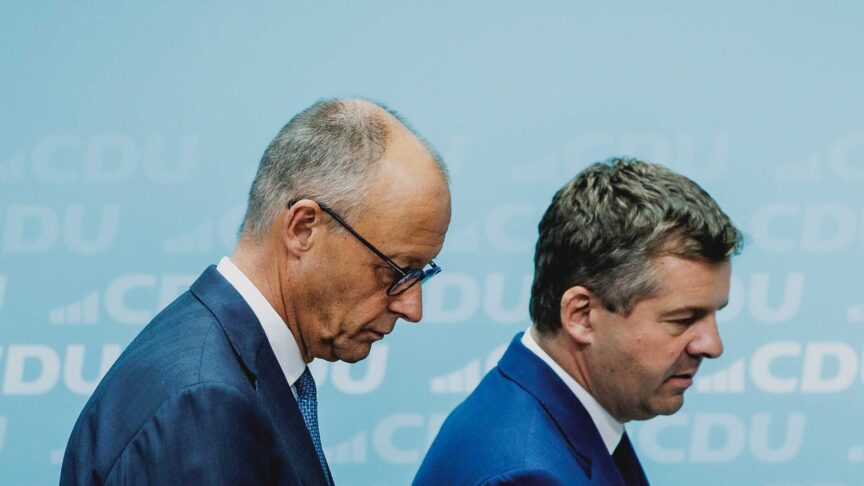
Beyond Saxony-Anhalt: What Merz’s crisis means for Europe
The far-right AfD’s win in a small German state calls for dynamism in Berlin and hedging in Brussels


Editorial Director
Senior Policy Fellow
European politics and foreign policy; EU institutions; Multilateralism; Geopolitics and global order
English (native), French, German, Italian, Spanish
Jeremy Cliffe is editorial director and senior fellow at the European Council on Foreign Relations. He leads the editorial team, oversees ECFR’s publications, and co-heads the New Politics Project within the European Power programme. He is also a future world fellow at IE University in Madrid.
Previously Cliffe spent eight years at The Economist, where he wrote the Bagehot and Charlemagne columns, and served as bureau chief in Berlin and Brussels. He subsequently joined the New Statesman as international editor, building and leading the magazine’s global affairs coverage, before working as chief speechwriter and special adviser at the Open Society Foundations.
Cliffe has written widely across the European media including for the Financial Times, The Guardian, Die Zeit, Il Foglio, and El País, and appeared on broadcasters including CNN, CNBC, BBC World, Al Jazeera, and Deutsche Welle. He has also written and presented documentaries for BBC Radio 4. Cliffe was educated at the universities of Oxford and Harvard.
The far-right AfD’s win in a small German state calls for dynamism in Berlin and hedging in Brussels
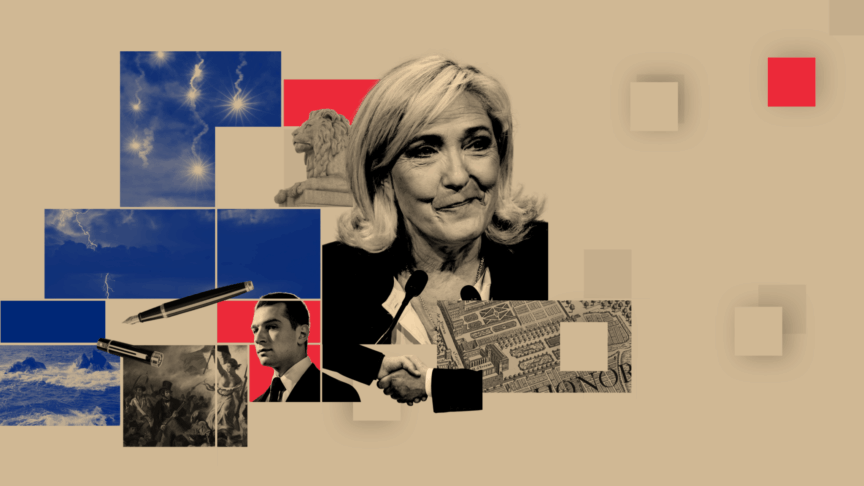
A Le Pen-led France would mean major changes to European politics. Here’s how political leaders can begin to prepare

Le Pen is racing into the French presidential election, even with a fraud conviction hanging over her campaign. Europeans should begin preparing for the rupture her victory could bring
Mark Leonard welcomes Célia Belin and Jeremy Cliffe to discuss Marine Le Pen’s return to the French presidential race
As the rise of the new right and “MAGA-ization” of politics is having a greater impact on the UK and Europe, this event will aim to discuss these new movements – looking at their critique of the status-quo, their electoral base, policy agenda and organising and communication methods. Having spent the past year talking to…

Jordan Bardella is the frontrunner in the French presidential election next year. His win would transform France’s place in Europe. This scenario shows how

As climate policy becomes increasingly contested, Europe must adapt its Green Deal to a new political era. The first policy brief in the New Politics project outlines five new deals to make the transition more durable, popular and politically resilient

Brussels should set clear conditions for Hungary’s European comeback—and use its moment of leverage to incentivise a geopolitical shift
Mark Leonard welcomes Jeremy Cliffe, Ulrike Franke, Janka Oertel and Majda Ruge live from the Munich Security Conference to unpack its biggest moments
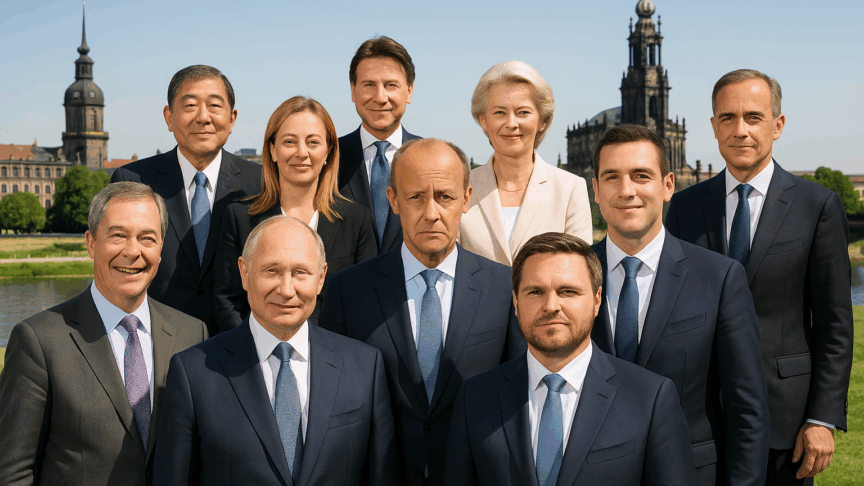
An array of populist parties are challenging Europe’s foreign policy mainstream. To secure European sovereignty, its politicians need to adapt—which means preparing for a variety of future diplomatic scenarios
A Le Pen-led France would mean major changes to European politics. Here’s how political leaders can begin to prepare
Jordan Bardella is the frontrunner in the French presidential election next year. His win would transform France’s place in Europe. This scenario shows how
As climate policy becomes increasingly contested, Europe must adapt its Green Deal to a new political era. The first policy brief in the New Politics project outlines five new deals to make the transition more durable, popular and politically resilient
An array of populist parties are challenging Europe’s foreign policy mainstream. To secure European sovereignty, its politicians need to adapt—which means preparing for a variety of future diplomatic scenarios
The far-right AfD’s win in a small German state calls for dynamism in Berlin and hedging in Brussels
Le Pen is racing into the French presidential election, even with a fraud conviction hanging over her campaign. Europeans should begin preparing for the rupture her victory could bring
Brussels should set clear conditions for Hungary’s European comeback—and use its moment of leverage to incentivise a geopolitical shift

On foreign policy, Germany’s new chancellor will be pulled between conservatism and radicalism. For Europe’s sake, he must choose the latter

To restore much-needed German impetus in Europe, the country’s next government must find a new sense of urgency and common purpose

Germany’s likely next chancellor shares his party’s pro-EU and Atlanticist instincts, but also the country’s wider reluctance to play an exceptional international role

In times of crisis the EU can no longer rely on its standard, slow procedures. A European Defence Production Act could transform its ability to deal with shocks
Mark Leonard welcomes Célia Belin and Jeremy Cliffe to discuss Marine Le Pen’s return to the French presidential race
Mark Leonard welcomes Jeremy Cliffe, Ulrike Franke, Janka Oertel and Majda Ruge live from the Munich Security Conference to unpack its biggest moments
Mark Leonard welcomes Jeremy Cliffe and Jana Puglierin to discuss the inauguration of the new German government, led by Chancellor Friedrich Merz
Mark Leonard welcomes Searching for Deutschland co-hosts Jeremy Cliffe and Jana Puglierin, and ECFR colleagues Piotr Buras and Marie Dumoulin, to discuss the impact of Germany’s federal election on the country and beyond

The final episode of Searching for Deutschland—a special crossover with the World in 30 Minutes—sees experts from Berlin, London, Paris and Warsaw break down…

On the morning after Germany’s election, Searching for Deutschland hosts Jeremy Cliffe and Jana Puglierin were joined for a live webinar by ECFR colleagues Timo Lochocki…

In Searching for Deutschland’s last pre-election episode, hosts Jeremy Cliffe and Jana Puglierin review the Munich Security Conference, the US-Russia talks on Ukraine, and what the new…
Ahead of the Munich Security Conference, hosts Jeremy Cliffe and Jana Puglierin talk German defence and the future of the country’s armed forces. They review the…

This week, hosts Jeremy Cliffe and Jana Puglierin discuss German election campaign frontrunner Friedrich Merz’s bid to win Bundestag votes on migration with support…

Germany’s industrial model thrived for years thanks to soaring Chinese demand. But the relationship has recently become more contentious. This week, hosts Jeremy Cliffe and…
As the rise of the new right and “MAGA-ization” of politics is having a greater impact on the UK and Europe, this event will aim to discuss these new movements – looking at their critique of the status-quo, their electoral base, policy agenda and organising and communication methods. Having spent the past year talking to…
Germany’s election results are in—now what? Join the European Council on Foreign Relations (ECFR) for a timely post-election analysis in the early morning after results are in. What does the outcome mean for Germany’s role on the European and global stage? Will the new government take a leadership role in shaping Europe’s foreign policy, or…
As the United States shifts its focus toward Southeast Asia and China, Europe faces a critical moment in evaluating its own approach to a potential conflict over Taiwan. Perhaps counterintuitively, the EU likely holds more economic leverage over China than the bloc typically assumes. This is because Beijing would probably factor in retaliatory sanctions…
Jana Puglierin and Jeremy Cliffe on the consequences of the state elections on Germany’s EU politics
Thomas Wright cites Jeremy Cliffe’s paper on the foreign policies of the AfD
Jana Puglierin and Jeremy Cliffe on Merz’s fight for survival ahead of the German state elections
Jeremy Cliffe’s research was cited in zenith on the AfD’s global foreign-policy outlook and its East-West split
Jeremy Cliffe and Jana Puglierin on why Merz’s weakened Germany cannot anchor the EU