How a Biden win could transform US policy in the Middle East and North Africa
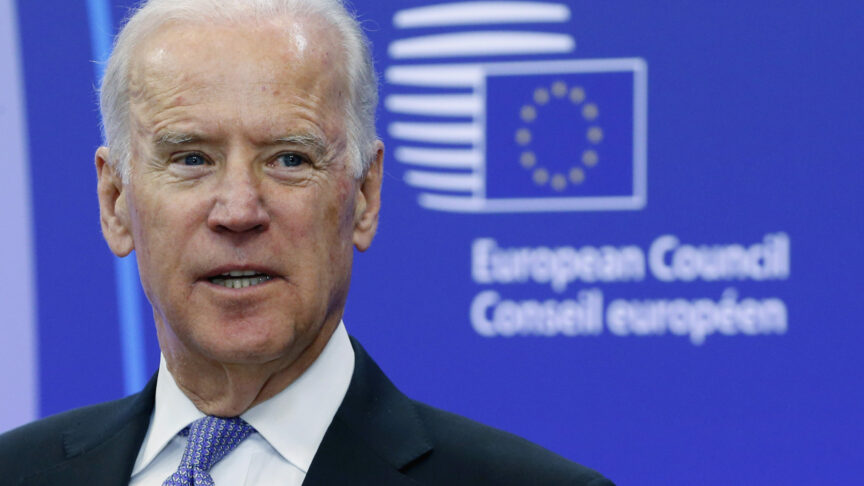
Victory for Joe Biden is likely to bring three big policy shifts in the region, opening new possibilities and challenges for Europeans
Deputy Director, Middle East and North Africa programme
Senior Policy Fellow
Europe-Iran relations; Iran nuclear deal and associated sanctions policy; Iranian foreign and domestic policy; Iran-Saudi relations
English, Persian
Ellie Geranmayeh is a senior policy fellow and deputy head of the Middle East and North Africa programme at the European Council on Foreign Relations. She focuses on European policy in relation to Iran, particularly on the nuclear and regional dossiers and sanctions policy.
Geranmayeh worked extensively on the diplomatic track that led to the 2015 nuclear deal and continues to brief senior policymakers on how to effectively contain Iran’s nuclear activities. Her research also covers wider regional dynamics including de-escalation efforts between the GCC states and Iran, and geopolitical trends in the Middle East as a consequence of increasing tensions between global powers.
She is regularly quoted by international media outlets including the New York Times, Wall Street Journal, The Guardian, and appears on CNN, Al-Jazeera and the BBC to provide commentary on developments in the Middle East.
Victory for Joe Biden is likely to bring three big policy shifts in the region, opening new possibilities and challenges for Europeans
A broad range of political and financial problems are likely to prevent Iran from importing advanced weapons systems in the coming years
After a humiliating defeat at the UN Security Council, Washington will seek snapback sanctions to sabotage what is left of the nuclear deal. Britain, France, and Germany can still keep it alive until after the US election
Iran’s rumoured talks with China on a partnership agreement could have significant economic benefits and provide it with valuable geopolitical bargaining chips
Europeans wish to persuade Iran to compromise on strategic issues – but, unless they understand the dynamics of domestic Iranian politics, they will not get far
France, Germany, and the United Kingdom will have to decide whether to support the US cause to extend the UN embargo or oppose it. But neither option is ideal
European governments and the EU should press the US to strengthen the humanitarian exemptions in its Iran sanctions
The coronavirus has hit the Middle East and north Africa at a time when the region is already burdened with multiple problems, including a series…
European governments must seek to dissuade the US from using Iraq as a new battlefield in its struggle with Iran.
The annual Munich Security Conference was themed “Westlessness”, defining “a widespread feeling of uneasiness and restlessness in the face of increasing uncertainty about the enduring purpose…
How Europe can use the current moment of flux in the Middle East to help stabilise Iraq, Lebanon and Syria
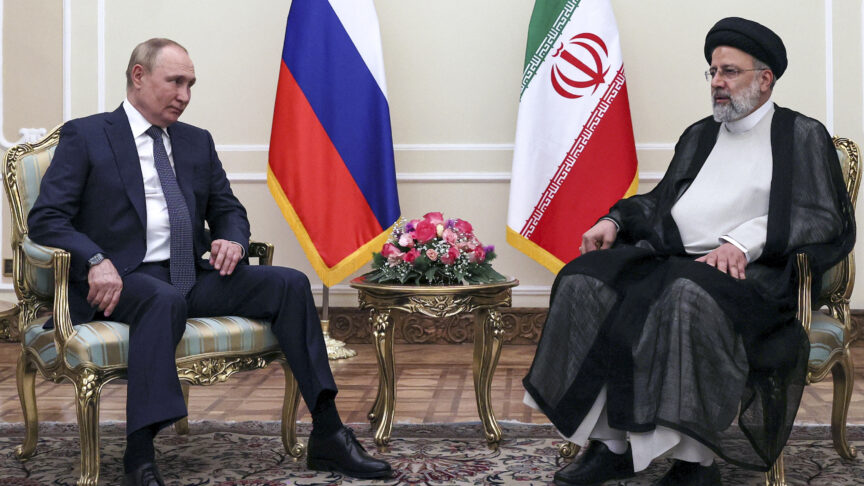
The war in Ukraine has led to unprecedented levels of cooperation between Russia and Iran. This new relationship poses a significant threat to European countries, whose governments should seek to mitigate the potential damage
The Trump years galvanised Europeans’ efforts to strengthen their own sovereignty; they now need to agree concrete offers they can make to the new administration
Europeans wish to persuade Iran to compromise on strategic issues – but, unless they understand the dynamics of domestic Iranian politics, they will not get far
The EU and its member states should strengthen their sanctions policy and begin to build up their deterrence and resilience against secondary sanctions
Europe must salvage the nuclear deal with Iran and step-up robust diplomacy with Teran on regional issues
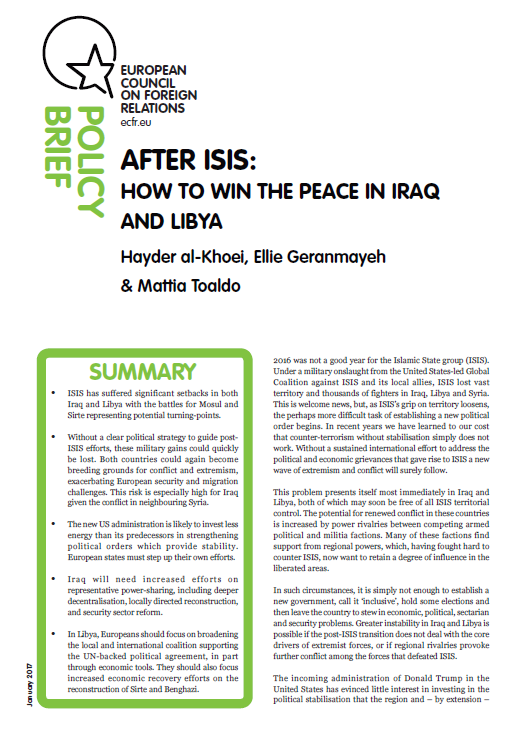
Recent terror attacks in Berlin, Baghdad and Istanbul demonstrate that defeating ISIS militarily is only half the battle
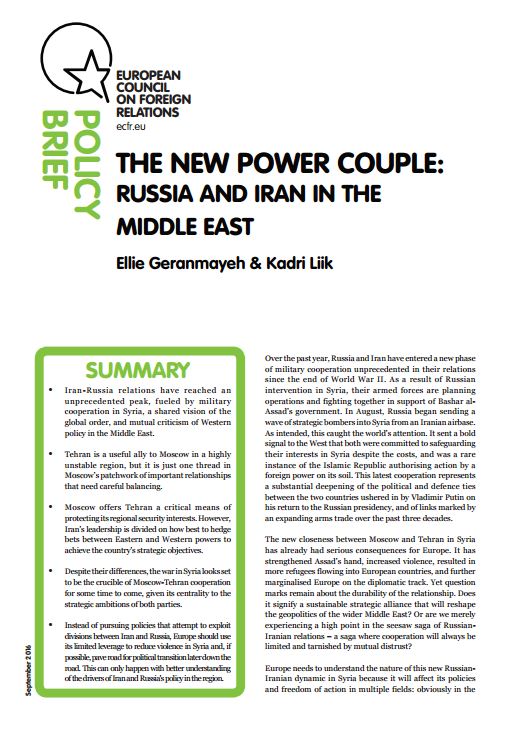
Joint military operations in Syria have brought Russia and Iran relations closer than at any point since World War II
The sixth ECFR Foreign Policy Scorecard highlights the EU’s diminishing ability to influence its neighbours, and the neighbourhood’s growing impact on the EU
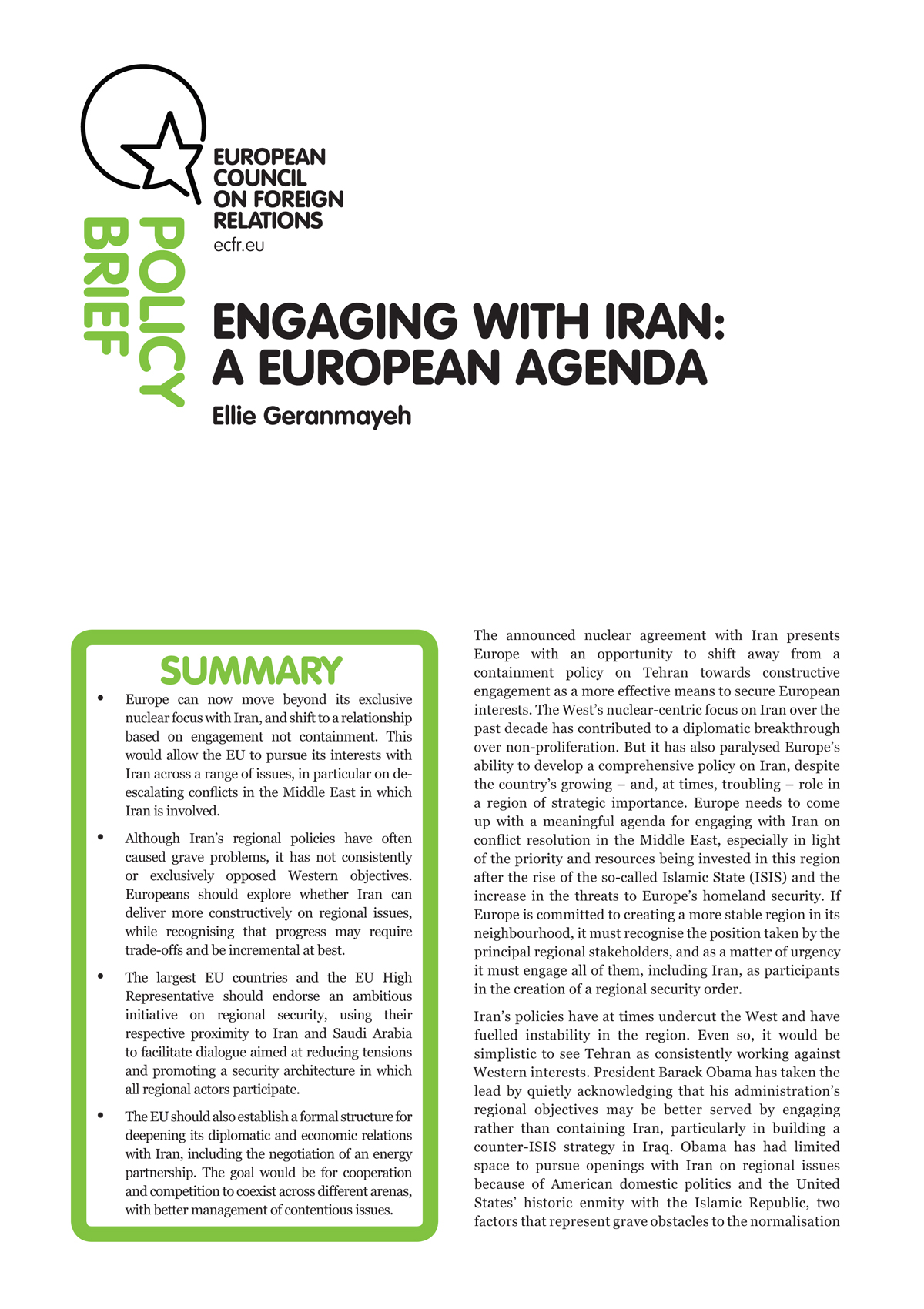
Iran deal should be a catalyst to end decade-long stand off with Tehran and lead to engagement on regional security
European leaders have reimposed UN sanctions on Iran. Now they must steer clear of America’s maximum pressure campaign and instead keep the diplomatic door open
The Doha strike risks deepening regional scepticism of Western security partnerships in the Middle East. Europe needs to do much more to pressure Israel into ending the war in Gaza and curbing its regional belligerence
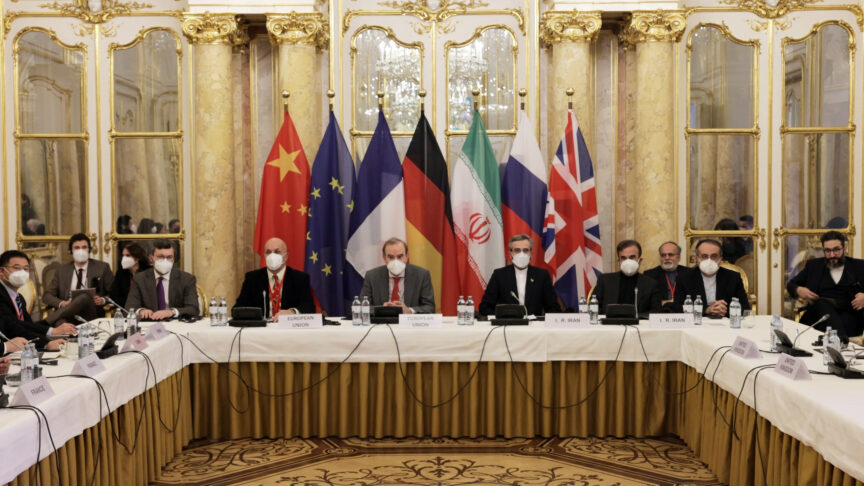
The deadline is looming for Britain, France and Germany to decide whether to reimpose sanctions on Iran. They are right to consider an extension to this “snapback” mechanism—and China could play a crucial role in what comes next
Israel has become the Middle East’s leading destabiliser, threatening key European interests. Europe must avoid making the same mistakes that led to the 2003 Iraq invasion, prioritise diplomacy and urge the US not to get entangled in a war with Iran
Israel’s unprecedented strikes across Iran have shattered nuclear diplomacy and paved the way for regional war. As America scrambles to respond, Europeans can help curb dangerous escalation
Europe’s sidelined diplomats watch as Trump’s team tussles over Iran’s nuclear fate. With “snapback” sanctions looming, Britain, France and Germany must hustle to shape a deal or risk being mere spectators
As Donald Trump prepares for his second US presidency, Iranian and Israeli military manoeuvring during President Biden’s lame-duck period risks drawing the US into all-out war in the Middle East
Under new president Masoud Pezeshkian, Iran will have a reform-minded government. Given the grave concern over Iran’s nuclear programme and regional posture, the West should seize the opportunity to pursue principled diplomacy with Tehran
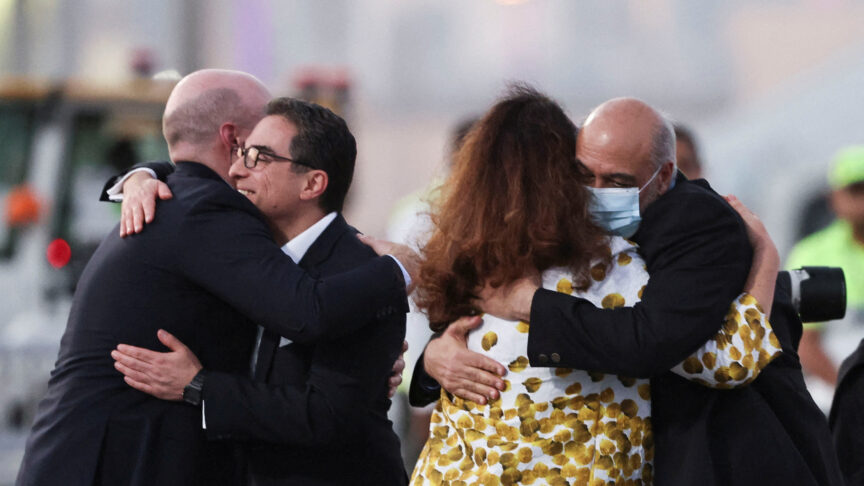
The Biden administration has secured the release of five US citizens from unjust detention in Iran. European countries should now coordinate with the US to tackle the use of arbitrary detention as diplomatic leverage in Iran and beyond
Quran desecration in Sweden and Denmark has drawn the ire of Muslim-majority countries. European governments should act now to prevent an escalation of tensions
European governments need a deeper engagement strategy to draw these powerful actors into inclusive political processes and power-sharing structures that can help stabilise the region
Turmoil in the Middle East and north Africa directly affects Europeans. Yet their influence in the region has never been weaker. This project maps Europe’s role across the Middle East and north Africa, making the case that Europeans can do more to leverage their influence in pursuit of core interests
An ECFR guide to the key disputes threatening to spark a wider Middle Eastern war
Mark Leonard welcomes Ellie Geranmayeh and Eran Etzion to unpack the latest developments in the conflict between Iran and Israel
Mark Leonard welcomes Ellie Geranmayeh to unpack Israel’s unprecedented strikes on Iran and the risk of regional escalation
Ellie Geranmayeh welcomes Dina Esfandiary, Yasmine Farouk and Dania Thafer to unpack how Arab Gulf monarchies used Donald Trump’s recent visit to showcase their geopolitical strength
Mark Leonard welcomes Ellie Geranmayeh, Mohsen Milani and Nathalie Tocci to unpack the latest developments in US-Iran diplomacy
Mark Leonard welcomes Julien Barnes-Dacey, Ellie Geranmayeh, and Vali Nasr to discuss shifting dynamics in the Middle East and their implications for global geopolitics
Ellie Geranmayeh welcomes Dr. Manal Radwan to talk about the impact of Donald Trump’s election for the wars in the Middle East
Mark Leonard welcomes Julien Barnes-Dacey, Ellie Geranmayeh, and Hugh Lovatt to discuss the regional war in the Middle East one year on from the 7 October Hamas attack on Israel
Mark Leonard welcomes Ellie Geranmayeh and Alistair Burt to understand the new multipolar order in the Middle East
Ellie Geranmayeh speaks to Tara Sepehri Far, Sussan Tahmasebi, and Sanam Vakil about the situation in Iran a year after the Mahsa Amini Protests
Ellie Geranmayeh speaks to Nadereh Chamlou and Sheikha Najla Al Qassimi about the geo-economic trends in the Middle East
A discussion assessing Iranian foreign policy following Hamas’s attacks of 7 October, Israel’s war on Gaza and the death of Iranian President Ebrahim Raisi
This Twitter Space will discuss important lessons from the ongoing protests in Iran and their implications for the country’s future
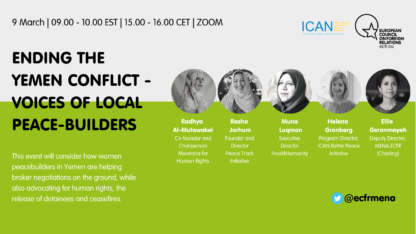
This event will consider how women peace-builders in Yemen are providing essential gender-responsive humanitarian and peacemaking support
You are currently viewing a placeholder content from Facebook. To access the actual content, click the button below. Please note that doing so will share data with third-party providers.
More InformationYou are currently viewing a placeholder content from Instagram. To access the actual content, click the button below. Please note that doing so will share data with third-party providers.
More InformationYou are currently viewing a placeholder content from OpenStreetMap. To access the actual content, click the button below. Please note that doing so will share data with third-party providers.
More Information