Laying the groundwork: Why EU-Japan industrial relations should begin at the bilateral level
Europe and Japan seek deeper defence-industrial cooperation; but the fragmented EU system is creating challenges. As a first step, Tokyo should establish stronger bilateral partnerships, particularly with Germany and Poland

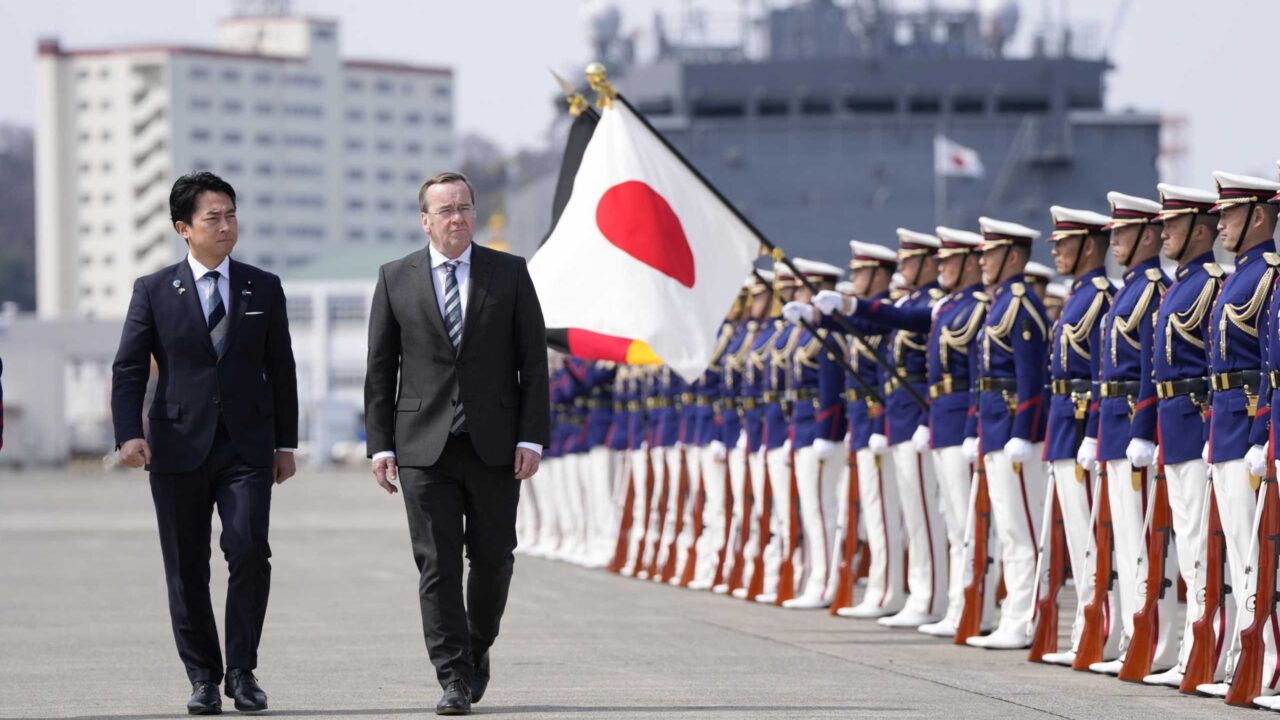
In March 2026, Boris Pistorius took a trip to Japan. This action, by Germany’s minister for defence, hinted at a new geopolitical truth: Japanese and European security is now linked and shaped by the same revisionist pressures, the same technology race, and the same question of industrial resilience.
This convergence is further underlined by Japan’s effort to participate in the European Union’s Security Action for Europe (SAFE) framework, which aims to reinforce Europe’s defence technological and industrial base. But Japan’s effort to join SAFE also exposes a tension that will define the next phase of Europe-Japan defence-industrial cooperation: as Europe seeks trusted external defence partners, its defence turn is becoming a project of internal industrial consolidation, supply security and political control.
While the case for deeper EU defence-industrial cooperation with Japan is strong, bilateral and minilateral projects with Germany and Poland are currently more credible
As such, while the case for deeper EU defence-industrial cooperation with Japan is strong, bilateral and minilateral projects with Germany and—in more selective form—Poland are currently more credible. An EU-wide industrial breakthrough will not happen until the correct legal, political and commercial conditions exist across the continent.
SAFEguarding future partnerships
Since 2024, the political foundation of the Europe-Japan relationship has become more operational. The EU-Japan Security and Defence Partnership committed both sides to structured consultations on defence initiatives and exchanges on defence‑industry matters. For its part, SAFE provides up to €150bn in long-maturity loans for member-state defence procurement and covers capability areas that overlap with Japanese strengths, including air and missile defence, cyber, military mobility, electronic warfare, AI and space asset protection.
However, SAFE has caveats. First, approvals for disbursements can only take place until December 31st, 2030. While this is workable for member states already inside the SAFE system, it is tight for external partners—such as Japan—that require political clearance, industrial matchmaking and legal arrangements. Second, as of late March 2026, 19 member states had submitted SAFE plans, with only certain EU member state plans approved. With internal approvals moving so slowly, the SAFE path for external partners such as Japan will no doubt drag further.
Furthermore, SAFE and its rules restrict the share of components from outside the EU, EEA-EFTA countries and Ukraine to 35%, meaning Japan will not simply plug into Europe’s rearmament as another major platform supplier. But Europe needs technological depth, resilient components, specialised manufacturing and systems integration more than another full‑spectrum defence contractor.
The EU should therefore consider how Japanese participation in its defence-industrial base can strengthen European capacity without disrupting the general European trend to push for domestic or EU-based suppliers. Germany, it seems, is at the heart of this conundrum.
Where Germany and Poland come in
Pistorius, accompanied by industry representatives, intended to show Tokyo that Berlin wants to move beyond strategic dialogue and towards more concrete cooperation. But the German bottleneck is its delay in becoming a defence-oriented ecosystem capable of turning political urgency into industrial delivery. Links between the armed forces, major companies, suppliers, startups and research institutions remain too weak, too opaque and too poorly aligned with capability demand.[1]
This makes Germany a relevant test case, however. Berlin’s 2026 defence budget is around €82.7bn, while Japan’s 2026 defence budget exceeds ¥9tn ($58bn); both countries are growing their budgets and building up defence supplies after lengthy periods of restraint. Established defence-industrial corporations in Germany, such as Rheinmetall, are door openers and gatekeepers. What the German government adopts, and what kind of defence-industrial cooperation is established, will be what fits their strategy. This means that new solutions that are disruptive to the core business risk being left outside.
Japan’s entry into Germany is therefore likely to occur through complementary industrial cooperation, such as air and missile defence—here, European demand is rising and Japan excels, specifically in advanced electronics, radar and seeker-related technologies and other relevant hardware. A partnership that links Japanese-origin sensing and processing to German-led and European interceptors and command architecture would therefore fit better than a politically sensitive contest over complete systems. The same logic applies in electronic warfare, C4ISTAR and software-heavy defence functions. Japan has depth in secure communications, radar, signal processing and other high-end electronics, while Germany is powerful in systems integration, and land and naval platforms.
On maritime cooperation, the EU-Japan partnership focuses heavily on security. Berlin and Tokyo have regular naval consultations and Germany undertook Indo‑Pacific deployment missions in 2021 and 2024. Underwater sensing, anti-drone protection for naval assets, resilience for maritime infrastructure, selected unmanned maritime systems, and cyber protection for ports and logistics networks are all areas where strategic value and political feasibility are better aligned than the two countries creating direct competition over, for example, major shipbuilding programmes.
Poland also fits into this defence-cooperation picture: Warsaw is one of Europe’s most dynamic defence markets and has recently intensified official contact with Tokyo. Yet South Korea is already embedded in Poland through major platform deals, financing support and localisation. Poland spent around 3.9% of GDP on defence in 2023 and is moving toward roughly 4.8% in the 2026 budget—and South Korea has used this demand surge to anchor its role in Poland through contracts for K2 tanks, K9 self-propelled howitzers and FA-50 aircraft.
It therefore makes little sense for Tokyo to imitate Seoul directly. A more promising partnership lies instead in sensors, electronics, unmanned and counter-unmanned systems, maritime surveillance and selected inputs into future airpower networks. These are areas where technological sophistication matters more than volume delivery.
Alleviating doubts
For Europe to make its case for cooperation persuasive, and for Germany and Poland to turn this into concrete projects, it must address two doubts.
The first is interoperability. Japanese technology is excellent, but this does not mean it easily integrates into NATO and EU procurement ecosystems. Here, bilateralism matters: Germany or Poland can evaluate interoperability through discrete projects and supply-chain links before any wider EU-level scaling, particularly as Germany has an Agreement on the Security of Information (GSA) with Japan and the EU does not.
The second is political reliability. Japan is a dependable strategic partner, but its defence-industrial system is shaped by export controls and a domestic debate over how far arms export liberalisation should go. This means that Europeans should expect Japanese political consent for deeper defence-industrial cooperation to be easier to obtain for incremental, high-trust projects than in broad, open-ended commitments.
It also matters that Japan’s decision-makers show that deeper cooperation is not only what Europe wants. Indeed, Japan is also moving in this direction. Tokyo has eased export rules for jointly developed fighters, is debating further changes to permit broader lethal exports, and has signalled interest in defence-tech partnerships with Europe and NATO on dual-use technologies, unmanned systems and supply-chain resilience—a position increasingly being reinforced as Tokyo’s industrial policy becomes shaped by concerns about over-reliance on American suppliers.
Bilateralism as the first step
The wider lesson is that instruments such as SAFE are not the same thing as an integrated defence-industrial system. Europe still lacks the degree of centralised demand, standardisation and procurement that, for example, allows the United States to absorb innovation and scale production quickly. As long as the EU market remains segmented by national budgets and different industrial and strategic interests, Europe’s cooperation with Japan will be more effective via flexible coalitions.
Bilateralism is not a fallback from ambition, but the mechanism through which it becomes deliverable. For example, Germany can use SAFE to lever cooperation that already makes sense under national demand, especially in missile-related subsystems, to secure communications, military mobility, maritime resilience and cyberspace functions. Poland, on the other hand, could be a testbed for targeted niche collaboration. Brussels should focus on the enabling layer: information-security arrangements, standards, export-control dialogue and frameworks which enable successful bilateral projects to scale outward later.
Europe’s partnership with Japan has thus moved beyond symbolism; but it stumbles on execution. While the political logic is mature and the industrial logic compelling, the ecosystem that connects demand, innovation, production and trust across borders remains underdeveloped. That is why the next phase of EU-Japan defence-industrial cooperation will not be decided at summits—rather, in factories, procurement pathways, supply chains and the institutional habits of the states that claim to want it most.
[1] This paragraph draws on input provided by Rafaela Kraus for the Japan–Europe Core Group meeting in Warsaw (2026), as well as on her published comments in BR24, “Rüstung: Wie gelangen mehr Ideen vom Campus in die Wirtschaft?” (2026).
The European Council on Foreign Relations does not take collective positions. ECFR publications only represent the views of their individual authors.